Stelluti Stefania, Caser Matteo, Demasi Sonia, Scariot Valentina
Department of Agricultural, Forest and Food Sciences, University of Torino, Largo Paolo Braccini 2, 10095 Grugliasco, Italy.
Plants (Basel). 2021 Mar 11;10(3):523. doi: 10.3390/plants10030523.
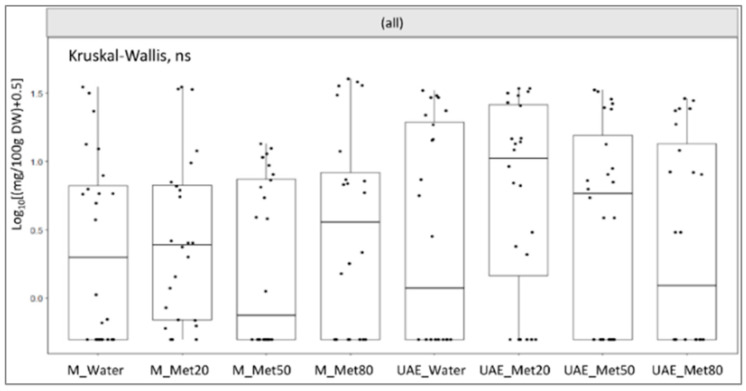
Tepals constitute the most abundant bio-residues of saffron ( L.). As they are a natural source of polyphenols with antioxidant properties, they could be processed to generate valuable biorefinery products for applications in the pharmaceutical, cosmetic, and food industries, becoming a new source of income while reducing bio-waste. Proper storage of by-products is important in biorefining and dehydration is widely used in the herb sector, especially for highly perishable harvested flowers. This study aimed to deepen the phytochemical composition of dried saffron tepals and to investigate whether this was influenced by the extraction technique. In particular, the conventional maceration was compared with the Ultrasound Assisted Extraction (UAE), using different solvents (water and three methanol concentrations, i.e., 20%, 50%, and 80%). Compared to the spice, the dried saffron tepals showed a lower content of total phenolics (average value 1127.94 ± 32.34 mg GAE 100 g DW) and anthocyanins (up to 413.30 ± 137.16 mg G3G 100 g DW), but a higher antioxidant activity, which was measured through the FRAP, ABTS, and DPPH assays. The HPLC-DAD analysis detected some phenolic compounds (i.e., ferulic acid, isoquercitrin, and quercitrin) not previously found in fresh saffron tepals. Vitamin C, already discovered in the spice, was interestingly detected also in dried tepals. Regarding the extraction technique, in most cases, UAE with safer solvents (i.e., water or low percentage of methanol) showed results of phenolic compounds and vitamin C similar to maceration, allowing an improvement in extractions by halving the time. Thus, this study demonstrated that saffron tepals can be dried maintaining their quality and that green extractions can be adopted to obtain high yields of valuable antioxidant phytochemicals, meeting the requirement for a sustainable biorefining.
番红花(Crocus sativus L.)的花被片是其最丰富的生物残渣。由于它们是具有抗氧化特性的多酚的天然来源,可以对其进行加工,以生产用于制药、化妆品和食品工业的有价值的生物精炼产品,在减少生物废物的同时成为新的收入来源。在生物精炼中,副产品的妥善储存很重要,脱水在草药领域被广泛使用,特别是对于极易腐烂的收获鲜花。本研究旨在深入了解干燥番红花花被片的植物化学成分,并研究其是否受提取技术的影响。具体而言,将传统浸渍法与超声辅助提取法(UAE)进行比较,使用不同的溶剂(水和三种甲醇浓度,即20%、50%和80%)。与香料相比,干燥的番红花花被片总酚含量较低(平均值为1127.94±32.34 mg GAE/100 g DW),花青素含量较低(最高为413.30±137.16 mg G3G/100 g DW),但抗氧化活性较高,通过FRAP、ABTS和DPPH测定法进行测量。HPLC-DAD分析检测到一些以前在新鲜番红花花被片中未发现的酚类化合物(即阿魏酸、异槲皮苷和槲皮苷)。有趣的是,在香料中已发现的维生素C在干燥的花被片中也被检测到。关于提取技术,在大多数情况下,使用更安全的溶剂(即水或低百分比甲醇)的UAE显示出与浸渍法相似的酚类化合物和维生素C提取结果,通过将时间减半提高了提取效率。因此,本研究表明,番红花花被片可以干燥并保持其品质,并且可以采用绿色提取方法获得高产量的有价值的抗氧化植物化学成分,满足可持续生物精炼的要求。