Gomez Enrique, Canela Nuria, Herrero Pol, Cereto Adrià, Gimeno Isabel, Carrocera Susana, Martin-Gonzalez David, Murillo Antonio, Muñoz Marta
Centro de Biotecnología Animal, Servicio Regional de Investigación y Desarrollo Agroalimentario, 33394 Gijon, Spain.
Centre for Omic Sciences, Eurecat, Centre Tecnològic de Catalunya (Joint Unit Eurecat- Universitat Rovira i Virgili), Unique Scientific and Technical Infrastructure (ICTS), 43204 Reus, Spain.
Metabolites. 2021 Mar 11;11(3):162. doi: 10.3390/metabo11030162.
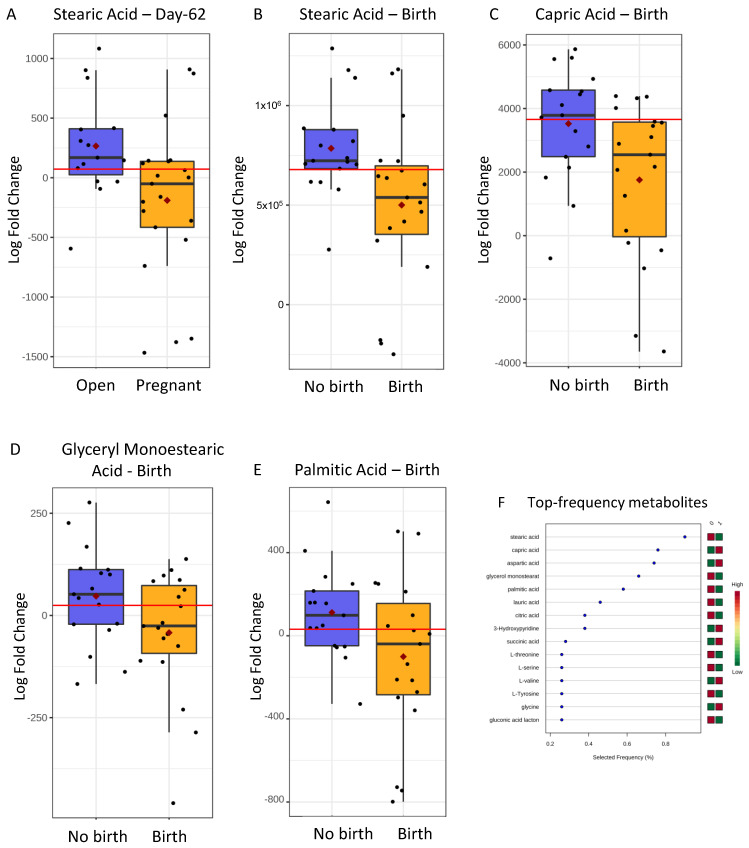
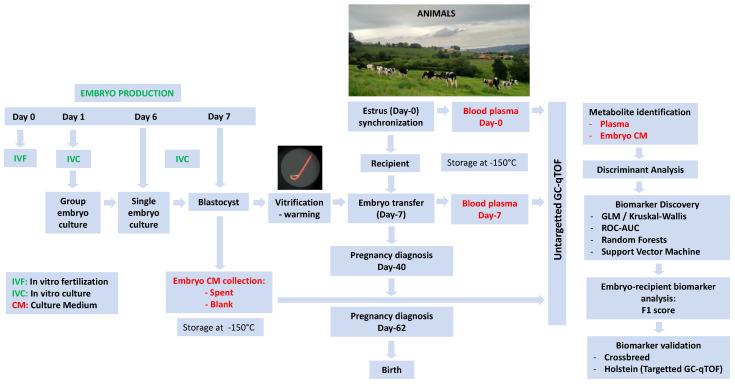
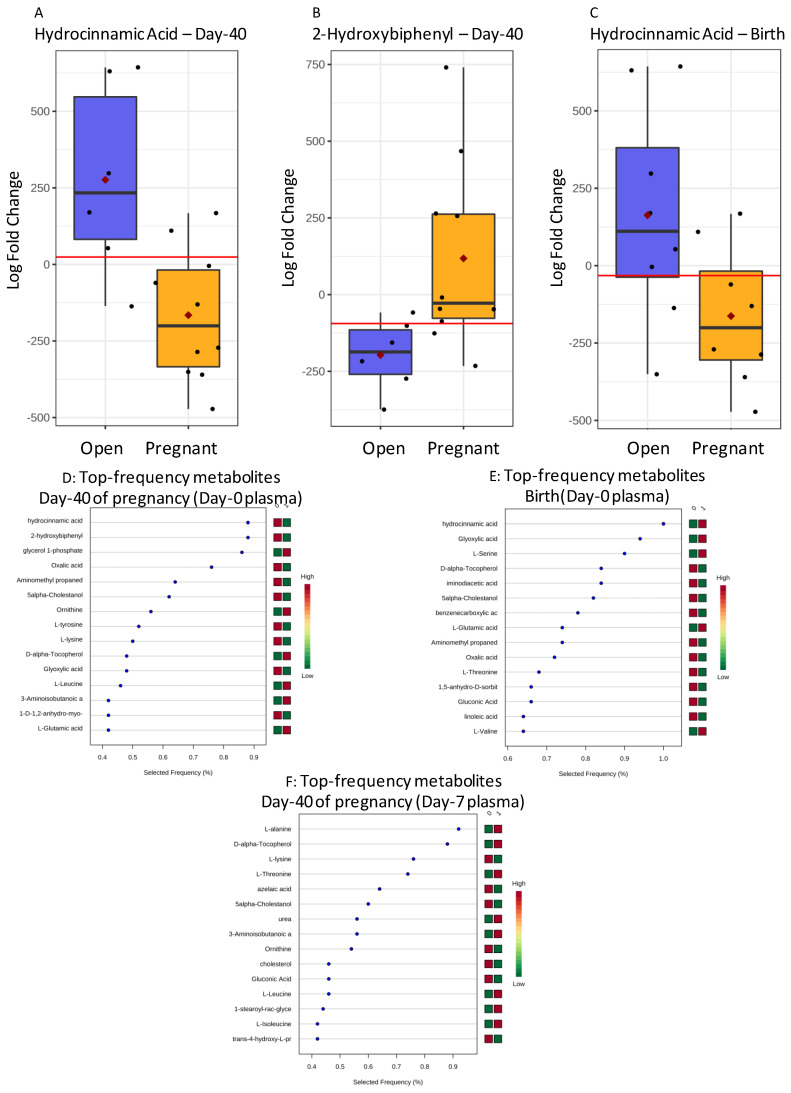
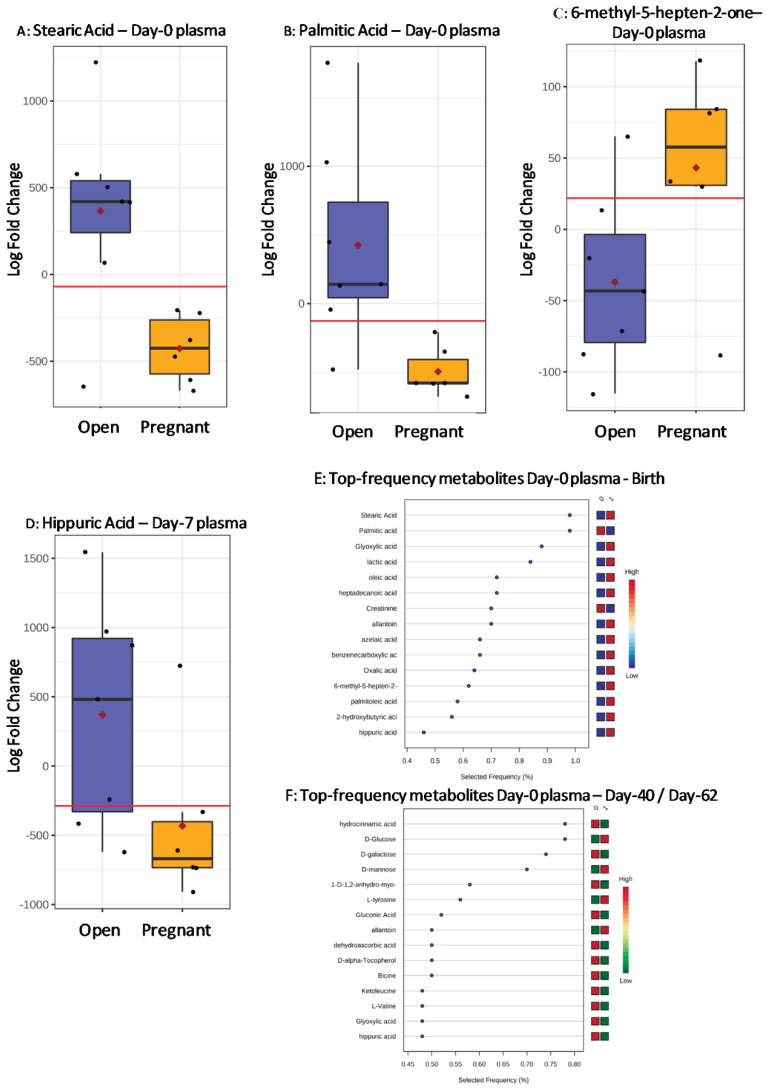
This work describes the use of mass spectrometry-based metabolomics as a non-invasive approach to accurately predict birth prior to embryo transfer (ET) starting from embryo culture media and plasma recipient. Metabolomics was used here as a predictive platform. Day-6 in vitro produced embryos developed singly in modified synthetic oviduct fluid culture medium (CM) drops for 24 h were vitrified as Day-7 blastocysts and transferred to recipients. Day-0 and Day-7 recipient plasma ( = 36 × 2) and CM ( = 36) were analyzed by gas chromatography coupled to the quadrupole time of flight mass spectrometry (GC-qTOF). Metabolites quantified in CM and plasma were analyzed as a function to predict pregnancy at Day-40, Day-62, and birth (univariate and multivariate statistics). Subsequently, a Boolean matrix (F1 score) was constructed with metabolite pairs (one from the embryo, and one from the recipient) to combine the predictive power of embryos and recipients. Validation was performed in independent cohorts of ETs analyzed. Embryos that did not reach birth released more stearic acid, capric acid, palmitic acid, and glyceryl monostearate in CM (i.e., ( < 0.05, FDR < 0.05, Receiver Operator Characteristic-area under curve (ROC-AUC) > 0.669)). Within Holstein recipients, hydrocinnamic acid, alanine, and lysine predicted birth (ROC-AUC > 0.778). Asturiana de los Valles recipients that reached birth showed lower concentrations of 6-methyl-5-hepten-2-one, stearic acid, palmitic acid, and hippuric acid (ROC-AUC > 0.832). Embryonal capric acid and glyceryl-monostearate formed F1 scores generally >0.900, with metabolites found both to differ (e.g., hippuric acid, hydrocinnamic acid) or not (e.g., heptadecanoic acid, citric acid) with pregnancy in plasmas, as hypothesized. Efficient lipid metabolism in the embryo and the recipient can allow pregnancy to proceed. Changes in phenolics from plasma suggest that microbiota and liver metabolism influence the pregnancy establishment in cattle.
这项研究描述了基于质谱的代谢组学作为一种非侵入性方法,从胚胎培养基和受体血浆出发,在胚胎移植(ET)前准确预测分娩情况。代谢组学在此被用作预测平台。在改良的合成输卵管液培养基(CM)滴中单独培养24小时的第6天体外产生的胚胎,作为第7天囊胚进行玻璃化处理并移植到受体中。通过气相色谱与四极杆飞行时间质谱联用(GC-qTOF)分析第0天和第7天受体血浆( = 36×2)和CM( = 36)。对CM和血浆中定量的代谢物进行分析,以预测第40天、第62天和分娩时的妊娠情况(单变量和多变量统计)。随后,用代谢物对(一个来自胚胎,一个来自受体)构建布尔矩阵(F1分数),以结合胚胎和受体的预测能力。在分析的独立ET队列中进行验证。未分娩的胚胎在CM中释放更多的硬脂酸、癸酸、棕榈酸和单硬脂酸甘油酯(即,( < 0.05,FDR < 0.05,受试者工作特征曲线下面积(ROC-AUC)> 0.669))。在荷斯坦受体中,氢化肉桂酸、丙氨酸和赖氨酸可预测分娩(ROC-AUC > 0.778)。分娩的阿斯图里亚纳·德洛斯瓦列斯受体显示6-甲基-5-庚烯-2-酮、硬脂酸、棕榈酸和马尿酸的浓度较低(ROC-AUC > 0.832)。胚胎癸酸和单硬脂酸甘油酯形成的F1分数通常>0.900,如假设的那样,血浆中的代谢物在妊娠时既有差异(如马尿酸、氢化肉桂酸)也有不变的(如十七烷酸、柠檬酸)。胚胎和受体中高效的脂质代谢可使妊娠继续。血浆中酚类物质的变化表明微生物群和肝脏代谢影响牛的妊娠建立。