Rabelo-Ruiz Miguel, Teso-Pérez Claudia, Peralta-Sánchez Juan Manuel, Ariza Juan José, Martín-Platero Antonio Manuel, Casabuena-Rincón Óscar, Vázquez-Chas Patricia, Guillamón Enrique, Aguinaga-Casañas María Arántzazu, Maqueda Mercedes, Valdivia Eva, Baños Alberto, Martínez-Bueno Manuel
Departamento de Microbiología, Universidad de Granada, Avda. Fuentenueva, s/n, 18071 Granada, Spain.
Departamento de Microbiología y Biotecnología, DMC Research Center, Camino de Jayena s/n, 18620 Granada, Spain.
Antibiotics (Basel). 2021 Mar 8;10(3):269. doi: 10.3390/antibiotics10030269.
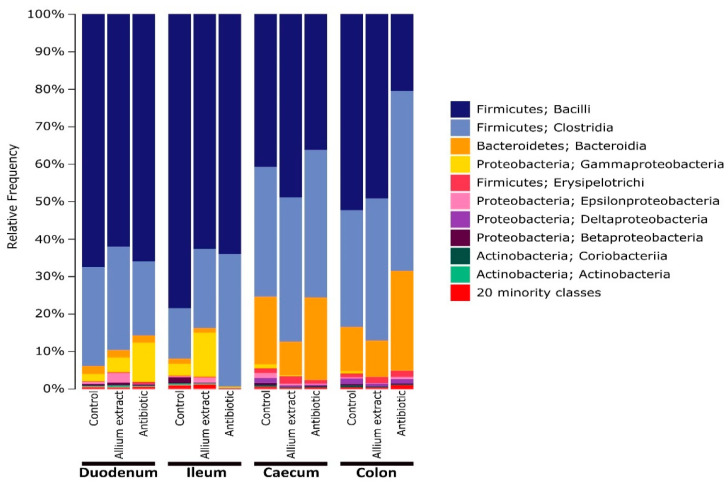
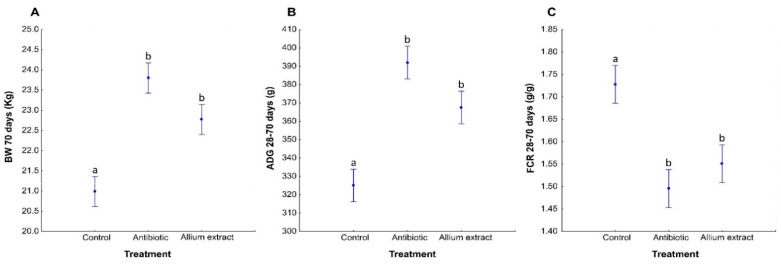
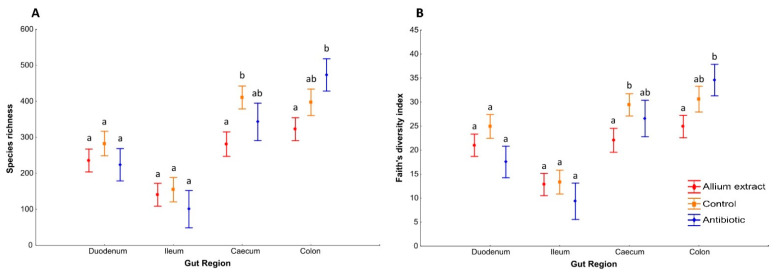
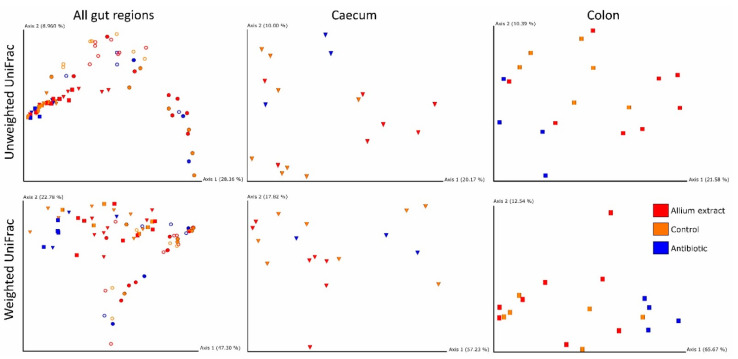
Antimicrobial resistance (AMR) has risen as a global threat for human health. One of the leading factors for this emergence has been the massive use of antibiotics growth-promoter (AGPs) in livestock, enhancing the spread of AMR among human pathogenic bacteria. Thus, several alternatives such as probiotics, prebiotics, or phytobiotics have been proposed for using in animal feeding to maintain or improve productive levels while diminishing the negative effects of AGPs. Reducing the use of antibiotics is a key aspect in the pig rearing for production reasons, as well as for the production of high-quality pork, acceptable to consumers. Here we analyze the potential use of extract as an alternative. In this study, weaned piglets were fed with extract supplementation and compared with control and antibiotic (colistin and zinc oxide) treated piglets. The effects of extract were tested by analyzing the gut microbiome and measuring different productive parameters. Alpha diversity indices decreased significantly in extract group in caecum and colon. Regarding beta diversity, significant differences between treatments appeared only in caecum and colon. extract and antibiotic piglets showed better values of body weight (BW), average daily weight gain (ADG), and feed conversion ratio (FCR) than control group. These results indicate that productive parameters can be implemented by modifying the gut microbiota through phytobiotics such as extract, which will drive to drop the use of antibiotics in piglet diet.
抗菌药物耐药性(AMR)已成为对人类健康的全球威胁。这种情况出现的主要因素之一是在牲畜中大量使用抗生素生长促进剂(AGPs),这加剧了AMR在人类病原菌中的传播。因此,人们提出了几种替代方法,如益生菌、益生元或植物源生物活性物质,用于动物饲养,以维持或提高生产水平,同时减少AGPs的负面影响。出于生产原因以及生产受消费者认可的高品质猪肉的考虑,减少抗生素的使用是养猪生产中的一个关键方面。在这里,我们分析了[提取物名称]提取物作为一种替代物的潜在用途。在本研究中,给断奶仔猪喂食添加了[提取物名称]提取物的饲料,并与对照组和用抗生素(黏菌素和氧化锌)处理的仔猪进行比较。通过分析肠道微生物群和测量不同的生产参数来测试[提取物名称]提取物的效果。[提取物名称]提取物组盲肠和结肠中的α多样性指数显著下降。关于β多样性,各处理之间的显著差异仅出现在盲肠和结肠中。[提取物名称]提取物组和抗生素处理组的仔猪在体重(BW)、平均日增重(ADG)和饲料转化率(FCR)方面的值均优于对照组。这些结果表明,可以通过植物源生物活性物质如[提取物名称]提取物来改变肠道微生物群,从而实现生产参数的改善,这将促使减少仔猪日粮中抗生素的使用。