Kubackova Jana, Holas Ondrej, Zbytovska Jarmila, Vranikova Barbora, Zeng Guanghong, Pavek Petr, Mullertz Anette
Department of Pharmaceutical Technology, Faculty of Pharmacy in Hradec Kralove, Charles University, Akademika Heyrovskeho 1203, 500 05 Hradec Kralove, Czech Republic.
Faculty of Chemical Technology, University of Chemistry and Technology Prague, Technicka 5, 166 28 Prague, Czech Republic.
Pharmaceutics. 2021 Mar 28;13(4):459. doi: 10.3390/pharmaceutics13040459.
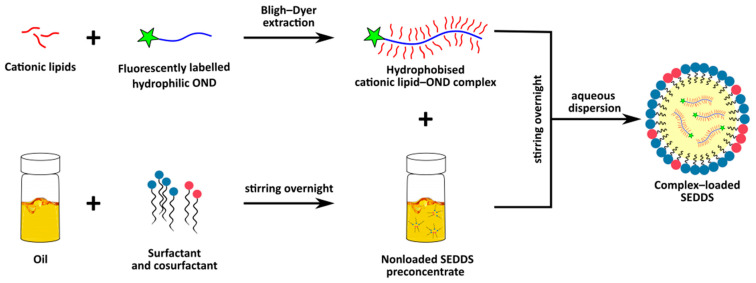
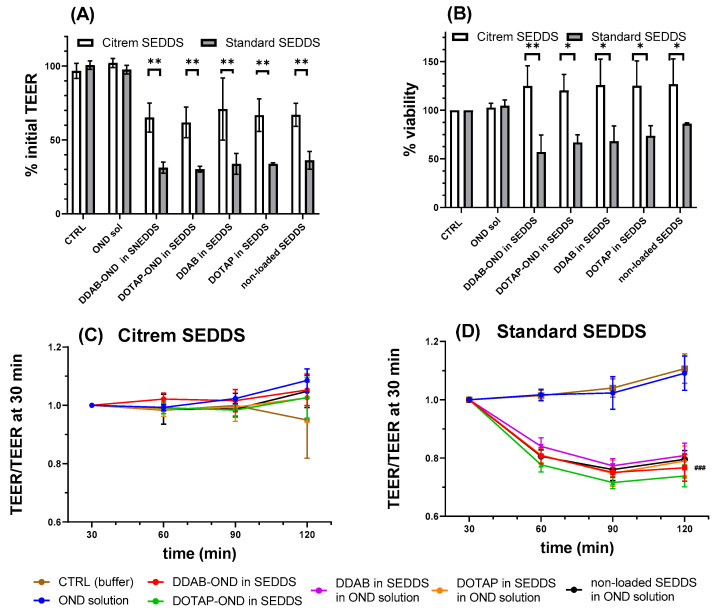
Oligonucleotides (OND) represent a promising therapeutic approach. However, their instability and low intestinal permeability hamper oral bioavailability. Well-established for oral delivery, self-emulsifying drug delivery systems (SEDDS) can overcome the weakness of other delivery systems such as long-term instability of nanoparticles or complicated formulation processes. Therefore, the present study aims to prepare SEDDS for delivery of a nonspecific fluorescently labeled OND across the intestinal Caco-2 monolayer. The hydrophobic ion pairing of an OND and a cationic lipid served as an effective hydrophobization method using either dimethyldioctadecylammonium bromide (DDAB) or 1,2-dioleoyl-3-trimethylammonium propane (DOTAP). This strategy allowed a successful loading of OND-cationic lipid complexes into both negatively charged and neutral SEDDS. Subjecting both complex-loaded SEDDS to a nuclease, the negatively charged SEDDS protected about 16% of the complexed OND in contrast to 58% protected by its neutral counterpart. Furthermore, both SEDDS containing permeation-enhancing excipients facilitated delivery of OND across the intestinal Caco-2 cell monolayer. The negatively charged SEDDS showed a more stable permeability profile over 120 min, with a permeability of about 2 × 10 cm/s, unlike neutral SEDDS, which displayed an increasing permeability reaching up to 7 × 10 cm/s. In conclusion, these novel SEDDS-based formulations provide a promising tool for OND protection and delivery across the Caco-2 cell monolayer.
寡核苷酸(OND)是一种很有前景的治疗方法。然而,它们的不稳定性和低肠道渗透性阻碍了口服生物利用度。自乳化药物递送系统(SEDDS)在口服给药方面已得到充分确立,它可以克服其他递送系统的缺点,如纳米颗粒的长期不稳定性或复杂的制剂工艺。因此,本研究旨在制备用于将非特异性荧光标记的OND穿过肠道Caco-2单层细胞的SEDDS。使用二甲基二辛基溴化铵(DDAB)或1,2-二油酰基-3-三甲基铵丙烷(DOTAP),将OND与阳离子脂质进行疏水离子配对作为一种有效的疏水化方法。该策略成功地将OND-阳离子脂质复合物负载到带负电荷和中性的SEDDS中。将两种负载复合物的SEDDS用核酸酶处理后,带负电荷的SEDDS保护了约16%的复合OND,而其对应的中性SEDDS保护了58%。此外,两种含有渗透促进辅料的SEDDS都促进了OND穿过肠道Caco-2细胞单层。与中性SEDDS不同,带负电荷的SEDDS在120分钟内显示出更稳定的渗透率曲线,渗透率约为2×10 cm/s,而中性SEDDS的渗透率则不断增加,最高可达7×10 cm/s。总之,这些基于SEDDS的新型制剂为OND在Caco-2细胞单层上的保护和递送提供了一种有前景的工具。