Roedel Alice, Vincze Szilvia, Projahn Michaela, Roesler Uwe, Robé Caroline, Hammerl Jens Andre, Noll Matthias, Al Dahouk Sascha, Dieckmann Ralf
German Federal Institute for Risk Assessment, Max-Dohrn-Str. 8-10, 10589 Berlin, Germany.
Institute for Animal Hygiene and Environmental Health, Freie Universität Berlin, Robert-von-Ostertag Str. 7-13, 14163 Berlin, Germany.
Microorganisms. 2021 Mar 21;9(3):651. doi: 10.3390/microorganisms9030651.
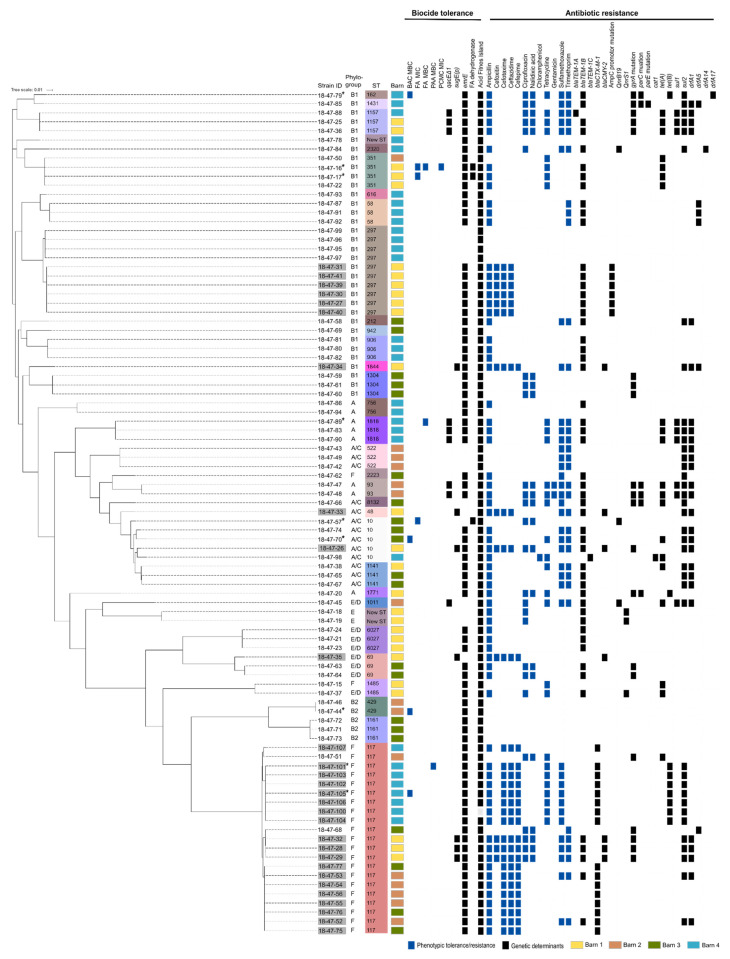
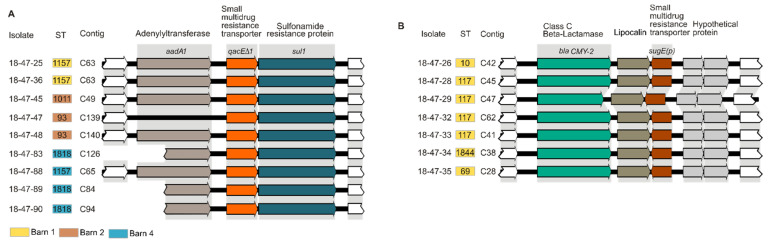
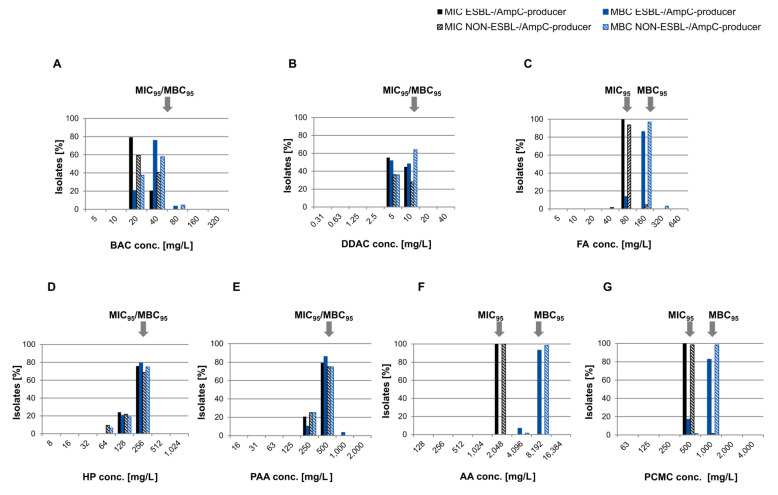
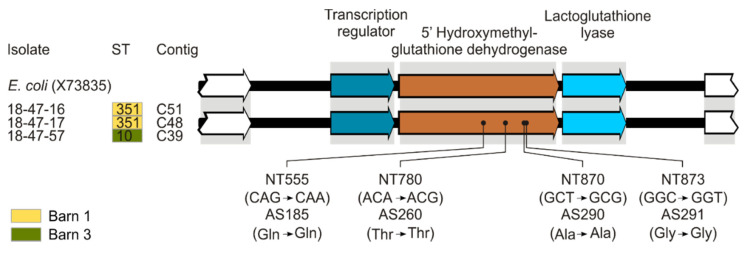
Biocides are frequently applied as disinfectants in animal husbandry to prevent the transmission of drug-resistant bacteria and to control zoonotic diseases. Concerns have been raised, that their use may contribute to the selection and persistence of antimicrobial-resistant bacteria. Especially, extended-spectrum β-lactamase- and AmpC β-lactamase-producing have become a global health threat. In our study, 29 ESBL-/AmpC-producing and 64 NON-ESBL-/AmpC-producing isolates from three German broiler fattening farms collected in 2016 following regular cleaning and disinfection were phylogenetically characterized by whole genome sequencing, analyzed for phylogenetic distribution of virulence-associated genes, and screened for determinants of and associations between biocide tolerance and antibiotic resistance. Of the 30 known and two unknown sequence types detected, ST117 and ST297 were the most common genotypes. These STs are recognized worldwide as pandemic lineages causing disease in humans and poultry. Virulence determinants associated with extraintestinal pathogenic showed variable phylogenetic distribution patterns. Isolates with reduced biocide susceptibility were rarely found on the tested farms. Nine isolates displayed elevated MICs and/or MBCs of formaldehyde, chlorocresol, peroxyacetic acid, or benzalkonium chloride. Antibiotic resistance to ampicillin, trimethoprim, and sulfamethoxazole was most prevalent. The majority of ESBL-/AmpC-producing isolates carried (55%) or (24%) genes. Phenotypic biocide tolerance and antibiotic resistance were not interlinked. However, biocide and metal resistance determinants were found on mobile genetic elements together with antibiotic resistance genes raising concerns that biocides used in the food industry may lead to selection pressure for strains carrying acquired resistance determinants to different antimicrobials.
杀生剂经常作为消毒剂应用于畜牧业,以防止耐药菌的传播并控制人畜共患病。人们担心,其使用可能有助于耐药菌的选择和持续存在。特别是,产超广谱β-内酰胺酶和AmpCβ-内酰胺酶的细菌已成为全球健康威胁。在我们的研究中,对2016年从德国三个肉鸡育肥场收集的29株产ESBL-/AmpC和64株不产ESBL-/AmpC的分离株进行了全基因组测序,以进行系统发育特征分析,分析毒力相关基因的系统发育分布,并筛选杀生剂耐受性和抗生素抗性的决定因素及相关性。在所检测到的30种已知和2种未知序列类型中,ST117和ST297是最常见的基因型。这些序列类型在全球范围内被认为是导致人类和家禽发病的大流行谱系。与肠外致病性大肠杆菌相关的毒力决定因素表现出可变的系统发育分布模式。在所测试的农场中很少发现对杀生剂敏感性降低的分离株。9株分离株对甲醛、氯甲酚、过氧乙酸或苯扎氯铵的最低抑菌浓度(MIC)和/或最低杀菌浓度(MBC)升高。对氨苄西林、甲氧苄啶和磺胺甲恶唑的抗生素抗性最为普遍。大多数产ESBL-/AmpC的分离株携带blaCTX-M(55%)或blaTEM(24%)基因。杀生剂的表型耐受性和抗生素抗性没有相互联系。然而,在移动遗传元件上发现了杀生剂和金属抗性决定因素以及抗生素抗性基因,这引发了人们对食品工业中使用的杀生剂可能导致对携带不同抗菌药物获得性抗性决定因素的菌株产生选择压力的担忧。