
生物膜作为杀菌剂的保护性茧:从细菌适应到 1 种健康问题。
Biofilms as protective cocoons against biocides: from bacterial adaptation to One Health issues.
机构信息
Antibiotics, Biocides, Residues and Resistance Unit, Fougères Laboratory, French Agency for Food, Environmental and Occupational Health & Safety (ANSES), 35300 Fougères, France.
Université Paris-Saclay, INRAE, AgroParisTech, Micalis Institute, 78350, Jouy-en-Josas, France.
出版信息
Microbiology (Reading). 2023 Jun;169(6). doi: 10.1099/mic.0.001340.
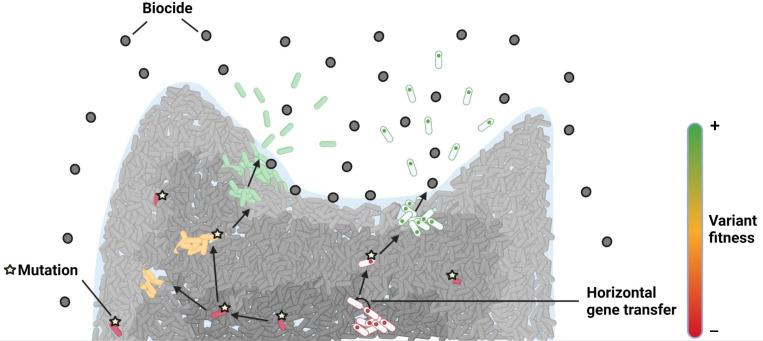
Bacteria in the food chain mostly live in communities associated with surfaces known as biofilms, which confer specific survival and adaptive abilities. In such communities, the bacteria mostly exhibit higher tolerance to external stress, and their recurrent exposure along the food chain to biocides used during cleaning and disinfection procedures raises concern about the adaptation routes they develop, both at single-cell and communal levels. In recent years, an increasing number of research subjects have focused on understanding the specific features of biofilms that enable bacterial populations to adapt to biocide exposure within a 'protective cocoon'. The first part of this review concentrates on the diversity of adaptive strategies, including structural modulation of these biofilms, physiological response or the acquisition of genetic resistance. The second part discusses the possible side effects of biofilm adaptation to biocides on antimicrobial cross-resistance, virulence and colonization features from a One Health perspective.
食物链中的细菌大多生活在与表面相关的群落中,这些群落被称为生物膜,它们赋予了特定的生存和适应能力。在这些群落中,细菌对外界压力的耐受性通常更高,并且它们在食物链中反复暴露于清洁和消毒过程中使用的生物杀灭剂,这引起了人们对它们在单细胞和群落水平上发展的适应途径的关注。近年来,越来越多的研究主题集中在了解生物膜的特定特征上,这些特征使细菌种群能够适应“保护性茧”内的杀菌剂暴露。本文综述的第一部分集中讨论了适应性策略的多样性,包括这些生物膜的结构调节、生理反应或遗传抗性的获得。第二部分从“同一健康”的角度讨论了生物膜对杀菌剂的适应性可能对抗菌药物交叉耐药性、毒力和定植特征产生的副作用。

 Zotero 插件