Institute of Clinical and Molecular Virology, Friedrich-Alexander University Erlangen-Nürnberg, 91054 Erlangen, Germany.
Viruses. 2021 Mar 2;13(3):395. doi: 10.3390/v13030395.
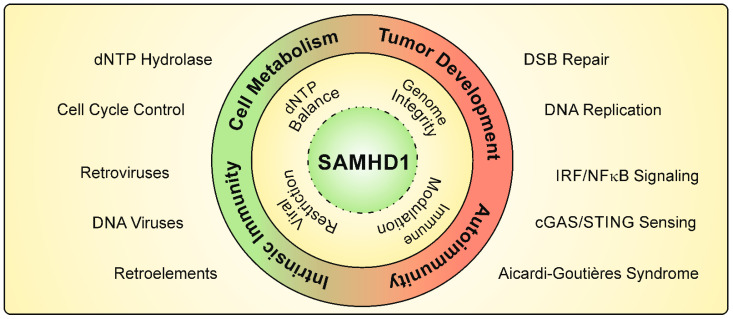
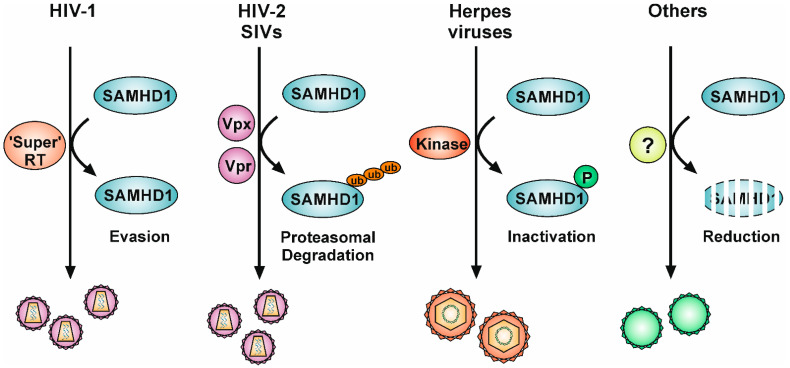
The SAM and HD domain-containing protein 1 (SAMHD1) is a dNTP triphosphohydrolase that plays a crucial role for a variety of different cellular functions. Besides balancing intracellular dNTP concentrations, facilitating DNA damage repair, and dampening excessive immune responses, SAMHD1 has been shown to act as a major restriction factor against various virus species. In addition to its well-described activity against retroviruses such as HIV-1, SAMHD1 has been identified to reduce the infectivity of different DNA viruses such as the herpesviruses CMV and EBV, the poxvirus VACV, or the hepadnavirus HBV. While some viruses are efficiently restricted by SAMHD1, others have developed evasion mechanisms that antagonize the antiviral activity of SAMHD1. Within this review, we summarize the different cellular functions of SAMHD1 and highlight the countermeasures viruses have evolved to neutralize the restriction factor SAMHD1.
SAM 和 HD 结构域蛋白 1(SAMHD1)是一种 dNTP 三磷酸水解酶,在多种不同的细胞功能中发挥着关键作用。除了平衡细胞内 dNTP 浓度、促进 DNA 损伤修复和抑制过度的免疫反应外,SAMHD1 还被证明是一种针对各种病毒的主要限制因子。除了其对 HIV-1 等逆转录病毒的已有描述的活性外,SAMHD1 已被确定可降低不同 DNA 病毒如疱疹病毒 CMV 和 EBV、痘病毒 VACV 或嗜肝 DNA 病毒 HBV 的感染性。虽然一些病毒被 SAMHD1 有效限制,但其他病毒已经发展出逃避机制,对抗 SAMHD1 的抗病毒活性。在这篇综述中,我们总结了 SAMHD1 的不同细胞功能,并强调了病毒进化出的对策来中和限制因子 SAMHD1。