
选择性去除龋坏牙本质后炎症和内稳态生物标志物的检测——一项体内可行性研究
Detection of Inflammatory and Homeostasis Biomarkers after Selective Removal of Carious Dentin-An In Vivo Feasibility Study.
作者信息
Schmidt Jana, Hübler Clemens, Krohn Sandra, Schmalz Gerhard, Schneider Hartmut, Berg Thomas, Haak Rainer, Ziebolz Dirk
机构信息
Department of Cariology, Endodontology and Periodontology, University of Leipzig, Liebigstr. 12, 04103 Leipzig, Germany.
Division of Hepatology, Department of Medicine II, University Hospital Leipzig, Liebigstr. 20, 04103 Leipzig, Germany.
出版信息
J Clin Med. 2021 Mar 2;10(5):1003. doi: 10.3390/jcm10051003.
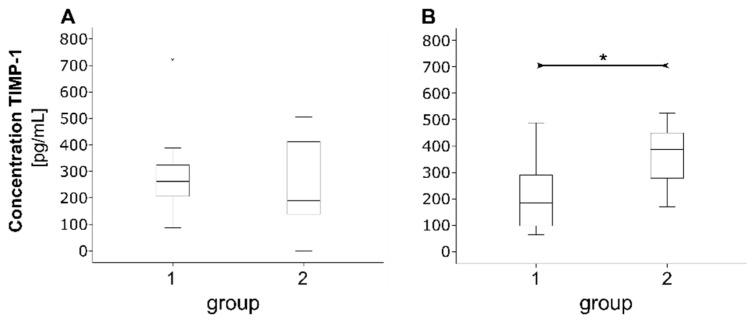
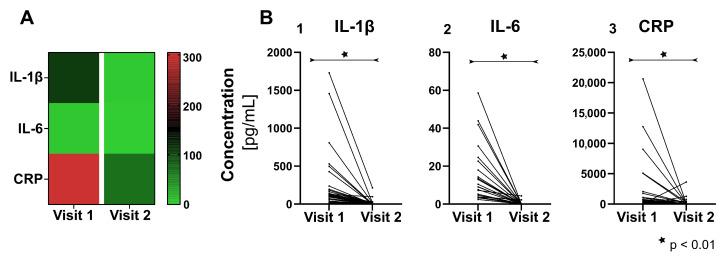
Deep carious dentin lesions induce an immune reaction within the pulp-dentin complex, leading to the release of cytokines, which might be suitable biomarkers in pulp diagnostics. This in vivo feasibility study determines the concentration of different cytokines after selective removal of carious infected dentin (SCR). In our methodology, paired samples are obtained from 21 patients-each of them with two deep carious lesions at posterior teeth without clinical symptoms. After SCR, lesions are randomly assigned to treatment strategy: Group 1 (11 patients): Carious dentin is covered either with Biodentine ( = 11) or gutta-percha ( = 11) before using the adhesive Optibond FL. Group 2 (10 patients): The adhesives Clearfil SE Protect Bond ( = 10) or Clearfil SE Bond 2 ( = 10) are directly applied. Prepared cavities are rinsed with phosphate buffered saline containing 0.05% Tween 20 (10X) for five minutes immediately after SCR (visit 1) and eight weeks later (visit 2). Rinsing liquid is regained. Concentrations of IL-1β, IL-6, IL-10, C-reactive protein (CRP), TNF-α, IFN-γ, TIMP-1, -2, and MMP-7, -8, -9 are assessed by customized multiplex assays, evaluated with fluorescence analyzer. Non-parametric statistical analysis (Wilcoxon, Mann-Whitney U Test, < 0.05) is performed (SPSS 25). Our results show that concentrations of CRP, IL-1β, IL-6, TIMP-1, -2, and MMPs were detectable. Median concentrations of CRP, IL-1β und IL-6 were significantly higher in visit 1 (304.9, 107.4, 3.8 pg/mL), compared to visit 2 (67.8, 2.3, 0.0 pg/mL; p < 0.001). The study revealed that the non-invasive determination of cytokines from prepared dental cavities is possible.
深龋牙本质病变会在牙髓-牙本质复合体中引发免疫反应,导致细胞因子释放,这些细胞因子可能是牙髓诊断中合适的生物标志物。这项体内可行性研究确定了选择性去除龋坏感染牙本质(SCR)后不同细胞因子的浓度。在我们的方法中,从21名患者身上获取配对样本,他们每人后牙都有两个无临床症状的深龋病变。SCR后,病变被随机分配到治疗策略组:第1组(11名患者):在使用粘结剂Optibond FL之前,龋坏牙本质用生物活性玻璃(=11)或牙胶(=11)覆盖。第2组(10名患者):直接应用粘结剂Clearfil SE Protect Bond(=10)或Clearfil SE Bond 2(=10)。SCR后(就诊1)和八周后(就诊2),立即用含0.05%吐温20的磷酸盐缓冲盐水(10倍)冲洗制备好的窝洞五分钟。收集冲洗液。通过定制的多重检测法评估白细胞介素-1β、白细胞介素-6、白细胞介素-10、C反应蛋白(CRP)、肿瘤坏死因子-α、干扰素-γ、金属蛋白酶组织抑制因子-1、-2以及基质金属蛋白酶-7、-8、-9的浓度,并用荧光分析仪进行评估。进行非参数统计分析(Wilcoxon检验、Mann-Whitney U检验,p<0.05)(SPSS 25)。我们的结果表明,CRP、白细胞介素-1β、白细胞介素-6、金属蛋白酶组织抑制因子-1、-2和基质金属蛋白酶的浓度是可检测到的。与就诊2(67.8、2.3、0.0 pg/mL;p<0.001)相比,就诊1时CRP、白细胞介素-1β和白细胞介素-6的中位数浓度显著更高(304.9、107.4、3.8 pg/mL)。该研究表明,从制备好的牙洞中进行细胞因子的非侵入性测定是可行的。


 Zotero 插件