Department of Electrical and Electronic Engineering, The University of Manchester, Manchester M13 9PL, UK.
Department of Mechanical, Aerospace and Civil Engineering, The University of Manchester, Manchester M13 9PL, UK.
Sensors (Basel). 2021 Mar 2;21(5):1717. doi: 10.3390/s21051717.
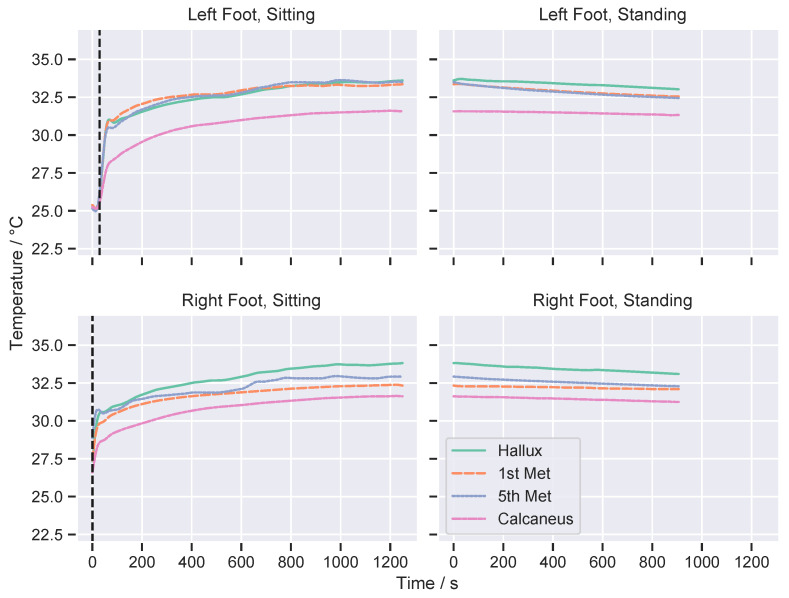
Diabetic foot ulcers (DFUs) are a life-changing complication of diabetes that can lead to amputation. There is increasing evidence that long-term management with wearables can reduce incidence and recurrence of this condition. Temperature asymmetry measurements can alert to DFU development, but measurements of dynamic information, such as rate of temperature change, are under investigated. We present a new wearable device for temperature monitoring at the foot that is personalised to account for anatomical variations at the foot. We validate this device on 13 participants with diabetes (no neuropathy) (group name D) and 12 control participants (group name C), during sitting and standing. We extract dynamic temperature parameters from four sites on each foot to compare the rate of temperature change. During sitting the time constant of temperature rise after shoe donning was significantly ( < 0.05) faster at the hallux ( = 0.032, 370.4 s (C), 279.1 s (D)) and 5th metatarsal head ( = 0.011, 481.9 s (C), 356.6 s (D)) in participants with diabetes compared to controls. No significant differences at the other sites or during standing were identified. These results suggest that temperature rise time is faster at parts of the foot in those who have developed diabetes. Elevated temperatures are known to be a risk factor of DFUs and measurement of time constants may provide information on their development. This work suggests that temperature rise time measured at the plantar surface may be an indicative biomarker for differences in soft tissue biomechanics and vascularisation during diabetes onset and progression.
糖尿病足溃疡(DFU)是糖尿病改变生活的并发症,可导致截肢。越来越多的证据表明,可穿戴设备的长期管理可以降低这种情况的发生率和复发率。体温不对称测量可以提示 DFU 的发展,但体温变化率等动态信息的测量仍在研究中。我们提出了一种新的可穿戴设备,用于监测足部的体温,该设备针对足部的解剖结构变化进行了个性化设置。我们在 13 名无神经病变的糖尿病患者(组名 D)和 12 名对照参与者(组名 C)进行坐姿和站立时对该设备进行了验证。我们从每个脚的四个部位提取动态温度参数,以比较温度变化率。在坐姿下,穿鞋后体温上升的时间常数在糖尿病患者的大脚趾(=0.032,370.4 s(C),279.1 s(D))和第 5 跖骨头(=0.011,481.9 s(C),356.6 s(D))处明显(<0.05)快于对照组。在其他部位或站立时没有发现显著差异。这些结果表明,与对照组相比,患有糖尿病的患者足部某些部位的体温上升时间更快。已知高温是 DFU 的一个风险因素,测量时间常数可能提供有关其发展的信息。这项工作表明,足底表面测量的温升时间可能是糖尿病发病和进展过程中软组织生物力学和血管化差异的指示性生物标志物。