Peng Chi-Hao, Chen Jiun-Liang, Liao Ming-Feng, Hsu Jung-Lung, Hsu Hui-Ching, Ro Long-Sun
Division of Chinese Internal Medicine, Center for Traditional Chinese Medicine, Chang Gung Memorial Hospital, Taoyuan 333, Taiwan.
School of Traditional Chinese Medicine, College of Medicine, Chang Gung University, Taoyuan 333, Taiwan.
J Pers Med. 2021 Mar 2;11(3):171. doi: 10.3390/jpm11030171.
This retrospective study investigated prognostic factors and recovery time in patients with Bell's palsy after different doses and durations of oral glucocorticoid treatments.
A total of 396 patients initially diagnosed with Bell's palsy that had visited the Department of Neurology of Chang Gung Memorial Hospital, Taoyuan, a tertiary referral medical center in Taiwan, between January 2014 and December 2018 were included. Medical records, facial electroneurography (fENoG), and blink reflex (BR) tests were reviewed and analyzed. A favorable outcome was defined as patients who improved to grade ≤ II, and an unfavorable outcome was defined as patients who improved to grade ≥ III in 6 months according to the House-Brackmann (HB) grading system.
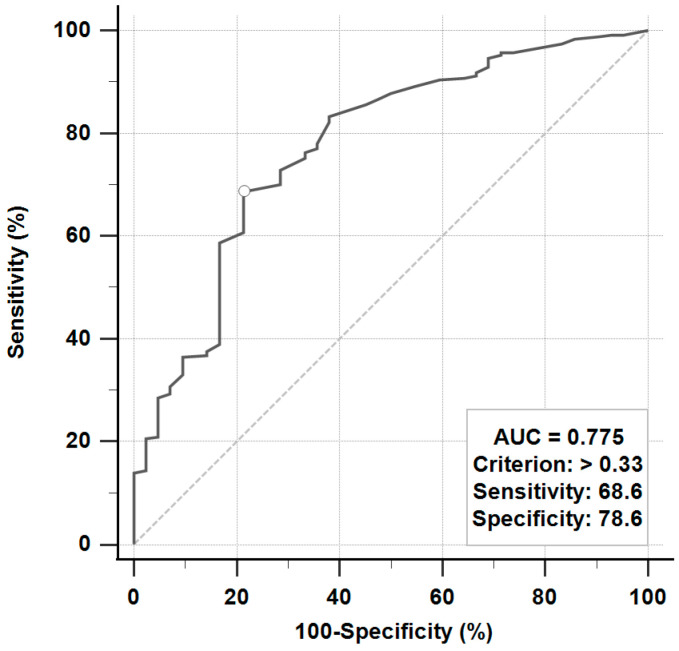
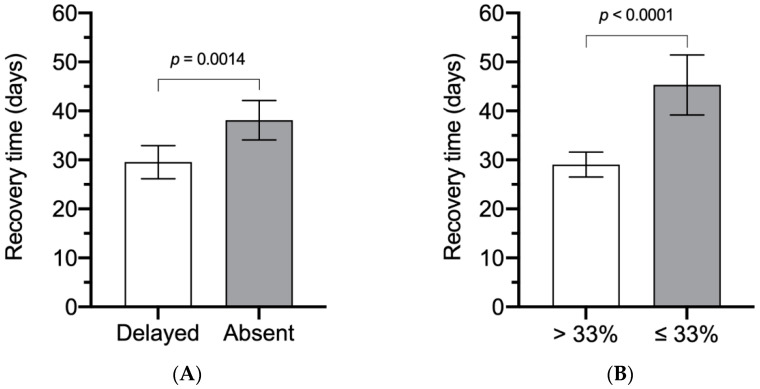
The rate of favorable outcomes was 89.4% (354 of 396 patients) at the 6-month follow-up. A favorable outcome (HB less than grade II) was associated with a delayed BR (odds ratio, OR, 5.38; 95% CI, 1.82 to 15.90) and fENoG values (the lesion side/the healthy side) over 33% (OR, 6.67; 95% CI, 3.02 to 14.71). The recovery time was significantly shorter for those with a delayed BR than for those with an absent BR and shorter for those with good fENoG values (>33%) than for those with poor values (≤33%). However, treatment without or with different doses and durations of oral glucocorticoid did not influence the final outcome or recovery time in this study.
The fENoG and BR tests were significant and highly valuable examinations for predicting the final outcome. Moreover, age younger than 60 years, a delayed BR, and fENoG values > 33% were associated with shorter recovery times.
本回顾性研究调查了不同剂量和疗程的口服糖皮质激素治疗后贝尔面瘫患者的预后因素及恢复时间。
纳入2014年1月至2018年12月期间在台湾桃园长庚纪念医院神经内科就诊的396例初诊为贝尔面瘫的患者。回顾并分析病历、面部神经电图(fENoG)和眨眼反射(BR)检查结果。根据House-Brackmann(HB)分级系统,预后良好定义为6个月内改善至≤Ⅱ级的患者,预后不良定义为6个月内改善至≥Ⅲ级的患者。
6个月随访时,预后良好率为89.4%(396例患者中的354例)。预后良好(HB低于Ⅱ级)与BR延迟(比值比,OR,5.38;95%可信区间,1.82至15.90)和fENoG值(患侧/健侧)超过33%(OR,6.67;95%可信区间,3.02至14.71)相关。BR延迟的患者恢复时间明显短于BR缺失的患者,fENoG值良好(>33%)的患者恢复时间明显短于fENoG值差(≤33%)的患者。然而,本研究中口服糖皮质激素不同剂量和疗程的治疗与否并未影响最终结局或恢复时间。
fENoG和BR检查对于预测最终结局具有重要意义且极具价值。此外,年龄小于60岁、BR延迟和fENoG值>33%与较短的恢复时间相关。