Chevigné Andy, Janji Bassam, Meyrath Max, Reynders Nathan, D'Uonnolo Giulia, Uchański Tomasz, Xiao Malina, Berchem Guy, Ollert Markus, Kwon Yong-Jun, Noman Muhammad Zaeem, Szpakowska Martyna
Department of Infection and Immunity, Immuno-Pharmacology and Interactomics, Luxembourg Institute of Health (LIH), L-4354 Esch-sur-Alzette, Luxembourg.
Department of Oncology, Tumor Immunotherapy and Microenvironment (TIME), Luxembourg Institute of Health (LIH), L-1526 Luxembourg City, Luxembourg.
Cancers (Basel). 2021 Mar 2;13(5):1054. doi: 10.3390/cancers13051054.
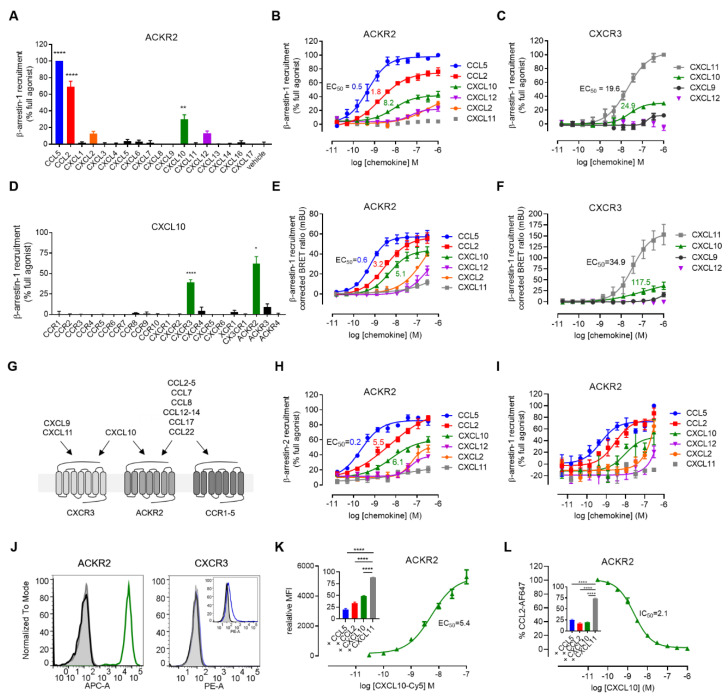
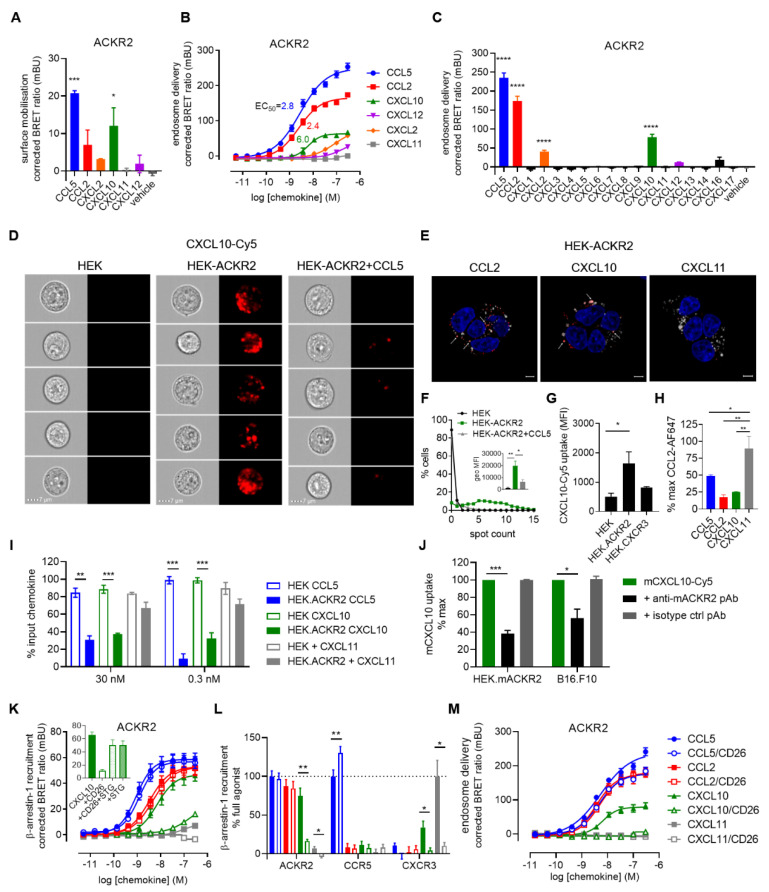
Atypical chemokine receptors (ACKRs) are important regulators of chemokine functions. Among them, the atypical chemokine receptor ACKR2 (also known as D6) has long been considered as a scavenger of inflammatory chemokines exclusively from the CC family. In this study, by using highly sensitive β-arrestin recruitment assays based on NanoBiT and NanoBRET technologies, we identified the inflammatory CXC chemokine CXCL10 as a new strong agonist ligand for ACKR2. CXCL10 is known to play an important role in the infiltration of immune cells into the tumour bed and was previously reported to bind to CXCR3 only. We demonstrated that ACKR2 is able to internalize and reduce the availability of CXCL10 in the extracellular space. Moreover, we found that, in contrast to CC chemokines, CXCL10 activity towards ACKR2 was drastically reduced by the dipeptidyl peptidase 4 (DPP4 or CD26) N-terminal processing, pointing to a different receptor binding pocket occupancy by CC and CXC chemokines. Overall, our study sheds new light on the complexity of the chemokine network and the potential role of CXCL10 regulation by ACKR2 in many physiological and pathological processes, including tumour immunology. Our data also testify that systematic reassessment of chemokine-receptor pairing is critically needed as important interactions may remain unexplored.
非典型趋化因子受体(ACKRs)是趋化因子功能的重要调节因子。其中,非典型趋化因子受体ACKR2(也称为D6)长期以来一直被认为是专门清除CC家族炎性趋化因子的清道夫。在本研究中,我们通过基于NanoBiT和NanoBRET技术的高灵敏度β-抑制蛋白招募分析,确定炎性CXC趋化因子CXCL10是ACKR2的一种新的强效激动剂配体。已知CXCL10在免疫细胞浸润到肿瘤床中起重要作用,且此前报道其仅与CXCR3结合。我们证明ACKR2能够内化并减少细胞外空间中CXCL10的可用性。此外,我们发现,与CC趋化因子不同,二肽基肽酶4(DPP4或CD26)的N端加工会大幅降低CXCL10对ACKR2的活性,这表明CC和CXC趋化因子占据不同的受体结合口袋。总体而言,我们的研究为趋化因子网络的复杂性以及ACKR2对CXCL10的调节在包括肿瘤免疫学在内的许多生理和病理过程中的潜在作用提供了新的线索。我们的数据还证明,由于重要的相互作用可能仍未被探索,因此迫切需要对趋化因子-受体配对进行系统的重新评估。