Camus Vincent, Jardin Fabrice
Department of Hematology, Centre Henri Becquerel, 76038 Rouen, France.
Pharmaceuticals (Basel). 2021 Mar 2;14(3):207. doi: 10.3390/ph14030207.
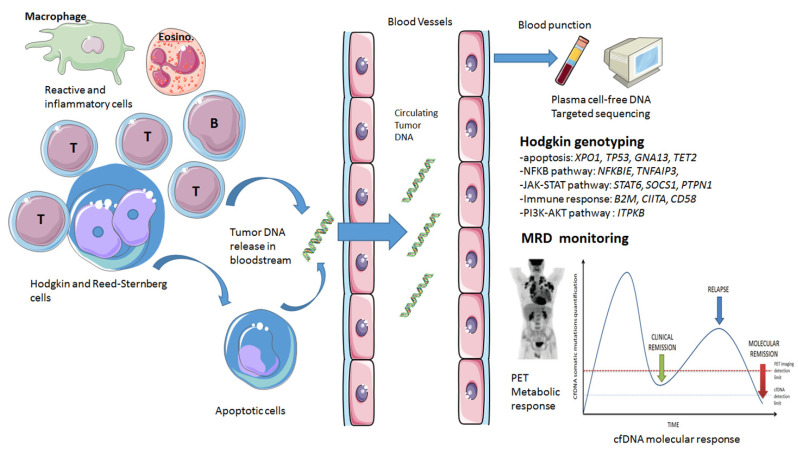
Cell-free DNA (cfDNA) testing, is an emerging "liquid biopsy" tool for noninvasive lymphoma detection, and an increased amount of data are now available to use this technique with accuracy, especially in classical Hodgkin lymphoma (cHL). The advantages of cfDNA include simplicity of repeated blood sample acquisition over time; dynamic, noninvasive, and quantitative analysis; fast turnover time; reasonable cost; and established consistency with results from tumor genomic DNA. cfDNA analysis offers an easy method for genotyping the overall molecular landscape of pediatric and adult cHL and may help in cases of diagnostic difficulties between cHL and other lymphomas. cfDNA levels are correlated with clinical, prognostic, and metabolic features, and may serve as a therapeutic response evaluation tool and as a minimal residual disease (MRD) biomarker in complement to positron emission tomography (PET). Indeed, cfDNA real-time monitoring by fast high-throughput techniques enables the prompt detection of refractory disease or may help to address PET residual hypermetabolic situations during or at the end of treatment. The major recent works presented and described here demonstrated the clinically meaningful applicability of cfDNA testing in diagnostic and theranostic settings, but also in disease risk assessment, therapeutic molecular response, and monitoring of cHL treatments.
游离DNA(cfDNA)检测是一种新兴的用于非侵入性淋巴瘤检测的“液体活检”工具,现在有越来越多的数据可用于准确使用该技术,尤其是在经典型霍奇金淋巴瘤(cHL)中。cfDNA的优点包括随着时间推移重复采集血样操作简单;动态、非侵入性和定量分析;周转时间快;成本合理;以及与肿瘤基因组DNA结果具有既定的一致性。cfDNA分析为对儿童和成人cHL的整体分子格局进行基因分型提供了一种简便方法,并且在cHL与其他淋巴瘤的诊断困难病例中可能有所帮助。cfDNA水平与临床、预后和代谢特征相关,并且可以作为治疗反应评估工具以及作为正电子发射断层扫描(PET)补充的微小残留病(MRD)生物标志物。实际上,通过快速高通量技术对cfDNA进行实时监测能够及时检测难治性疾病,或者有助于解决治疗期间或治疗结束时PET残留高代谢情况。本文介绍和描述的近期主要研究表明,cfDNA检测在诊断和治疗诊断环境中具有临床意义的适用性,而且在疾病风险评估、治疗分子反应以及cHL治疗监测方面也具有适用性。