Mayton E Handly, Hernandez Heather M, Vitek Christopher J, Christofferson Rebecca C
Department of Pathobiological Sciences, School of Veterinary Medicine, Louisiana State University, Baton Rouge, LA 70803, USA.
Center for Vector-Borne Diseases, The University of Texas Rio Grande Valley, Edinburg, TX 78539, USA.
Insects. 2021 Mar 27;12(4):292. doi: 10.3390/insects12040292.
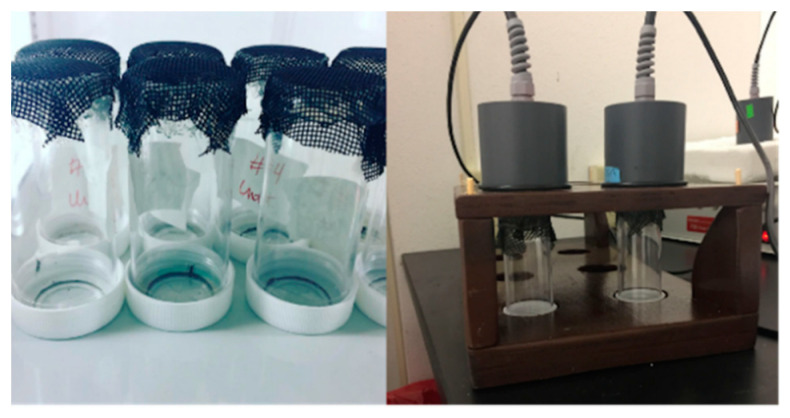
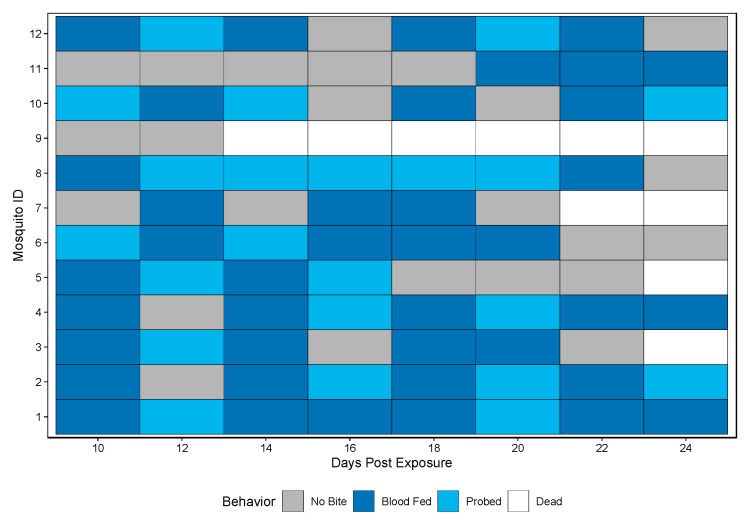
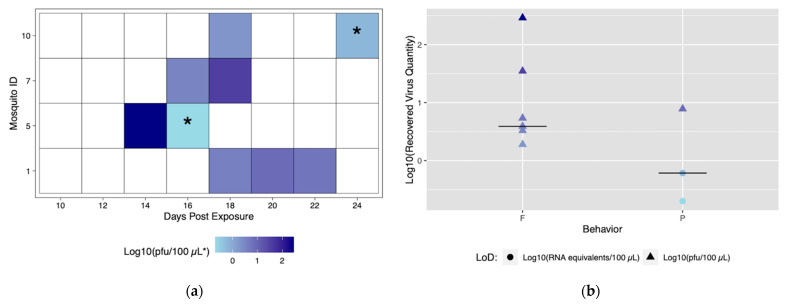
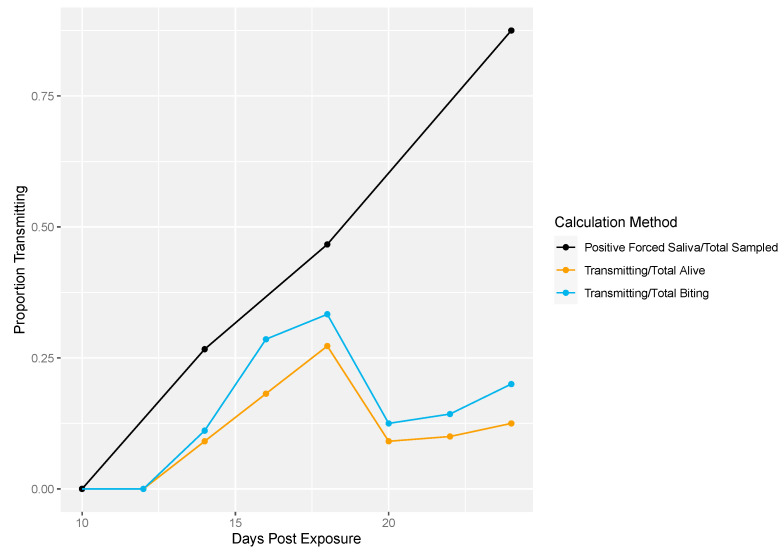
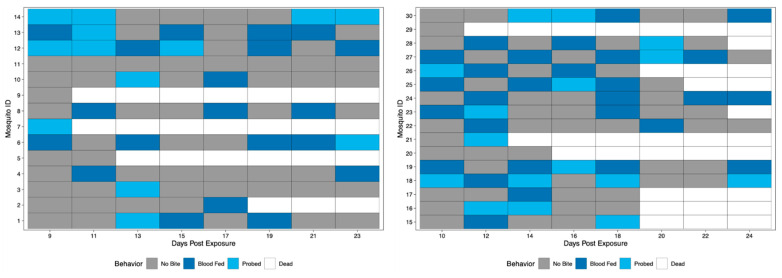
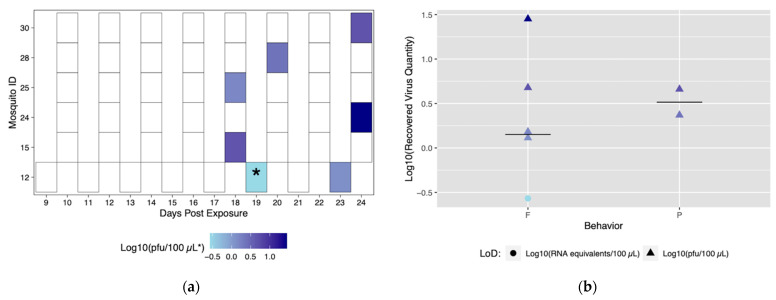
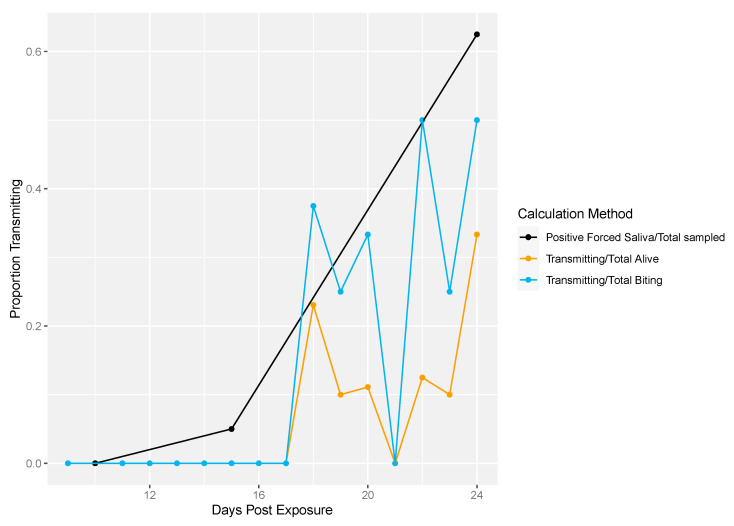
Mosquito-borne viruses are the cause of significant morbidity and mortality worldwide, especially in low- and middle-income countries. Assessing risk for viral transmission often involves characterization of the vector competence of vector-virus pairings. The most common determination of vector competence uses discreet, terminal time points, which cannot be used to investigate variation in transmission aspects, such as biting behavior, over time. Here, we present a novel method to longitudinally measure individual biting behavior and Zika virus (ZIKV) transmission. Individual mosquitoes were exposed to ZIKV, and from 9 to 24 days post-exposure, individuals were each offered a 180 μL bloodmeal every other day. Biting behavior was observed and characterized as either active probing, feeding, or no bite. The bloodmeal was then collected, spun down, serum collected, and tested for ZIKV RNA via qRT-PCR to determine individuals' vector competence over time. This included whether transmission to the bloodmeal was successful and the titer of expectorated virus. Additionally, serum was inoculated onto Vero cells in order to determine infectiousness of positive recovered sera. Results demonstrate heterogeneity in not only biting patterns but expectorated viral titers among individual mosquitoes over time. These findings demonstrate that the act of transmission is a complex process governed by mosquito behavior and mosquito-virus interaction, and herein we offer a method to investigate this phenomenon.
蚊媒病毒是全球重大发病和死亡的原因,尤其是在低收入和中等收入国家。评估病毒传播风险通常涉及对病媒-病毒配对的媒介能力进行表征。最常见的媒介能力测定使用离散的终末时间点,这些时间点无法用于研究传播方面随时间的变化,例如叮咬行为。在此,我们提出一种纵向测量个体叮咬行为和寨卡病毒(ZIKV)传播的新方法。将个体蚊子暴露于寨卡病毒,在暴露后9至24天,每隔一天给每个个体提供180μL血餐。观察叮咬行为并将其表征为主动探查、进食或未叮咬。然后收集血餐,离心,收集血清,并通过qRT-PCR检测寨卡病毒RNA,以确定个体随时间的媒介能力。这包括向血餐的传播是否成功以及咳出病毒的滴度。此外,将血清接种到Vero细胞上,以确定阳性回收血清的传染性。结果表明,随着时间的推移,个体蚊子不仅在叮咬模式上存在异质性,而且在咳出的病毒滴度上也存在异质性。这些发现表明,传播行为是一个由蚊子行为和蚊子-病毒相互作用所控制的复杂过程,在此我们提供了一种研究这一现象的方法。