Department of Pathology, Microbiology, and Immunology, School of Veterinary Medicine, University of California Davis, Davis, California, United States of America.
Abt Associates Inc., Boulder, Colorado, United States of America.
PLoS Negl Trop Dis. 2018 Jun 21;12(6):e0006524. doi: 10.1371/journal.pntd.0006524. eCollection 2018 Jun.
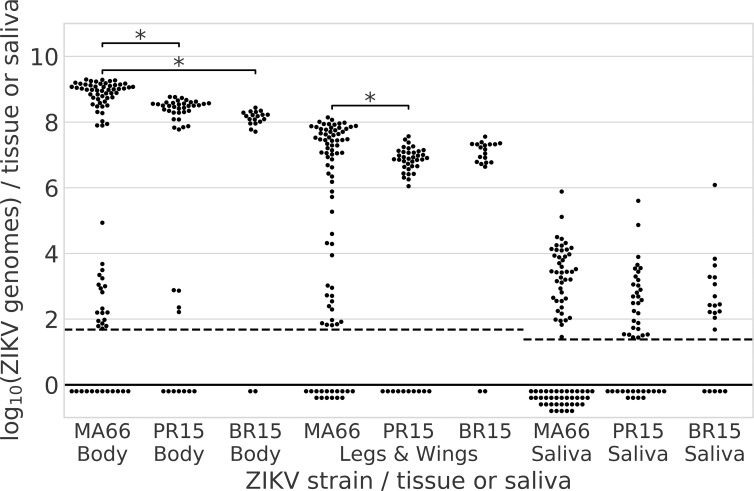
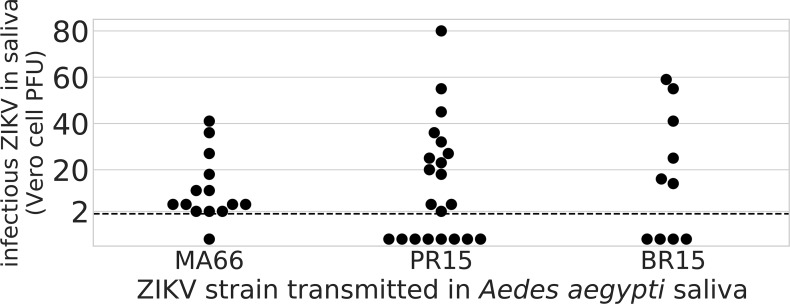
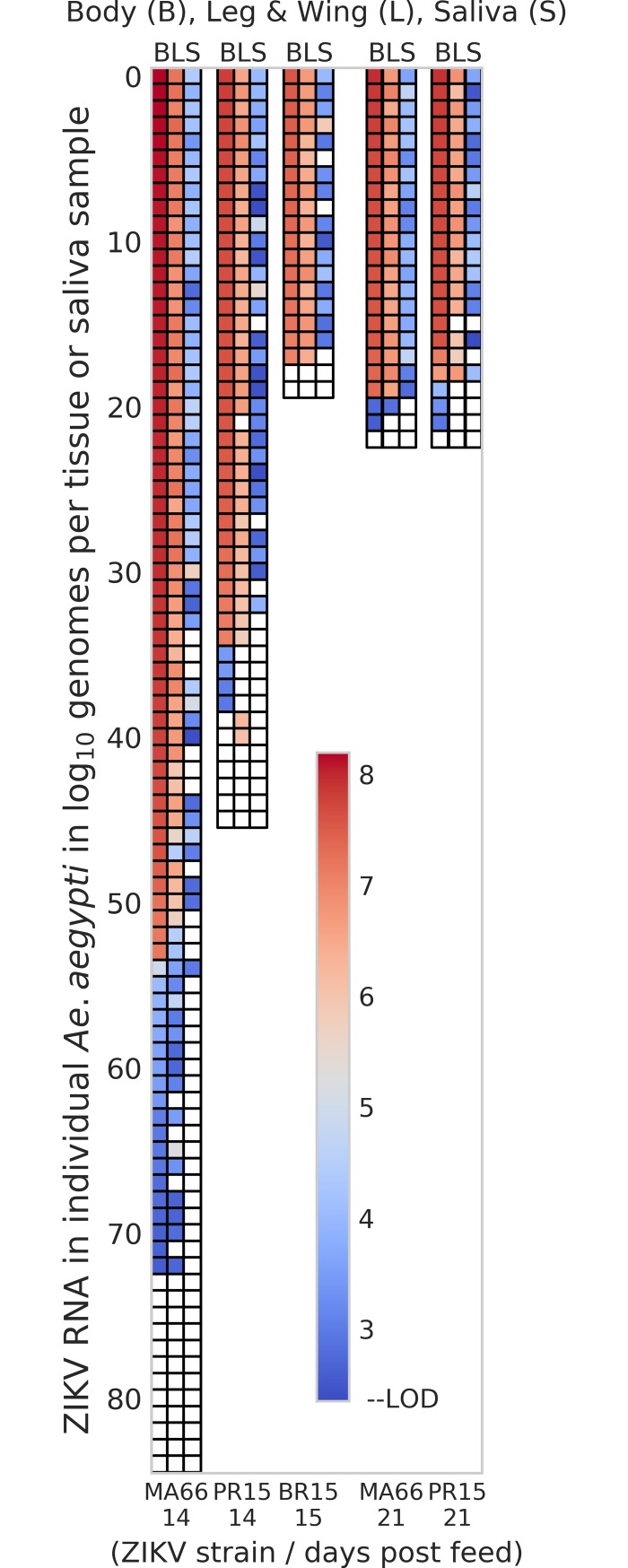
Zika virus (ZIKV) has emerged since 2013 as a significant global human health threat following outbreaks in the Pacific Islands and rapid spread throughout South and Central America. Severe congenital and neurological sequelae have been linked to ZIKV infections. Assessing the ability of common mosquito species to transmit ZIKV and characterizing variation in mosquito transmission of different ZIKV strains is important for estimating regional outbreak potential and for prioritizing local mosquito control strategies for Aedes and Culex species. In this study, we evaluated the laboratory vector competence of Aedes aegypti, Culex quinquefasciatus, and Culex tarsalis that originated in areas of California where ZIKV cases in travelers since 2015 were frequent. We compared infection, dissemination, and transmission rates by measuring ZIKV RNA levels in cohorts of mosquitoes that ingested blood meals from type I interferon-deficient mice infected with either a Puerto Rican ZIKV strain from 2015 (PR15), a Brazilian ZIKV strain from 2015 (BR15), or an ancestral Asian-lineage Malaysian ZIKV strain from 1966 (MA66). With PR15, Cx. quinquefasciatus was refractory to infection (0%, N = 42) and Cx. tarsalis was infected at 4% (N = 46). No ZIKV RNA was detected in saliva from either Culex species 14 or 21 days post feeding (dpf). In contrast, Ae. aegypti developed infection rates of 85% (PR15; N = 46), 90% (BR15; N = 20), and 81% (MA66; N = 85) 14 or 15 dpf. Although MA66-infected Ae. aegypti showed higher levels of ZIKV RNA in mosquito bodies and legs, transmission rates were not significantly different across virus strains (P = 0.13, Fisher's exact test). To confirm infectivity and measure the transmitted ZIKV dose, we enumerated infectious ZIKV in Ae. aegypti saliva using Vero cell plaque assays. The expectorated plaque forming units PFU varied by viral strain: MA66-infected expectorated 13±4 PFU (mean±SE, N = 13) compared to 29±6 PFU for PR15-infected (N = 13) and 35±8 PFU for BR15-infected (N = 6; ANOVA, df = 2, F = 3.8, P = 0.035). These laboratory vector competence results support an emerging consensus that Cx. tarsalis and Cx. quinquefasciatus are not vectors of ZIKV. These results also indicate that Ae. aegypti from California are efficient laboratory vectors of ancestral and contemporary Asian lineage ZIKV.
寨卡病毒(ZIKV)自 2013 年以来已成为重大的全球人类健康威胁,此前该病毒在太平洋岛屿爆发,并迅速传播至南美洲和中美洲。寨卡病毒感染与严重的先天性和神经后遗症有关。评估常见蚊子传播寨卡病毒的能力,并描述不同寨卡病毒株在蚊子中的传播差异,对于估计区域暴发潜力和优先考虑针对埃及伊蚊和库蚊的本地蚊虫控制策略非常重要。在这项研究中,我们评估了源自加利福尼亚州的埃及伊蚊、库蚊和库蚊的实验室媒介能力,自 2015 年以来,旅行者中的寨卡病毒病例在该地区频繁发生。我们通过测量从感染 I 型干扰素缺陷型小鼠的血液中摄入血液的蚊子群体中的寨卡病毒 RNA 水平,比较了感染、传播和传播率,这些小鼠感染了来自波多黎各的 2015 年寨卡病毒株(PR15)、巴西的 2015 年寨卡病毒株(BR15)或马来西亚的 1966 年的祖代亚洲谱系寨卡病毒株(MA66)。对于 PR15,Cx. quinquefasciatus 对感染具有抗性(0%,N = 42),Cx. tarsalis 的感染率为 4%(N = 46)。在喂食后 14 或 21 天,从任何一种库蚊的唾液中均未检测到寨卡病毒 RNA。相比之下,Ae. aegypti 的感染率为 85%(PR15;N = 46)、90%(BR15;N = 20)和 81%(MA66;N = 85)在 14 或 15 天。尽管 MA66 感染的 Ae. aegypti 在蚊子的身体和腿部中显示出更高水平的寨卡病毒 RNA,但病毒株之间的传播率没有显著差异(P = 0.13,Fisher 确切检验)。为了确认感染力并测量传播的寨卡病毒剂量,我们使用 Vero 细胞噬斑测定法对 Ae. aegypti 的唾液中的传染性寨卡病毒进行了计数。喷出的蚀斑形成单位(PFU)因病毒株而异:MA66 感染的喷出 13±4 PFU(平均值±SE,N = 13),而 PR15 感染的喷出 29±6 PFU(N = 13),BR15 感染的喷出 35±8 PFU(N = 6;ANOVA,df = 2,F = 3.8,P = 0.035)。这些实验室媒介能力的结果支持了一种新兴共识,即库蚊和致倦库蚊不是寨卡病毒的传播媒介。这些结果还表明,来自加利福尼亚州的埃及伊蚊是祖代和当代亚洲谱系寨卡病毒的有效实验室媒介。