Cebrián-Camisón Sonia, Martínez-de la Puente Josué, Figuerola Jordi
Estación Biológica de Doñana, Departamento de Ecología de Humedales, Av. Américo Vespucio 26, 41092 Sevilla, Spain.
Departamento de Parasitología, Facultad de Farmacia, Campus Universitario de Cartuja, Universidad de Granada, 18071 Granada, Spain.
Insects. 2020 Nov 29;11(12):848. doi: 10.3390/insects11120848.
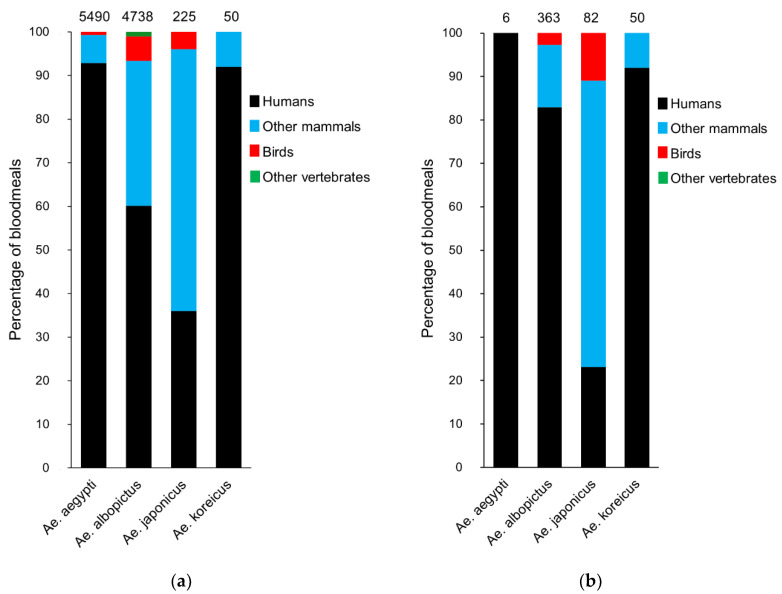
invasive mosquitoes (AIMs) play a key role as vectors of several pathogens of public health relevance. Four species have been established in Europe, including , , and . In addition, has been repeatedly recorded although it has not yet been established. In spite of their importance in the transmission of endemic (e.g., heartworms) and imported pathogens (e.g., dengue virus), basic information of parameters affecting their vectorial capacity is poorly investigated. The aim of this study is to review the blood feeding patterns of these invasive mosquito species in Europe, summarizing available information from their native and introduced distribution ranges. The feeding patterns of mosquitoes constitute a key parameter affecting the contact rates between infected and susceptible hosts, thus playing a central role in the epidemiology of mosquito-borne pathogens. Our results highlight that these mosquito species feed on the blood of different vertebrate groups from ectotherms to birds and mammals. However, humans represent the most important source of blood for these species, accounting for 36% and 93% of hosts identified for and , respectively. In spite of that, limited information has been obtained for some particular species, such as . , or it is restricted to a few particular areas. Given the high vector competence of the four AIM species for the transmission of different emerging arboviruses such as dengue, Chikungunya, Zika or Yellow fever viruses and their high feeding rates on humans, these AIM species may have an important impact on the vectorial capacity for such pathogens on urban and periurban areas. Finally, we propose directions for future research lines based on identified knowledge gaps.
入侵性蚊子(AIMs)作为几种具有公共卫生意义的病原体的传播媒介发挥着关键作用。欧洲已确定有四种此类蚊子,包括[具体物种1]、[具体物种2]、[具体物种3]和[具体物种4]。此外,[另一物种]虽未在欧洲定殖,但已多次被记录到。尽管它们在传播地方性病原体(如犬心丝虫)和输入性病原体(如登革病毒)方面具有重要性,但影响其传播能力的参数的基础信息却鲜有研究。本研究的目的是回顾这些入侵性蚊子在欧洲的吸血模式,总结来自其原生分布范围和引入分布范围的现有信息。蚊子的吸血模式是影响感染宿主与易感宿主接触率的关键参数,因此在蚊媒病原体的流行病学中起着核心作用。我们的结果表明,这些蚊子物种以从变温动物到鸟类和哺乳动物等不同脊椎动物群体的血液为食。然而,人类是这些物种最重要的血液来源,分别占[具体物种1]和[具体物种2]已确定宿主的36%和93%。尽管如此,对于一些特定物种,如[具体物种3],所获得的信息有限。[此处可能缺失关于该物种信息有限的具体原因描述],或者仅限于少数特定区域。鉴于这四种AIM物种对登革热、基孔肯雅热、寨卡或黄热病病毒等不同新兴虫媒病毒的传播具有很高的媒介能力,且它们对人类的高吸血率,这些AIM物种可能会对城市和城郊地区此类病原体的传播能力产生重要影响。最后,我们基于已确定的知识空白提出了未来研究方向。