Hingorani Dina V, Camargo Maria F, Quraishi Maryam A, Adams Stephen R, Advani Sunil J
Department of Radiation Medicine and Applied Sciences, University of California San Diego, La Jolla, CA 92093, USA.
Department of Pharmacology, University of California San Diego, La Jolla, CA 92093, USA.
Pharmaceutics. 2021 Mar 10;13(3):365. doi: 10.3390/pharmaceutics13030365.
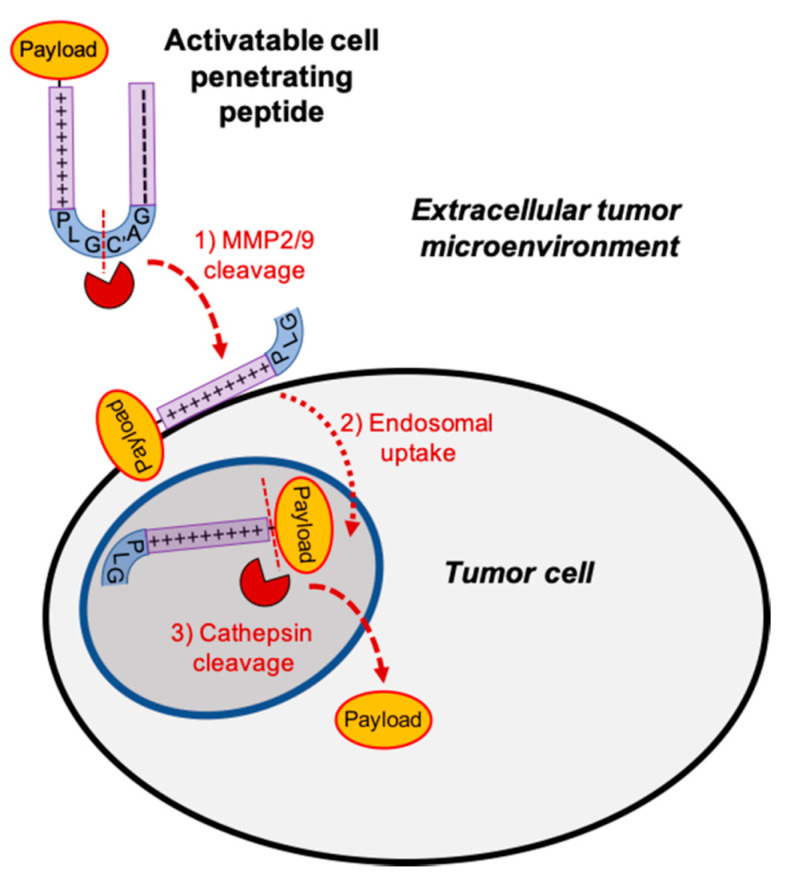
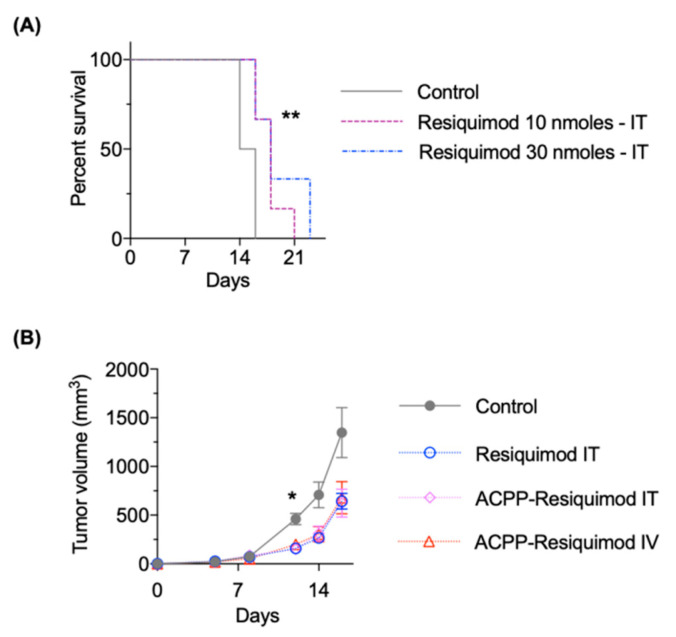
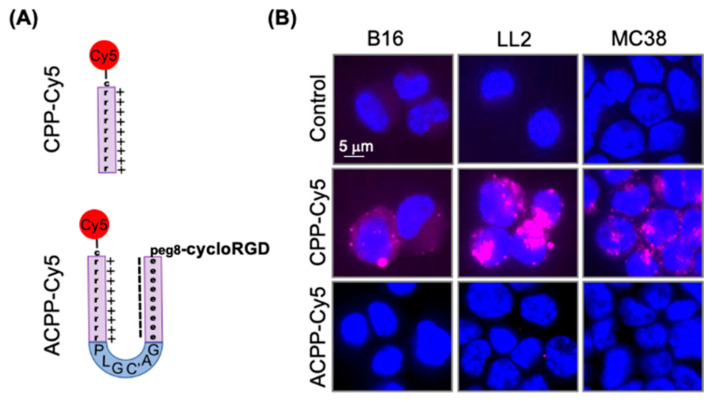
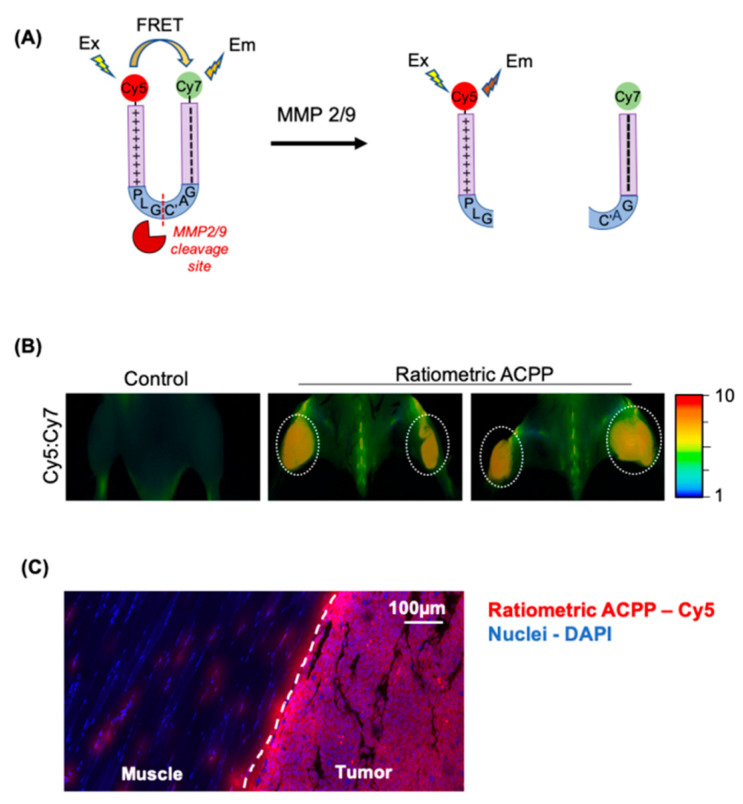
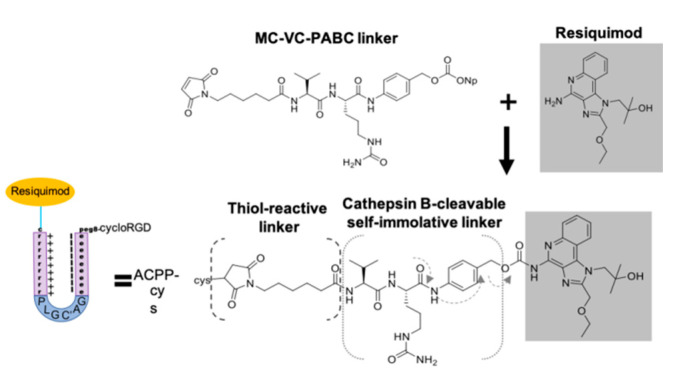
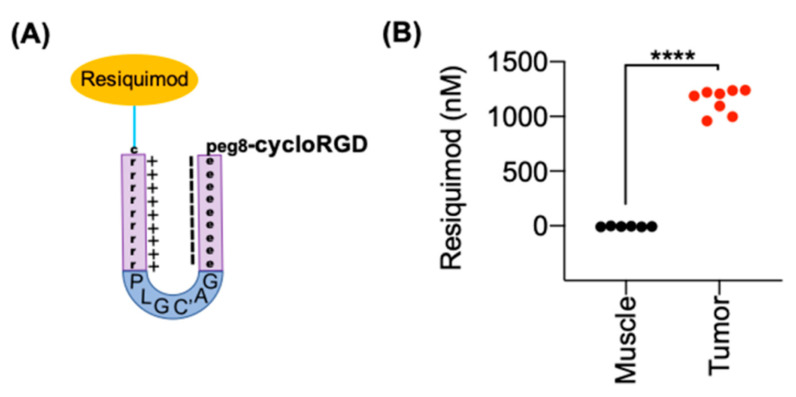
Recent advances in immunotherapy have revolutionized cancer therapy. Immunotherapies can engage the adaptive and innate arms of the immune system. Therapeutics targeting immune checkpoint inhibitors (i.e., CTLA-4; PD-1, and PD-L1) have shown efficacy for subsets of cancer patients by unleashing an adaptive antitumor immune response. Alternatively, small molecule immune modulators of the innate immune system such as toll-like receptor (TLR) agonists are being developed for cancer therapy. TLRs function as pattern recognition receptors to microbial products and are also involved in carcinogenesis. Reisquimod is a TLR 7/8 agonist that has antitumor efficacy. However, systemic delivery free resiquimod has proven to be challenging due to toxicity of nonspecific TLR 7/8 activation. Therefore, we developed a targeted peptide-drug conjugate strategy for systemic delivery of resiquimod. We designed an activatable cell penetrating peptide to deliver resiquimod specifically to the tumor tissue while avoiding normal tissues. The activatable cell penetrating peptide (ACPP) scaffold undergoes enzymatic cleavage by matrix metalloproteinases 2/9 in the extracellular matrix followed by intracellular lysosomal cathepsin B mediated release of the free resiquimod. Importantly, when conjugated to ACPP; the tumor tissue concentration of resiquimod was more than 1000-fold greater than that of surrounding non-cancerous tissue. Moreover, systemic ACPP-resiquimod delivery produced comparable therapeutic efficacy to localized free resiquimod in syngeneic murine tumors. These results highlight a precision peptide-drug conjugate delivery.
免疫疗法的最新进展彻底改变了癌症治疗方式。免疫疗法能够激活免疫系统的适应性免疫和固有免疫分支。针对免疫检查点抑制剂(即细胞毒性T淋巴细胞相关抗原4;程序性死亡受体1,以及程序性死亡受体配体1)的疗法,通过释放适应性抗肿瘤免疫反应,已在部分癌症患者中显示出疗效。另外,作为固有免疫系统小分子免疫调节剂的 toll样受体(TLR)激动剂也正在被开发用于癌症治疗。TLR作为微生物产物的模式识别受体,也参与肿瘤发生过程。瑞喹莫德是一种具有抗肿瘤疗效的TLR 7/8激动剂。然而,由于非特异性TLR 7/8激活的毒性,游离瑞喹莫德的全身给药已被证明具有挑战性。因此,我们开发了一种用于瑞喹莫德全身给药的靶向肽-药物偶联策略。我们设计了一种可激活的细胞穿透肽,将瑞喹莫德特异性递送至肿瘤组织,同时避开正常组织。可激活的细胞穿透肽(ACPP)支架在细胞外基质中被基质金属蛋白酶2/9酶解,随后通过细胞内溶酶体组织蛋白酶B介导释放游离的瑞喹莫德。重要的是,与ACPP偶联时,瑞喹莫德在肿瘤组织中的浓度比周围非癌组织高1000多倍。此外,ACPP-瑞喹莫德全身给药在同基因小鼠肿瘤中产生了与局部游离瑞喹莫德相当的治疗效果。这些结果突出了一种精准的肽-药物偶联递送方式。