Polverari Giulia, Ceci Francesco, Bertaglia Valentina, Reale Maria Lucia, Rampado Osvaldo, Gallio Elena, Passera Roberto, Liberini Virginia, Scapoli Paola, Arena Vincenzo, Racca Manuela, Veltri Andrea, Novello Silvia, Deandreis Désirée
Division of Nuclear Medicine, Department of Medical Sciences, University of Turin, AOU Città della Salute e della Scienza, 10126 Turin, Italy.
PET/CT Center, Affidea IRMET, 10135 Turin, Italy.
Cancers (Basel). 2020 May 5;12(5):1163. doi: 10.3390/cancers12051163.
(1.1) to evaluate the association between baseline 18F-FDG PET/CT semi-quantitative parameters of the primary lesion with progression free survival (PFS), overall survival (OS) and response to immunotherapy, in advanced non-small cell lung carcinoma (NSCLC) patients eligible for immunotherapy; (1.2) to evaluate the application of radiomics analysis of the primary lesion to identify features predictive of response to immunotherapy; (1.3) to evaluate if tumor burden assessed by 18F-FDG PET/CT (N and M factors) is associated with PFS and OS.
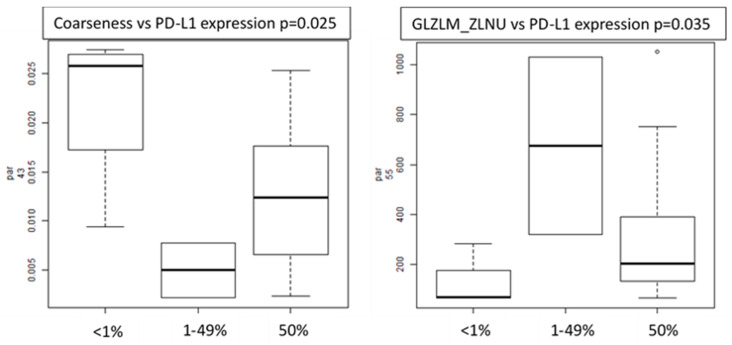
we retrospectively analyzed clinical records of advanced NCSLC patients (stage IIIb/c or stage IV) candidate to immunotherapy who performed 18F-FDG PET/CT before treatment to stage the disease. Fifty-seven (57) patients were included in the analysis (F:M 17:40; median age = 69 years old). Notably, 38/57 of patients had adenocarcinoma (AC), 10/57 squamous cell carcinoma (SCC) and 9/57 were not otherwise specified (NOS). Overall, 47.4% patients were stage IVA, 42.1% IVB and 8.8% IIIB. Immunotherapy was performed as front-line therapy in 42/57 patients and as second line therapy after chemotherapy platinum-based in 15/57. The median follow up after starting immunotherapy was 10 months (range: 1.5-68.6). Therapy response was assessed by RECIST 1.1 criteria (CT evaluation every 4 cycles of therapy) in 48/57 patients or when not feasible by clinical and laboratory data (fast disease progression or worsening of patient clinical condition in nine patients). Radiomics analysis was performed by applying regions of interest (ROIs) of the primary tumor delineated manually by two operators and semi-automatically applying a threshold at 40% of SUVmax.
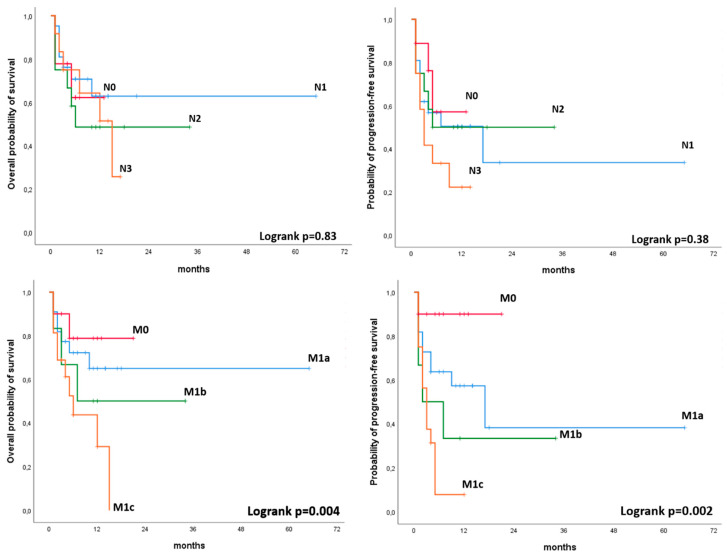
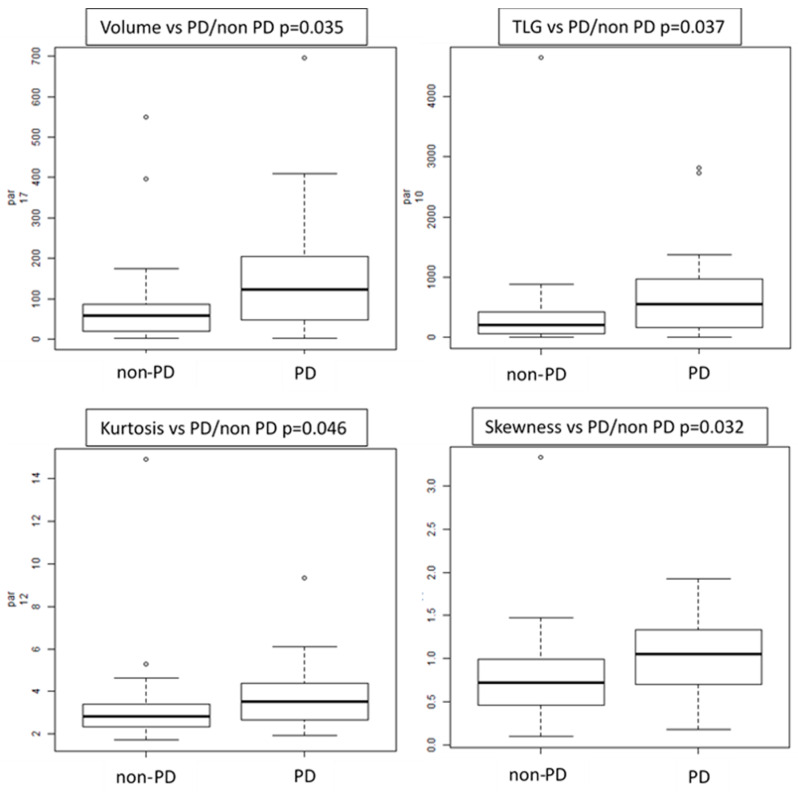
(1.1) metabolic tumor volume (MTV) ( = 0.028) and total lesion glycolysis (TLG) ( = 0.035) were significantly associated with progressive vs. non-progressive disease status. Patients with higher values of MTV and TLG had higher probability of disease progression, compared to those patients presenting with lower values. SUVmax did not show correlation with PD status, PFS and OS. MTV ( = 0.027) and TLG ( = 0.022) also resulted in being significantly different among PR, SD and PD groups, while SUVmax was confirmed to not be associated with response to therapy ( = 0.427). (1.2) We observed the association of several radiomics features with PD status. Namely, patients with high tumor volume, TLG and heterogeneity expressed by "skewness" and "kurtosis" had a higher probability of failing immunotherapy. (1.3) M status at 18F-FDG PET/CT was significantly associated with PFS ( = 0.002) and OS ( = 0.049). No significant associations were observed for N status.
18F-FDG PET/CT performed before the start of immunotherapy might be an important prognostic tool able to predict the disease progression and response to immunotherapy in patients with advanced NSCLC, since MTV, TLG and radiomics features (volume and heterogeneity) are associated with disease progression.
(1.1)评估在适合免疫治疗的晚期非小细胞肺癌(NSCLC)患者中,原发灶的基线18F-FDG PET/CT半定量参数与无进展生存期(PFS)、总生存期(OS)及免疫治疗反应之间的关联;(1.2)评估原发灶的放射组学分析在识别免疫治疗反应预测特征方面的应用;(1.3)评估通过18F-FDG PET/CT评估的肿瘤负荷(N和M因素)与PFS和OS是否相关。
我们回顾性分析了适合免疫治疗的晚期NSCLC患者(IIIb/c期或IV期)的临床记录,这些患者在治疗前进行了18F-FDG PET/CT以对疾病进行分期。57例患者纳入分析(女性:男性为17:40;中位年龄 = 69岁)。值得注意的是,57例患者中38例为腺癌(AC),10例为鳞状细胞癌(SCC),9例为其他未特指类型(NOS)。总体而言,47.4%的患者为IVA期,42.1%为IVB期,8.8%为IIIB期。42/57例患者将免疫治疗作为一线治疗,15/57例患者在铂类化疗后作为二线治疗。开始免疫治疗后的中位随访时间为10个月(范围:1.5 - 68.6个月)。48/57例患者根据RECIST 1.1标准(每4个治疗周期进行CT评估)评估治疗反应,另外9例患者若不可行则根据临床和实验室数据评估(疾病快速进展或患者临床状况恶化)。放射组学分析通过两名操作人员手动勾勒原发肿瘤的感兴趣区域(ROIs)并半自动应用SUVmax的40%作为阈值来进行。
(1.1)代谢肿瘤体积(MTV)( = 0.028)和总病变糖酵解(TLG)( = 0.035)与疾病进展与否显著相关。与MTV和TLG值较低的患者相比,MTV和TLG值较高的患者疾病进展的可能性更高。SUVmax与疾病进展状态、PFS和OS均无相关性。MTV( = 0.027)和TLG( = 0.022)在部分缓解(PR)、疾病稳定(SD)和疾病进展(PD)组之间也存在显著差异,而SUVmax被证实与治疗反应无关( = 0.427)。(1.2)我们观察到几个放射组学特征与疾病进展状态相关。具体而言,肿瘤体积大、TLG高以及由“偏度”和“峰度”表示的异质性高的患者免疫治疗失败的可能性更高。(1.3)18F-FDG PET/CT的M状态与PFS( = 0.002)和OS( = 0.049)显著相关。未观察到N状态有显著关联。
免疫治疗开始前进行的18F-FDG PET/CT可能是一种重要的预后工具,能够预测晚期NSCLC患者的疾病进展和免疫治疗反应,因为MTV、TLG和放射组学特征(体积和异质性)与疾病进展相关。