Ungefroren Hendrik, Christl Jessica, Eiden Caroline, Wellner Ulrich F, Lehnert Hendrik, Marquardt Jens-Uwe
First Department of Medicine, University Hospital Schleswig-Holstein, Campus Lübeck, D-23538 Lübeck, Germany.
Clinic for General Surgery, Visceral, Thoracic, Transplantation and Pediatric Surgery, University Hospital Schleswig-Holstein, Campus Kiel, D-24105 Kiel, Germany.
Cancers (Basel). 2021 Mar 17;13(6):1357. doi: 10.3390/cancers13061357.
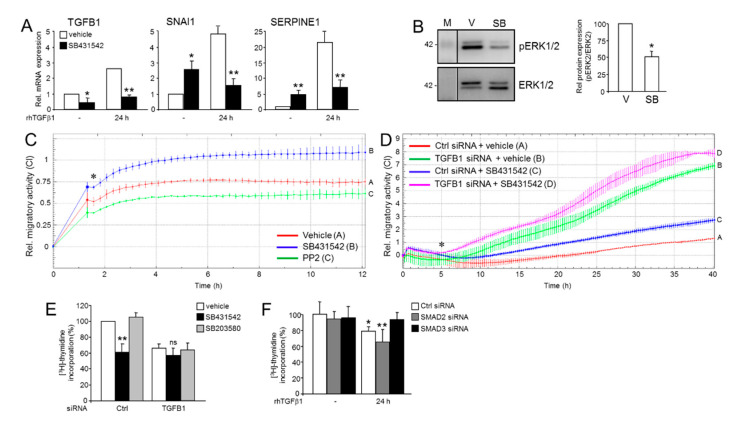
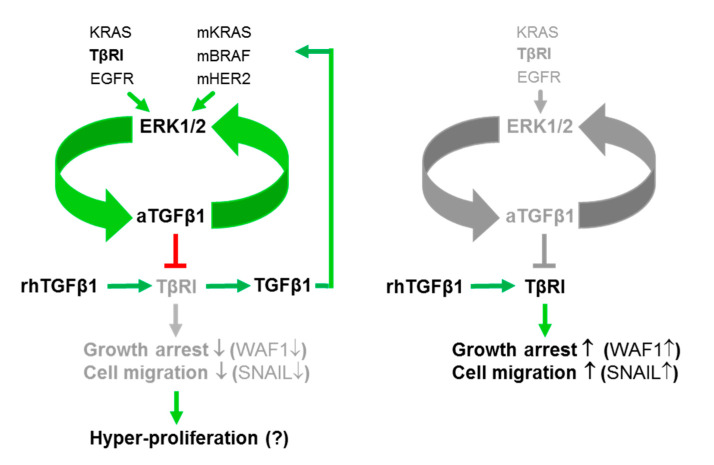
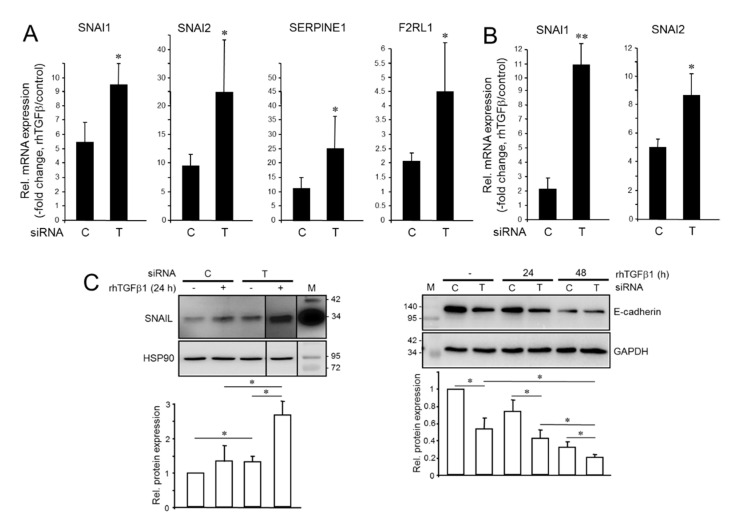
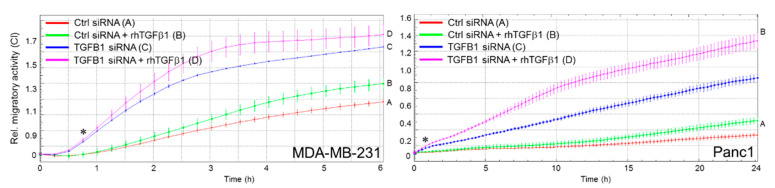
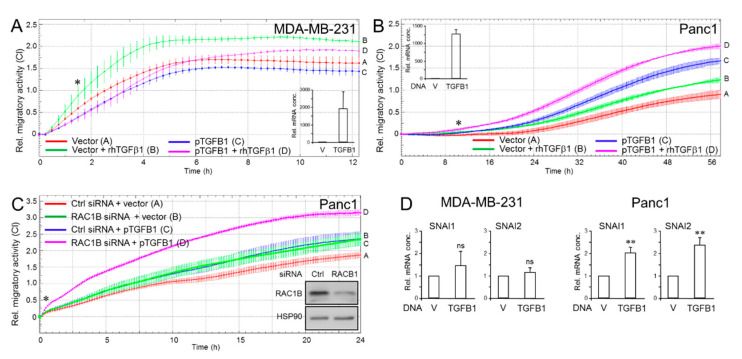
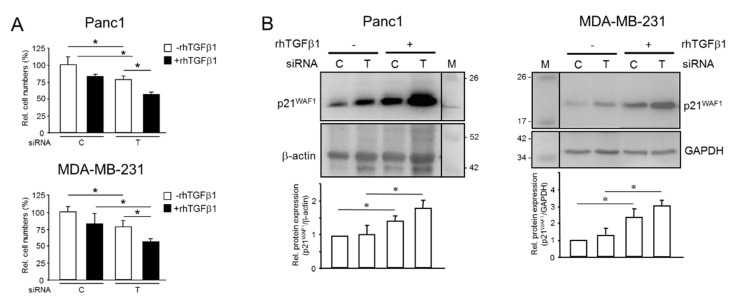
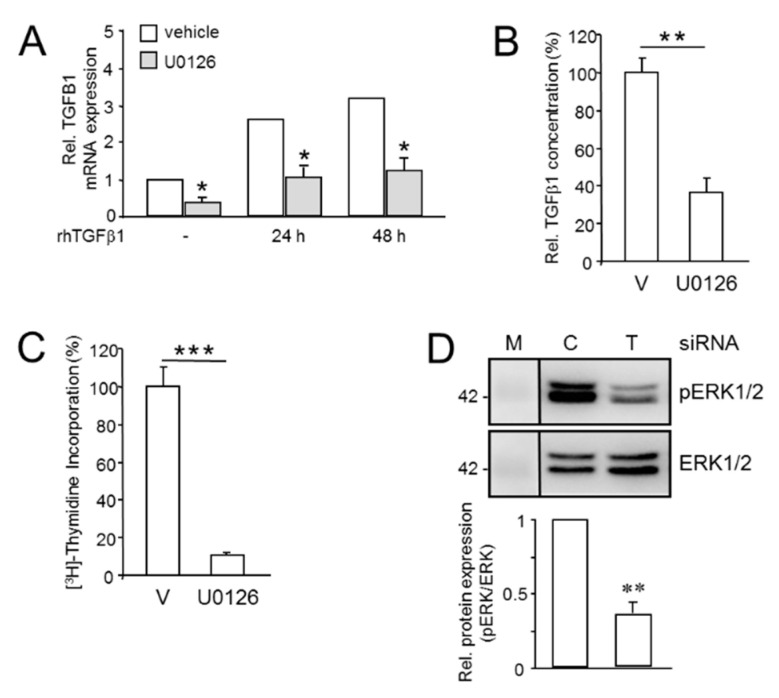
Autocrine transforming growth factor β (aTGFβ) has been implicated in the regulation of cell invasion and growth of several malignant cancers such as pancreatic ductal adenocarcinoma (PDAC) or triple-negative breast cancer (TNBC). Recently, we observed that endogenous can inhibit rather than stimulate cell motility in cell lines with high aTGFβ production and mutant KRAS, i.e., Panc1 (PDAC) and MDA-MB-231 (TNBC). The unexpected anti-migratory role prompted us to evaluate if aTGFβ1 may be able to antagonize the action of exogenous (recombinant human) TGFβ (rhTGFβ), a well-known promoter of cell motility and growth arrest in these cells. Surprisingly, RNA interference-mediated knockdown of the endogenous sensitized genes involved in EMT and cell motility (i.e., ) to up-regulation by rhTGFβ1, which was associated with a more pronounced migratory response following rhTGFβ1 treatment. Ectopic expression of decreased both basal and rhTGFβ1-induced migratory activities in MDA-MB-231 cells but had the opposite effect in Panc1 cells. Moreover, silencing reduced basal proliferation and enhanced growth inhibition by rhTGFβ1 and induction of cyclin-dependent kinase inhibitor, p21. Finally, we show that aTGFβ1 promotes MEK-ERK signaling and vice versa to form a self-perpetuating feedforward loop that is sensitive to SB431542, an inhibitor of the TGFβ type I receptor, ALK5. Together, these data suggest that in transformed cells an ALK5-MEK-ERK-aTGFβ1 pathway opposes the promigratory and growth-arresting function of rhTGFβ1. This observation has profound translational implications for TGFβ signaling in cancer.
自分泌转化生长因子β(aTGFβ)与多种恶性肿瘤(如胰腺导管腺癌(PDAC)或三阴性乳腺癌(TNBC))的细胞侵袭和生长调节有关。最近,我们观察到,在高aTGFβ产生和KRAS突变的细胞系中,即Panc1(PDAC)和MDA-MB-231(TNBC),内源性[此处原文缺失相关内容]可抑制而非刺激细胞运动。这种意外的抗迁移作用促使我们评估aTGFβ1是否能够拮抗外源性(重组人)TGFβ(rhTGFβ)的作用,rhTGFβ是这些细胞中众所周知的细胞运动和生长停滞促进因子。令人惊讶的是,RNA干扰介导的内源性[此处原文缺失相关内容]敲低使参与上皮-间质转化(EMT)和细胞运动的基因(即[此处原文缺失相关内容])对rhTGFβ1的上调敏感,这与rhTGFβ1处理后更明显的迁移反应相关。[此处原文缺失相关内容]的异位表达降低了MDA-MB-231细胞的基础迁移活性和rhTGFβ1诱导的迁移活性,但在Panc1细胞中具有相反的效果。此外,沉默[此处原文缺失相关内容]可降低基础增殖,并增强rhTGFβ1对生长的抑制作用以及细胞周期蛋白依赖性激酶抑制剂p21的诱导。最后,我们表明aTGFβ1促进MEK-ERK信号传导,反之亦然,形成一个对TGFβ I型受体ALK5的抑制剂SB431542敏感的自我延续的前馈环。总之,这些数据表明在转化细胞中,ALK5-MEK-ERK-aTGFβ1途径对抗rhTGFβ1的促迁移和生长停滞功能。这一观察结果对癌症中TGFβ信号传导具有深远的转化意义。