Costa Patrícia Daniela, Canaan Juliana Cristina Reis, Midori Castelo Paula, Campideli Fonseca Douglas, Márcia Pereira-Dourado Stela, Mendonça Murata Ramiro, Pardi Vanessa, Pereira Luciano José
Health Sciences Faculty, Universidade Federal de Lavras (UFLA), 37200-900 Lavras, Minas Gerais, Brazil.
Department of Pharmaceutical Sciences, Universidade Federal de São Paulo (UNIFESP), 09913-030 Diadema, São Paulo, Brazil.
Nutrients. 2021 Mar 17;13(3):973. doi: 10.3390/nu13030973.
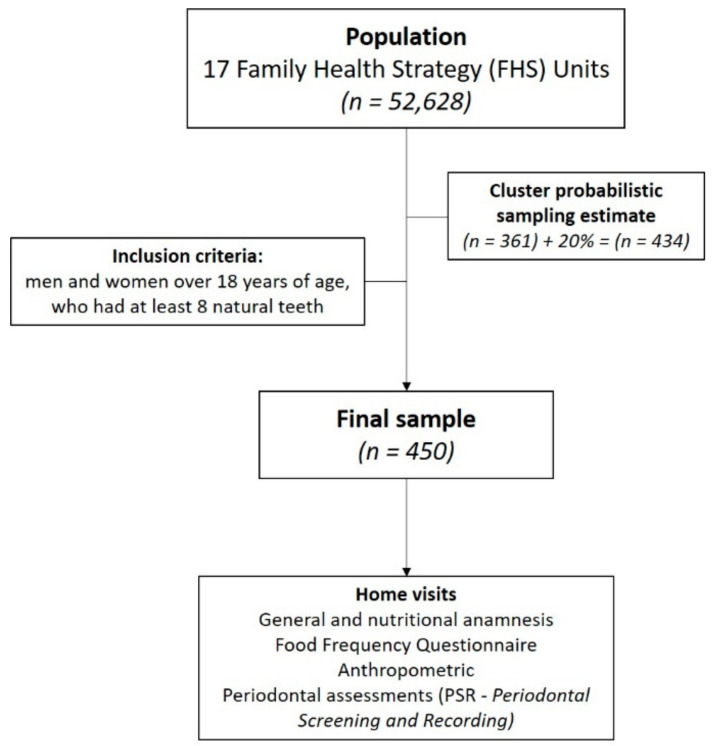
The lack of access to a balanced diet, rich in vitamins and minerals, can predispose people to inflammatory diseases such as obesity, diabetes mellitus, and periodontitis. We aimed to evaluate the relationship between micronutrient intake, sociodemographic behavioral characteristics, and periodontal health in adults assisted by a public health care system. Participants ( = 450) answered a food frequency questionnaire and were submitted to anthropometric and oral clinical examinations. Principal component analysis was used to summarize the number of components emerging from 17-micronutrient intake. Subsequently, cluster analysis was employed. The prevalence of at least one periodontal pocket ≥ 4 mm was 67.4%. Three clusters were identified according to periodontal status. Cluster 1 "poor periodontal status" was characterized by older individuals ( = 202; 85% females) with poor periodontal status, lower education level, mainly smokers with non-transmissible chronic diseases (NTCD), with lower energy, omega-3, fiber, Zn, K, Cu, and vitamin C intake. Cluster 3 "healthy periodontal status" included younger individuals ( = 54) with the healthiest periodontal status, a higher education level, without NTCD, and with higher energy, omega-3, fiber, Zn, calcium, retinol, and riboflavin intake. Cluster 2 was labeled as "intermediate periodontal status". Micronutrient ingestion was associated with periodontal status and may be considered in health promotion actions for low-income populations.
无法获取富含维生素和矿物质的均衡饮食会使人们易患肥胖症、糖尿病和牙周炎等炎症性疾病。我们旨在评估在公共卫生保健系统协助下的成年人中,微量营养素摄入量、社会人口行为特征与牙周健康之间的关系。参与者(n = 450)回答了一份食物频率问卷,并接受了人体测量和口腔临床检查。主成分分析用于总结从17种微量营养素摄入量中得出的成分数量。随后,采用了聚类分析。至少有一个牙周袋≥4毫米的患病率为67.4%。根据牙周状况确定了三个聚类。聚类1“牙周状况差”的特征是年龄较大的个体(n = 202;85%为女性),牙周状况差,教育水平较低,主要是患有非传染性慢性病(NTCD)的吸烟者,能量、ω-3、纤维、锌、钾、铜和维生素C摄入量较低。聚类3“牙周健康状况良好”包括年龄较小的个体(n = 54),牙周状况最健康,教育水平较高,无NTCD,能量、ω-3、纤维、锌、钙、视黄醇和核黄素摄入量较高。聚类2被标记为“牙周状况中等”。微量营养素摄入与牙周状况相关,在针对低收入人群的健康促进行动中可予以考虑。