Kreher Conlan, Favret Jacob, Maulik Malabika, Shin Daesung
Department of Biotechnical and Clinical Laboratory Sciences, Jacobs School of Medicine and Biomedical Sciences, University at Buffalo-SUNY, Buffalo, NY 14214, USA.
Hunter James Kelly Research Institute, Jacobs School of Medicine and Biomedical Sciences, University at Buffalo-SUNY, Buffalo, NY 14203, USA.
Biomolecules. 2021 Mar 9;11(3):400. doi: 10.3390/biom11030400.
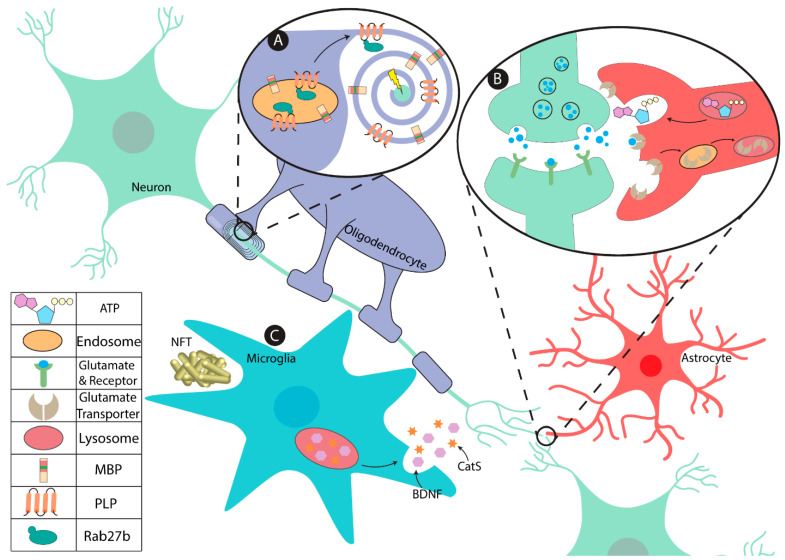
Lysosomes are cellular organelles that contain various acidic digestive enzymes. Despite their small size, they have multiple functions. Lysosomes remove or recycle unnecessary cell parts. They repair damaged cellular membranes by exocytosis. Lysosomes also sense cellular energy status and transmit signals to the nucleus. Glial cells are non-neuronal cells in the nervous system and have an active role in homeostatic support for neurons. In response to dynamic cues, glia use lysosomal pathways for the secretion and uptake of regulatory molecules, which affect the physiology of neighboring neurons. Therefore, functional aberration of glial lysosomes can trigger neuronal degeneration. Here, we review lysosomal functions in oligodendrocytes, astrocytes, and microglia, with emphasis on neurodegeneration.
溶酶体是含有各种酸性消化酶的细胞器。尽管它们体积小,但具有多种功能。溶酶体可清除或回收不需要的细胞成分。它们通过胞吐作用修复受损的细胞膜。溶酶体还能感知细胞的能量状态并向细胞核传递信号。神经胶质细胞是神经系统中的非神经元细胞,在对神经元的稳态支持中发挥着积极作用。响应动态信号,神经胶质细胞利用溶酶体途径分泌和摄取调节分子,这些分子会影响邻近神经元的生理功能。因此,神经胶质细胞溶酶体的功能异常可引发神经元变性。在此,我们综述少突胶质细胞、星形胶质细胞和小胶质细胞中的溶酶体功能,重点关注神经退行性变。