Kucova Pavla, Kantor Lumir, Fiserova Katerina, Lasak Jakub, Röderova Magdalena, Kolar Milan
Department of Microbiology, Faculty of Medicine and Dentistry, Palacky University Olomouc and University Hospital Olomouc, 779 00 Olomouc, Czech Republic.
Neonatal Department, University Hospital Olomouc, 779 00 Olomouc, Czech Republic.
Antibiotics (Basel). 2021 Mar 9;10(3):278. doi: 10.3390/antibiotics10030278.
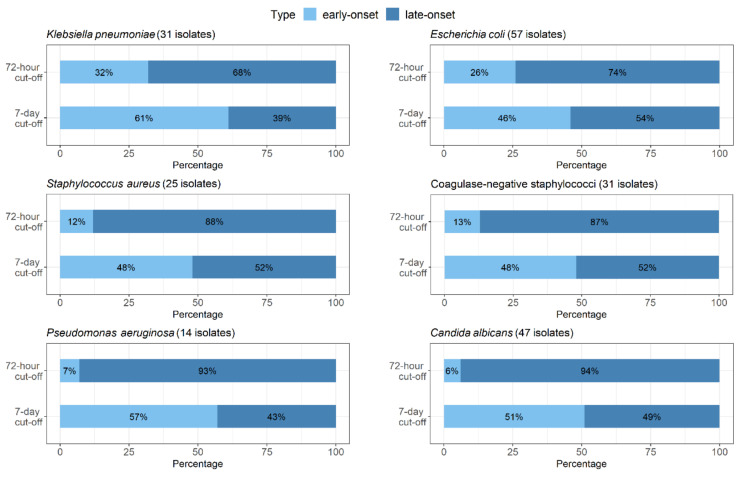
Bacterial infections are an important cause of mortality and morbidity in newborns. The main risk factors include low birth weight and prematurity. The study identified the most common bacterial pathogens causing neonatal infections including their resistance to antibiotics in the Neonatal Department of the University Hospital Olomouc. Additionally, the cut-off for distinguishing early- from late-onset neonatal infections was assessed. The results of this study show that a cut-off value of 72 h after birth is more suitable. Only in case of early-onset infections arising within 72 h of birth, initial antibiotic therapy based on gentamicin with ampicillin or amoxicillin/clavulanic acid may be recommended. It has been established that with the 72-h cut-off, late-onset infections caused by bacteria more resistant to antibiotics may be detected more frequently, a finding that is absolutely crucial for antibiotic treatment strategy.
细菌感染是新生儿死亡和发病的重要原因。主要风险因素包括低出生体重和早产。该研究在奥洛穆茨大学医院新生儿科确定了导致新生儿感染的最常见细菌病原体及其对抗生素的耐药性。此外,还评估了区分早发性和晚发性新生儿感染的界限。这项研究的结果表明,出生后72小时的界限更合适。仅在出生后72小时内发生的早发性感染情况下,可推荐基于庆大霉素联合氨苄西林或阿莫西林/克拉维酸的初始抗生素治疗。已经确定,采用72小时界限时,由对抗生素耐药性更强的细菌引起的晚发性感染可能会更频繁地被检测到,这一发现对抗生素治疗策略至关重要。