Translational Oncology Laboratory, Centre for Cancer Biology, SA Pathology and University of South Australia, Adelaide, SA 5001, Australia.
Clinical and Health Sciences, University of South Australia, Adelaide, SA 5001, Australia.
Cells. 2021 Mar 9;10(3):607. doi: 10.3390/cells10030607.
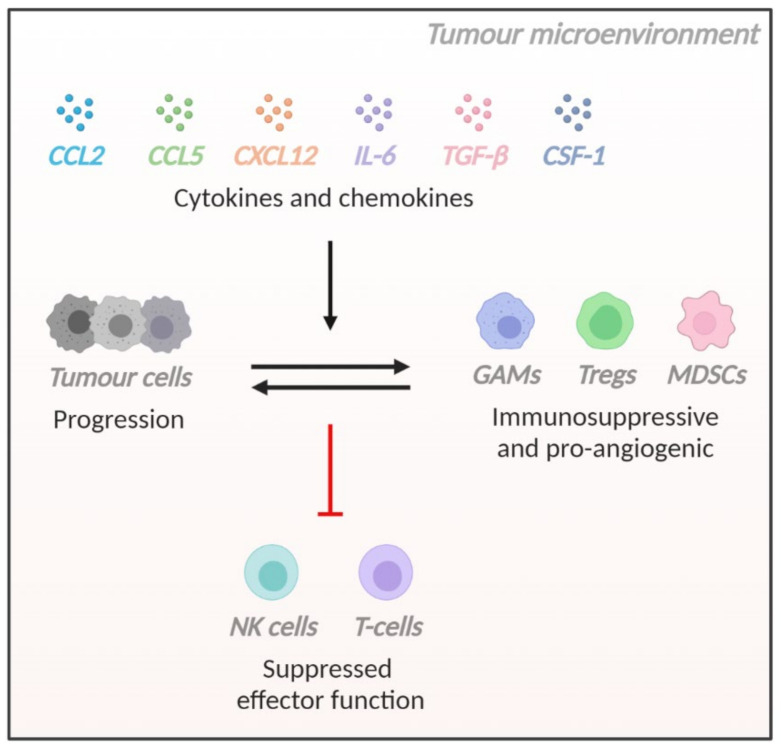
Glioblastoma is the most common form of primary brain tumour in adults. For more than a decade, conventional treatment has produced a relatively modest improvement in the overall survival of glioblastoma patients. The immunosuppressive mechanisms employed by neoplastic and non-neoplastic cells within the tumour can limit treatment efficacy, and this can include the secretion of immunosuppressive cytokines and chemokines. These factors can play a significant role in immune modulation, thus disabling anti-tumour responses and contributing to tumour progression. Here, we review the complex interplay between populations of immune and tumour cells together with defined contributions by key cytokines and chemokines to these intercellular interactions. Understanding how these tumour-derived factors facilitate the crosstalk between cells may identify molecular candidates for potential immunotherapeutic targeting, which may enable better tumour control and improved patient survival.
胶质母细胞瘤是成人中最常见的原发性脑肿瘤。十多年来,常规治疗对胶质母细胞瘤患者的总体生存率仅有相对较小的改善。肿瘤内的肿瘤细胞和非肿瘤细胞采用的免疫抑制机制可以限制治疗效果,这可能包括免疫抑制细胞因子和趋化因子的分泌。这些因素在免疫调节中起着重要作用,从而使抗肿瘤反应失活,并导致肿瘤进展。在这里,我们回顾了免疫细胞和肿瘤细胞群体之间的复杂相互作用,以及关键细胞因子和趋化因子对这些细胞间相互作用的明确贡献。了解这些肿瘤衍生因子如何促进细胞间的串扰,可能有助于确定潜在的免疫治疗靶点的分子候选物,从而更好地控制肿瘤并提高患者的生存率。