Di Pumpo Marcello, Vetrugno Giuseppe, Pascucci Domenico, Carini Elettra, Beccia Viria, Sguera Anna, Zega Maurizio, Pani Marcello, Cambieri Andrea, Nurchis Mario Cesare, D'Ambrosio Floriana, Damiani Gianfranco, Laurenti Patrizia
Section of Hygiene, University Department of Life Sciences and Public Health, Università Cattolica del Sacro Cuore, 00168 Roma, Italy.
Fondazione Policlinico Universitario A. Gemelli IRCCS, 00168 Roma, Italy.
Vaccines (Basel). 2021 Mar 18;9(3):276. doi: 10.3390/vaccines9030276.
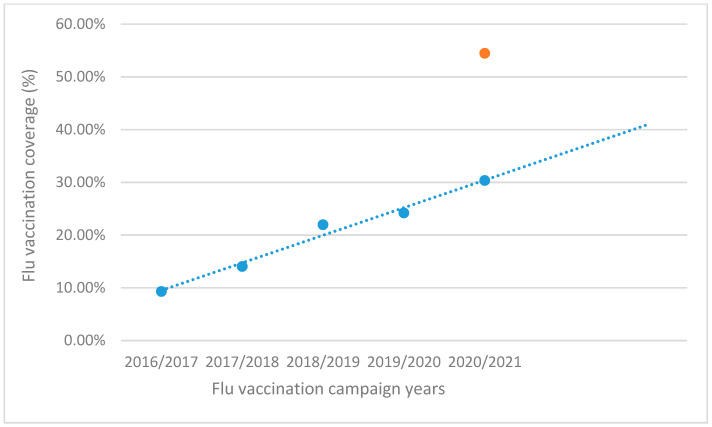
Seasonal flu vaccination is one of the most important strategies for preventing influenza. The attitude towards flu vaccination in light of the COVID-19 pandemic has so far been studied in the literature mostly with the help of surveys and questionnaires. Whether a person chooses to be vaccinated or not during the COVID-19 pandemic, however, speaks louder than any declaration of intention. In our teaching hospital, we registered a statistically significant increase in flu vaccination coverage across all professional categories between the 2019/2020 and the 2020/2021 campaign (24.19% vs. 54.56%, < 0.0001). A linear regression model, based on data from four previous campaigns, predicted for the 2020/2021 campaign a total flu vaccination coverage of 30.35%. A coverage of 54.46% was, instead, observed, with a statistically significant difference from the predicted value ( < 0.0001). The COVID-19 pandemic can, therefore, be considered as an incentive that significantly and dramatically increased adherence to flu vaccination among our healthcare workers.
季节性流感疫苗接种是预防流感最重要的策略之一。迄今为止,文献中大多借助调查和问卷研究了在新冠疫情背景下人们对流感疫苗接种的态度。然而,在新冠疫情期间一个人是否选择接种疫苗,比任何意向声明都更有说服力。在我们的教学医院,我们记录到在2019/2020年和2020/2021年流感疫苗接种活动期间,所有专业类别的流感疫苗接种覆盖率在统计学上有显著提高(24.19%对54.56%,<0.0001)。基于前四次活动的数据建立的线性回归模型预测2020/2021年活动的流感疫苗接种总覆盖率为30.35%。相反,观察到的覆盖率为54.46%,与预测值有统计学显著差异(<0.0001)。因此,可以认为新冠疫情是一种激励因素,它显著且大幅提高了我们医护人员对流感疫苗接种的依从性。