Polio Eradication Branch, Centers for Disease Control and Prevention, Global Immunization Division, Atlanta, GA 30329, USA.
Polio and Picornavirus Laboratory Branch, Centers for Disease Control and Prevention, Division of Viral Diseases, Atlanta, GA 30329, USA.
Viruses. 2021 Mar 18;13(3):505. doi: 10.3390/v13030505.
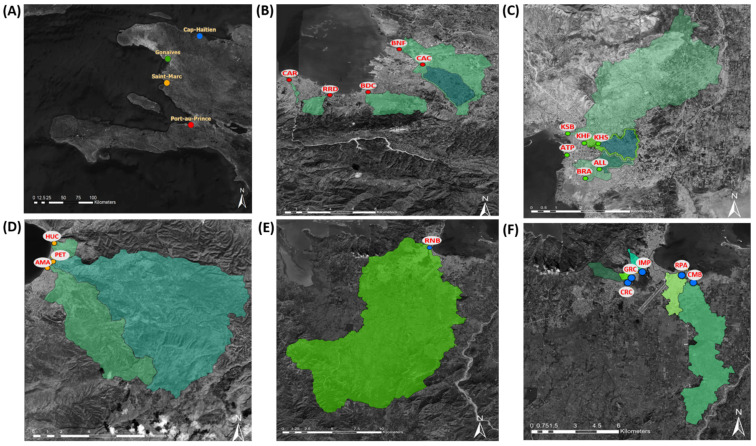
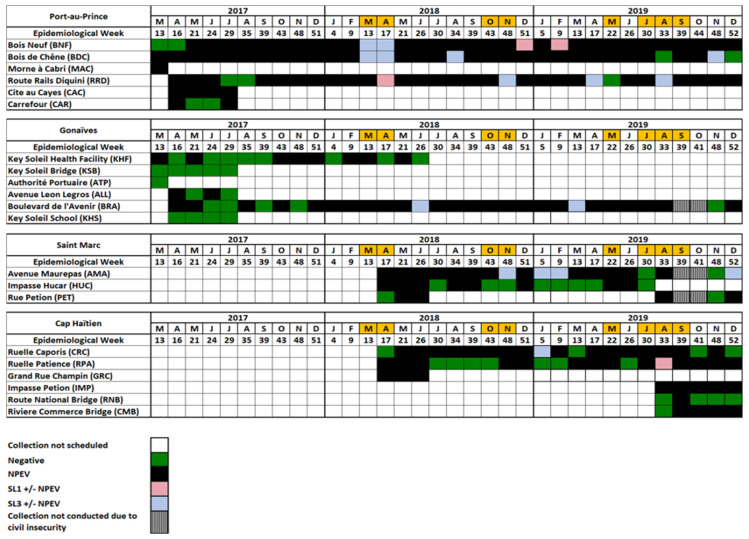
Haïti is at risk for wild poliovirus (WPV) importation and circulation, as well as vaccine-derived poliovirus (VDPV) emergence. Environmental surveillance (ES) for polioviruses was established in Port au Prince and Gonaïves in 2016. During 2017-2019, initial ES sites were re-evaluated, and ES was expanded into Cap Haïtien and Saint Marc. Wastewater samples and data on weather, hour of collection, and sample temperature and pH were collected every 4 weeks during March 2017-December 2019 (272 sampling events) from 21 sites in Cap Haïtien, Gonaïves, Port au Prince, and Saint Marc. Samples were processed for the detection of polio and non-polio enteroviruses using the two-phase and "Concentration and Filter Elution" methodologies. Polioviruses were serotyped and underwent intra-typic characterization. No WPV or VDPVs were isolated. Sabin-like polioviruses (oral vaccine strain) of serotypes 1 and 3 were sporadically detected. Five of six (83%), one of six (17%), five of six (83%), and two of three (67%) sites evaluated in Cap Haïtien, Gonaïves, Port au Prince, and Saint Marc, respectively, had enterovirus isolation from >50% of sampling events; these results and considerations, such as watershed population size and overlap, influence of sea water, and excessive particulates in samples, were factors in site retention or termination. The evaluation of 21 ES sampling sites in four Haïtian cities led to the termination of 11 sites. Every-four-weekly sampling continues at the remaining 10 sites across the four cities as a core Global Polio Eradication Initiative activity.
海地存在野生脊灰病毒(WPV)输入和传播以及疫苗衍生脊灰病毒(VDPV)出现的风险。2016 年在太子港和戈纳伊夫建立了脊灰病毒环境监测(ES)。2017-2019 年,重新评估了初始 ES 地点,并将 ES 扩展到海地角和圣马克。2017 年 3 月至 2019 年 12 月期间,每隔 4 周从海地角、戈纳伊夫、太子港和圣马克的 21 个地点采集污水样本,并收集有关天气、采集时间以及样本温度和 pH 值的数据(共 272 次采样)。使用两相和“浓缩和过滤洗脱”方法检测脊灰和非脊灰肠道病毒。对脊灰病毒进行血清型鉴定和种内特征分析。未分离到 WPV 或 VDPV。1 型和 3 型的类似萨宾脊灰病毒(口服疫苗株)偶尔被检出。在海地角、戈纳伊夫、太子港和圣马克,分别有 6 个地点中的 5 个(83%)、6 个中的 1 个(17%)、6 个中的 5 个(83%)和 3 个中的 2 个(67%)地点从超过 50%的采样事件中分离出肠道病毒;这些结果以及流域人口规模和重叠、海水影响以及样本中过多的颗粒物等考虑因素,是保留或终止采样点的因素。对海地四个城市的 21 个 ES 采样点进行评估后,有 11 个采样点被终止。四个城市的其余 10 个采样点仍继续每四周进行采样,这是全球根除脊灰行动的核心活动。