Zhou Jun-Yu, Park Sunmin
Department of Bio-Convergence System, Hoseo University, Asan 31499, Korea.
Department of Food and Nutrition, College of Life and Health Sciences, Hoseo University, Asan 31499, Korea.
J Pers Med. 2021 Mar 15;11(3):207. doi: 10.3390/jpm11030207.
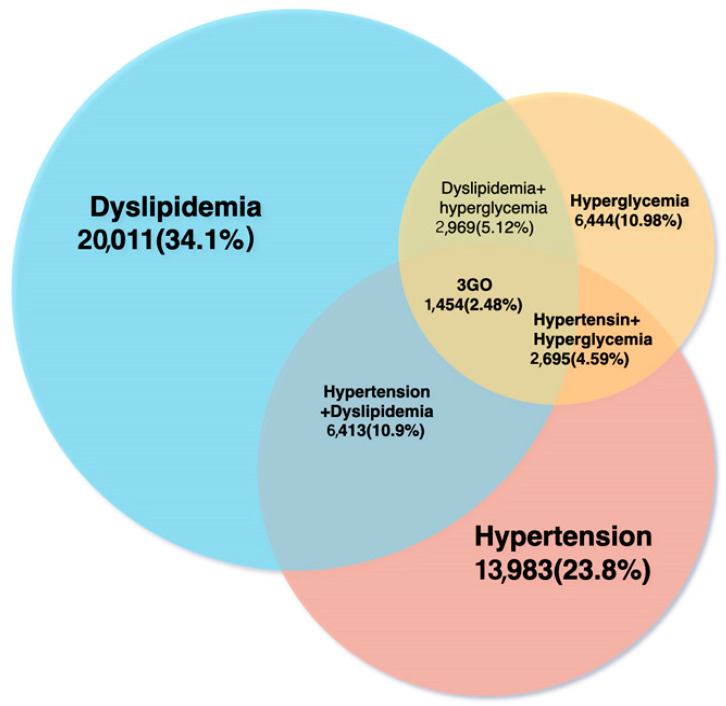
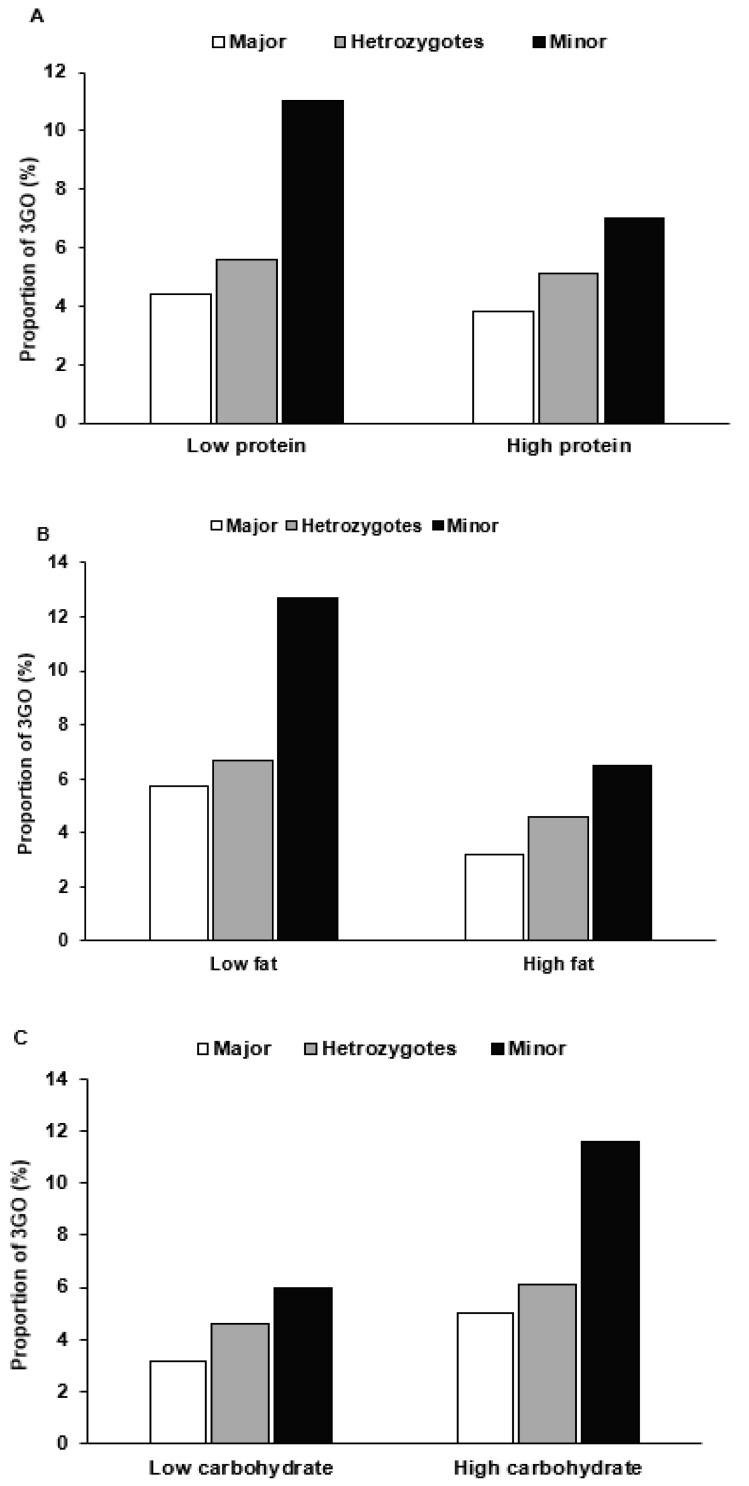
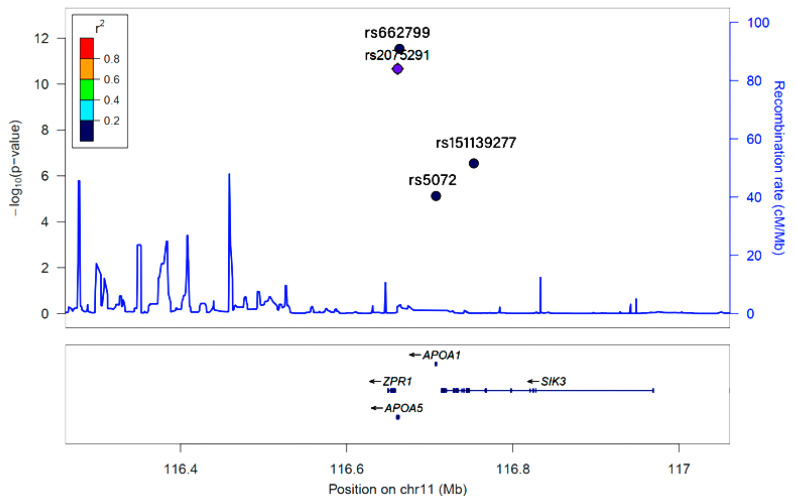
3GO is a condition in which hypertension, hyperglycemia, and dyslipidemia co-occur, and these conditions are related to each other and genetic and environmental factors. We hypothesized that common genetic variants and their interactions with lifestyles influenced 3GO risk. We aimed to explore common genetic variants to affect 3GO risk and their haplotype interaction with lifestyles in a city hospital-based cohort in 58,701 Koreans > 40 years. 3GO was defined as SBP ≥ 140 mmHg and DBP ≥ 90 mmHg for hypertension, fasting blood glucose ≥ 126 mg/dL for hyperglycemia, and LDL ≥ 160 mg/dL or HDL ≤ 40 mg/dL, or triglyceride ≥ 200 mg/dL for dyslipidemia. Haplotypes were generated by genetic variants selected from genome-wide association study ((GWAS) an observational study of the genetic variation of the whole genome in different individuals, used to see if any variation is related to traits) after adjusting for age, sex, area of residence, and body mass index (BMI). Nutrient intakes were assessed using food frequency questionnaires. Interactions between haplotype and lifestyles and 3GO risk were investigated. Parameters related to metabolic syndrome were significantly different in the 0GO, 1-2GO, and 3GO groups, that is, groups of individuals with none, one to two, or all three of the components of 3GO. At the 11q23 locus, _rs2237892, _rs2075291, _rs662799, _rs5072, and _rs151139277, influenced 3GO risk, and the minor alleles of their haplotype had a 3GO risk 3.23 times higher than the major alleles. For subjects with a high energy intake, the 3GO risk of the minor alleles was significantly higher than that of the major alleles (OR = 3.230, 95% confidence interval (CI) = 2.062~5.061, < 0.001). BMI, HbA1c, SBP, and serum concentrations of glucose, HDL, and triglyceride were significantly higher for the minor allele than the major alleles ( < 0.001). The haplotype interacted with the intakes of protein ( = 0.033), digestible carbohydrate ( = 0.012), fat ( = 0.008), and undigestible carbohydrates ( = 0.015) to increase 3GO risk. An interaction was also observed between smoking and the haplotype ( = 0.007). The minor allele effects on 3GO incidence were higher in the high digestible carbohydrate intake and smoking groups. By contrast, the minor allele impacts on 3GO frequencies were much higher in the low intake of undigestible carbohydrates, protein, and fat. In conclusion, people who carry a minor allele of the 11q23 locus haplotype should avoid smoking and replace digestible carbohydrate intake with consuming high-quality protein, healthy fat, and undigestible carbohydrates.
三组分代谢综合征(3GO)是一种高血压、高血糖和血脂异常同时出现的病症,这些病症相互关联,且与遗传和环境因素有关。我们假设常见的基因变异及其与生活方式的相互作用会影响3GO风险。我们旨在探索影响3GO风险的常见基因变异及其在一个以城市医院为基础的队列中与58701名40岁以上韩国人的生活方式的单倍型相互作用。3GO被定义为:高血压为收缩压≥140 mmHg且舒张压≥90 mmHg,高血糖为空腹血糖≥126 mg/dL,血脂异常为低密度脂蛋白≥160 mg/dL或高密度脂蛋白≤40 mg/dL,或甘油三酯≥200 mg/dL。单倍型由从全基因组关联研究(GWAS,对不同个体的全基因组遗传变异进行的观察性研究,用于查看是否有任何变异与性状相关)中选择的基因变异生成,同时对年龄、性别、居住地区和体重指数(BMI)进行了校正。使用食物频率问卷评估营养摄入量。研究了单倍型与生活方式和3GO风险之间的相互作用。与代谢综合征相关的参数在0GO、1 - 2GO和3GO组中存在显著差异,即分别为无3GO组分、有一到两个3GO组分或有全部三个3GO组分的个体组。在11q23位点,_rs2237892、_rs2075291、_rs662799、_rs5072和_rs151139277影响3GO风险,其单倍型的次要等位基因的3GO风险比主要等位基因高3.23倍。对于高能量摄入的受试者,次要等位基因的3GO风险显著高于主要等位基因(比值比 = 3.230,95%置信区间(CI) = 2.062~5.061,P < 0.001)。次要等位基因的BMI、糖化血红蛋白、收缩压以及血糖、高密度脂蛋白和甘油三酯的血清浓度显著高于主要等位基因(P < 0.001)。该单倍型与蛋白质摄入量(P = 0.033)、可消化碳水化合物摄入量(P = 0.012)、脂肪摄入量(P = 0.008)和不可消化碳水化合物摄入量(P = 0.015)相互作用,增加3GO风险。还观察到吸烟与单倍型之间存在相互作用(P = 0.007)。在高可消化碳水化合物摄入量和吸烟组中,次要等位基因对3GO发病率的影响更高。相比之下,在低不可消化碳水化合物、蛋白质和脂肪摄入量组中,次要等位基因对3GO频率的影响要高得多。总之,携带11q23位点单倍型次要等位基因的人应避免吸烟,并用高质量蛋白质、健康脂肪和不可消化碳水化合物替代可消化碳水化合物的摄入。