Wu Zhengwei, Lee Yi Fei, Yeo Xun Hui, Loo Ser Yue, Tam Wai Leong
Cancer Science Institute of Singapore, National University of Singapore, 14 Medical Drive, Singapore 117599, Singapore.
Genome Institute of Singapore, 60 Biopolis Street, Singapore 138672, Singapore.
Cancers (Basel). 2021 Mar 15;13(6):1316. doi: 10.3390/cancers13061316.
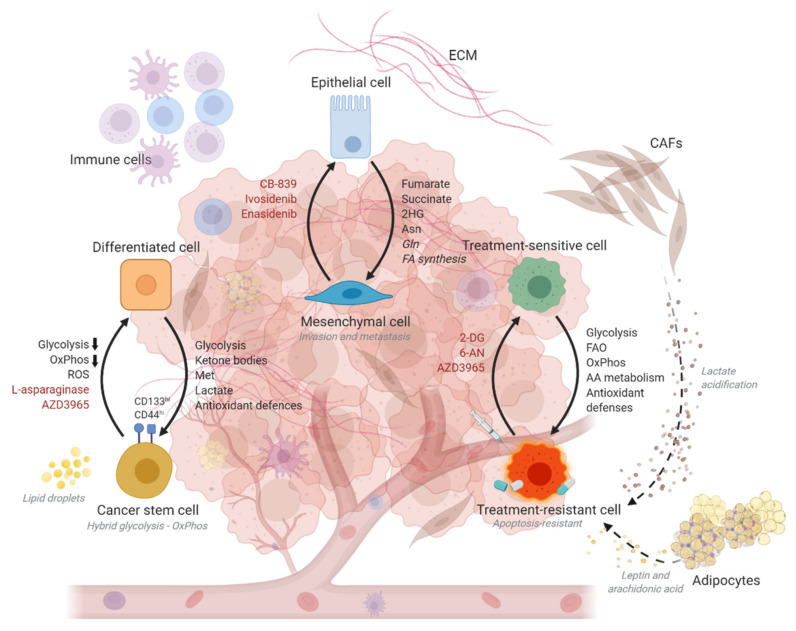
Cancer metabolism is a hallmark of cancer. Metabolic plasticity defines the ability of cancer cells to reprogram a plethora of metabolic pathways to meet unique energetic needs during the various steps of disease progression. Cell state transitions are phenotypic adaptations which confer distinct advantages that help cancer cells overcome progression hurdles, that include tumor initiation, expansive growth, resistance to therapy, metastasis, colonization, and relapse. It is increasingly appreciated that cancer cells need to appropriately reprogram their cellular metabolism in a timely manner to support the changes associated with new phenotypic cell states. We discuss metabolic alterations that may be adopted by cancer cells in relation to the maintenance of cancer stemness, activation of the epithelial-mesenchymal transition program for facilitating metastasis, and the acquisition of drug resistance. While such metabolic plasticity is harnessed by cancer cells for survival, their dependence and addiction towards certain metabolic pathways also present therapeutic opportunities that may be exploited.
癌症代谢是癌症的一个标志。代谢可塑性定义了癌细胞在疾病进展的各个阶段重新编程大量代谢途径以满足独特能量需求的能力。细胞状态转变是表型适应,赋予癌细胞明显优势,有助于其克服进展障碍,包括肿瘤起始、扩张性生长、对治疗的抗性、转移、定植和复发。人们越来越认识到,癌细胞需要及时适当地重新编程其细胞代谢,以支持与新的表型细胞状态相关的变化。我们讨论了癌细胞可能采用的代谢改变,这些改变与癌症干性的维持、促进转移的上皮-间质转化程序的激活以及耐药性的获得有关。虽然癌细胞利用这种代谢可塑性来生存,但它们对某些代谢途径的依赖性和成瘾性也提供了可能被利用的治疗机会。