Vernot Jean Paul
Facultad de Medicina, Universidad Nacional de Colombia, Bogotá, Colombia.
Front Mol Biosci. 2020 May 13;7:63. doi: 10.3389/fmolb.2020.00063. eCollection 2020.
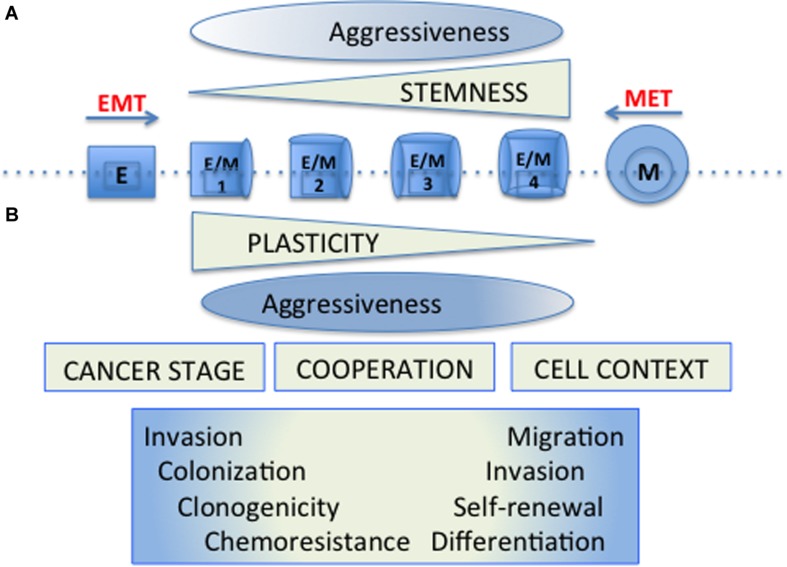
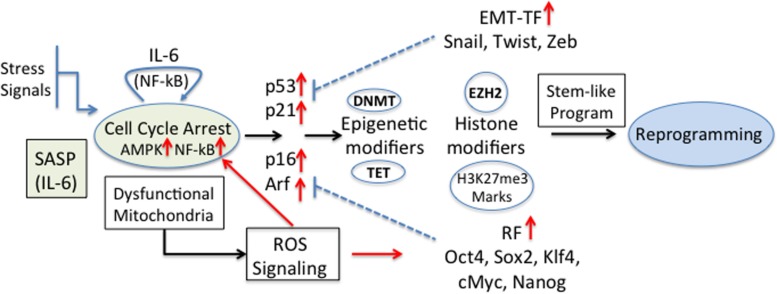
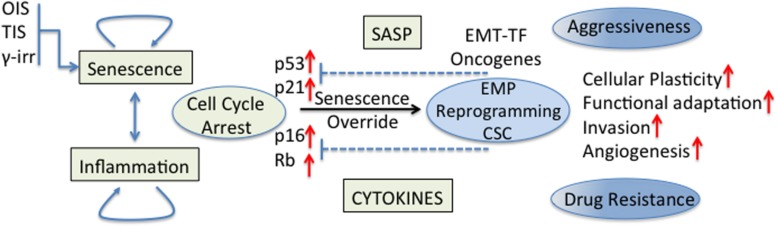
The well-recognized cell phenotypic heterogeneity in tumors is a great challenge for cancer treatment. Dynamic interconversion and movement within a spectrum of different cell phenotypes (cellular plasticity) with the acquisition of specific cell functions is a fascinating biological puzzle, that represent an additional difficulty for cancer treatment and novel therapies development. The understanding of the molecular mechanisms responsible for moving or stabilizing tumor cells within this spectrum of variable states constitutes a valuable tool to overcome these challenges. In particular, cell transitions between epithelial and mesenchymal phenotypes (EMT-MET) and de-and -differentiation processes are relevant, since it has been shown that they confer invasiveness, drug resistance, and metastatic ability, due to the simultaneous acquisition of stem-like cell properties. Multiple drivers participate in these cell conversions events. In particular, cellular senescence and senescence-associated soluble factors have been shown to unveil stem-like cell properties and cell plasticity. By modulating gradually the composition of their secretome and the time of exposure, senescent cells may have differential effect not only on tumor cells but also on surrounding cells. Intriguingly, tumor cells that scape from senescence acquire stem-like cell properties and aggressiveness. The reinforcement of senescence and inflammation by soluble factors and the participation of immune cells may provide a dynamic milieu having varied effects on cell transitions, reprogramming, plasticity, stemness and therefore heterogeneity. This will confer different epithelial/mesenchymal traits (hybrid phenotype) and stem-like cell properties, combinations of which, in a particular cell context, could be responsible for different cellular functions during cancer progression (survival, migration, invasion, colonization or proliferation). Additionally, cooperative behavior between cell subpopulations with different phenotypes/stemness functions could also modulate their cellular plasticity. Here, we will discuss the role of senescence and senescence-associated pro-inflammatory cytokines on the induction of cellular plasticity, their effect role in establishing particular states within this spectrum of cell phenotypes and how this is accompanied by stem-like cell properties that, as the epithelial transitions, may also have a continuum of characteristics providing tumor cells with functional adaptability specifically useful in the different stages of carcinogenesis.
肿瘤中公认的细胞表型异质性是癌症治疗的巨大挑战。在不同细胞表型谱(细胞可塑性)内的动态相互转化和移动以及获得特定细胞功能是一个引人入胜的生物学谜题,这给癌症治疗和新疗法开发带来了额外困难。理解负责在这个可变状态谱内移动或稳定肿瘤细胞的分子机制是克服这些挑战的宝贵工具。特别是,上皮和间充质表型之间的细胞转变(EMT-MET)以及去分化和再分化过程很重要,因为已表明它们由于同时获得干细胞样特性而赋予侵袭性、耐药性和转移能力。多种驱动因素参与这些细胞转化事件。特别是,细胞衰老和衰老相关的可溶性因子已被证明可揭示干细胞样特性和细胞可塑性。通过逐渐调节其分泌组的组成和暴露时间,衰老细胞不仅可能对肿瘤细胞而且对周围细胞产生不同影响。有趣的是,逃脱衰老的肿瘤细胞获得干细胞样特性和侵袭性。可溶性因子对衰老和炎症的增强以及免疫细胞的参与可能提供一个对细胞转变、重编程、可塑性、干性以及因此的异质性有不同影响的动态环境。这将赋予不同的上皮/间充质特征(混合表型)和干细胞样特性,在特定细胞背景下它们的组合可能在癌症进展过程中(存活、迁移、侵袭、定植或增殖)负责不同的细胞功能。此外,具有不同表型/干性功能的细胞亚群之间的协同行为也可能调节它们的细胞可塑性。在这里我们将讨论衰老和衰老相关促炎细胞因子在诱导细胞可塑性中的作用、它们在建立这个细胞表型谱内特定状态中的作用以及这如何伴随着干细胞样特性,如同上皮转变一样这些特性也可能具有一系列特征从而赋予肿瘤细胞在致癌作用不同阶段特别有用的功能适应性。