Wang Lifang, Choi Hack Sun, Lee Binna, Choi Jong Hyun, Jang Yong-Suk, Seo Jeong-Woo
Microbial Biotechnology Research Center, Korea Research Institute of Bioscience and Biotechnology (KRIBB), Jeongeup-Si 56212, Korea.
Department of Bioactive Material Sciences and the Institute for Molecular Biology and Genetics, Jeonbuk National University, Jeonju 54896, Korea.
Antioxidants (Basel). 2021 Mar 15;10(3):457. doi: 10.3390/antiox10030457.
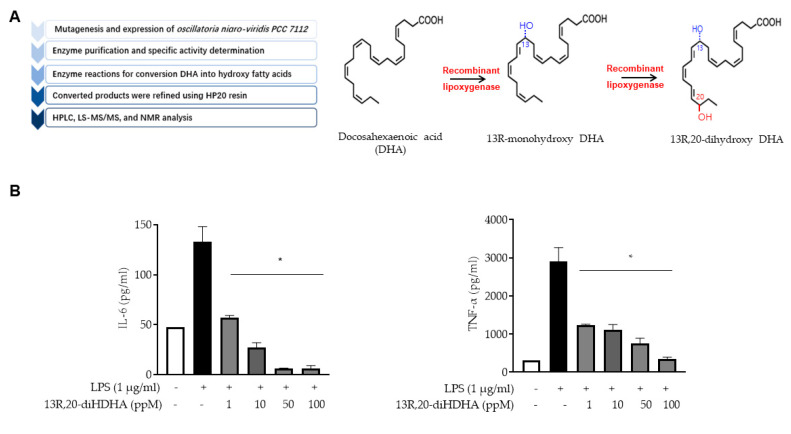
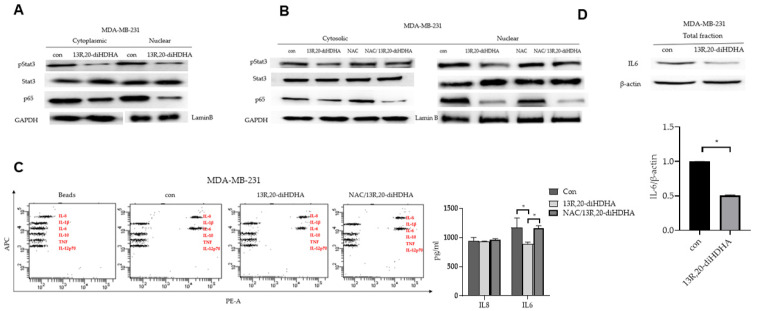
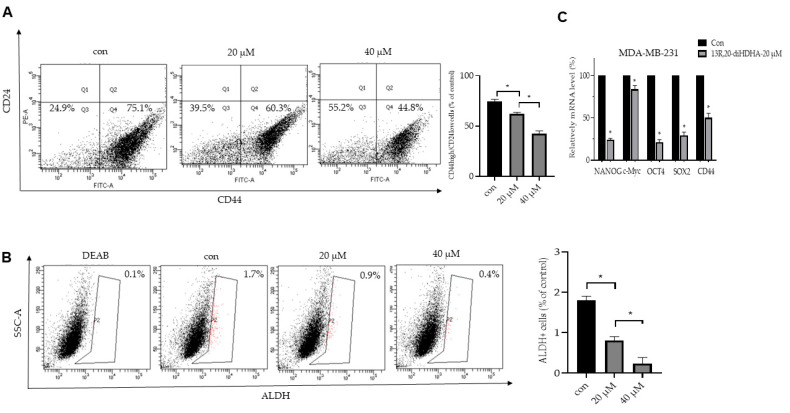
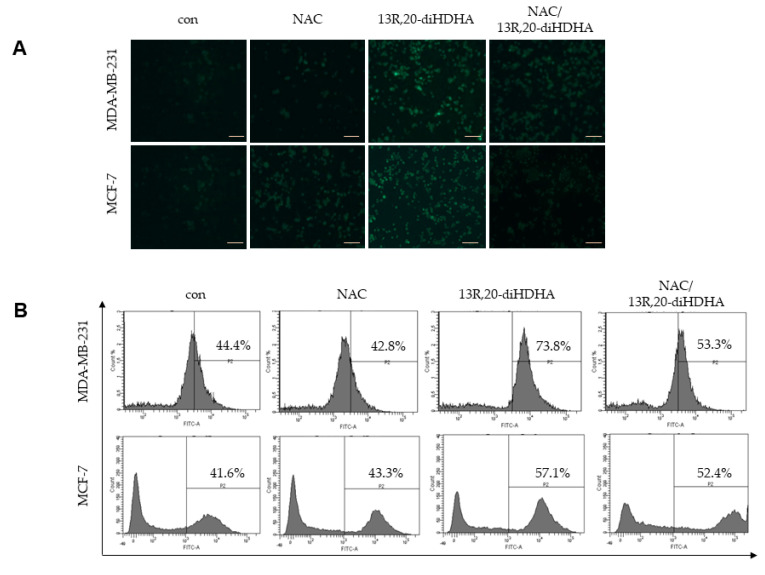
Breast cancer is a major health problem worldwide. Cancer stem cells (CSCs) are known to mediate breast cancer metastasis and recurrence and are therefore a promising therapeutic target. In this study, we investigated the anti-inflammatory effect of 13R,20-dihydroxydocosahexaenoic acid (13,20-diHDHA), a novel dihydroxy-DHA derivative, which was synthesized through an enzymatic reaction using cyanobacterial lipoxygenase. We found that 13,20-diHDHA reduced the macrophage secretion of the inflammatory cytokines, IL-6 and TNF-α, and thus appeared to have anti-inflammatory effects. As the inflammatory tumor microenvironment is largely devoted to supporting the cancer stemness of breast cancer cells, we investigated the effect of 13R,20-diHDHA on breast cancer stemness. Indeed, 13,20-diHDHA effectively inhibited breast cancer stemness, as evidenced by its ability to dose-dependently inhibit the mammospheres formation, colony formation, migration, and invasion of breast CSCs. 13,20-diHDHA reduced the populations of CD44/CD24 and aldehyde dehydrogenase (ALDH)-positive cells and the expression levels of the cancer stemness-related self-renewal genes, Nanog, Sox2, Oct4, c-Myc, and CD44. 13R,20-diHDHA increased reactive oxygen species (ROS) production, and the generated ROS reduced the phosphorylation of nuclear signal transducer and activator of transcription 3 (Stat3) and the secretion of IL-6 by mammospheres. These data collectively suggest that 13,20-diHDHA inhibits breast cancer stemness through ROS production and downstream regulation of Stat3/IL-6 signaling, and thus might be developed as an anti-cancer agent acting against CSCs.
乳腺癌是全球主要的健康问题。已知癌症干细胞(CSCs)介导乳腺癌转移和复发,因此是一个有前景的治疗靶点。在本研究中,我们研究了13R,20 - 二羟基二十二碳六烯酸(13,20 - diHDHA)的抗炎作用,13,20 - diHDHA是一种新型二羟基DHA衍生物,通过使用蓝藻脂氧合酶的酶促反应合成。我们发现13,20 - diHDHA可减少炎性细胞因子IL - 6和TNF -α的巨噬细胞分泌,因此似乎具有抗炎作用。由于炎性肿瘤微环境在很大程度上致力于支持乳腺癌细胞的癌干性,我们研究了13R,20 - diHDHA对乳腺癌癌干性的影响。事实上,13,20 - diHDHA有效抑制乳腺癌癌干性,这可通过其剂量依赖性抑制乳腺CSCs的球状体形成、集落形成、迁移和侵袭的能力得到证明。13,20 - diHDHA减少了CD44/CD24和醛脱氢酶(ALDH)阳性细胞的数量以及癌干性相关自我更新基因Nanog、Sox2、Oct4、c - Myc和CD44的表达水平。13R,20 - diHDHA增加了活性氧(ROS)的产生,并且所产生的ROS减少了核信号转导和转录激活因子3(Stat3)的磷酸化以及球状体分泌IL - 6。这些数据共同表明,13,20 - diHDHA通过ROS产生和Stat3/IL - 6信号的下游调节来抑制乳腺癌癌干性,因此可能被开发为一种针对CSCs的抗癌药物。