Research Institute of Health Sciences (IUNICS-IdISBa), University of the Balearic Islands, 07122 Palma de Mallorca, Spain.
Department of Nursing and Physiotherapy, University of the Balearic Islands, 07122 Palma de Mallorca, Spain.
Int J Environ Res Public Health. 2021 Mar 15;18(6):3007. doi: 10.3390/ijerph18063007.
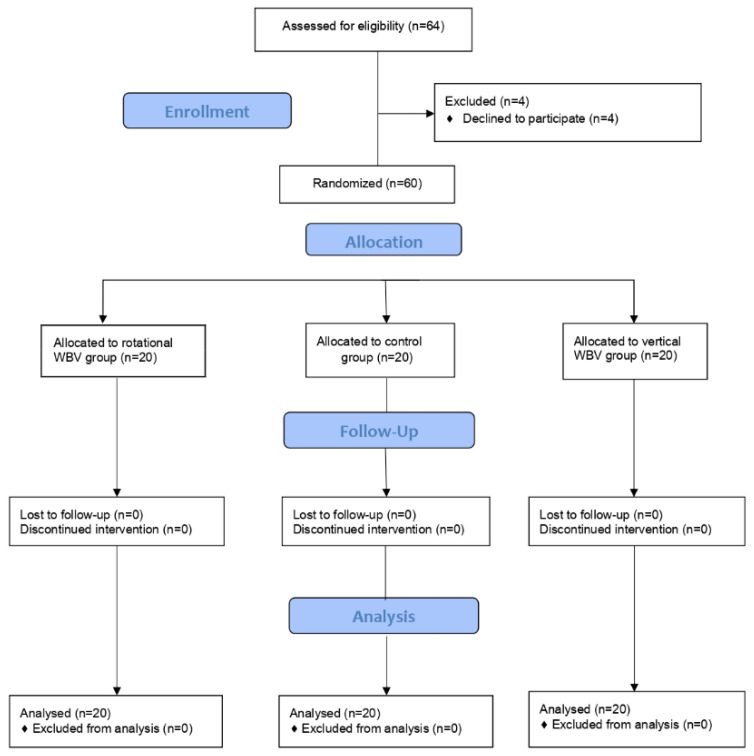
Whole body vibration has been proven to improve the health status of patients with fibromyalgia, providing an activation of the neuromuscular spindles, which are responsible for muscle contraction. The present study aimed to compare the effectiveness of two types of whole body vibrating platforms (vertical and rotational) during a 12-week training program. Sixty fibromyalgia patients (90% were women) were randomly assigned to one of the following groups: group A ( = 20), who performed the vibration training with a vertical platform; group B ( = 20), who did rotational platform training; or a control group C ( = 20), who did not do any training. Sensitivity measures (pressure pain and vibration thresholds), quality of life (Quality of Life Index), motor function tasks (Berg Scale, six-minute walking test, isometric back muscle strength), and static and dynamic balance (Romberg test and gait analysis) were assessed before, immediately after, and three months after the therapy program. Although both types of vibration appeared to have beneficial effects with respect to the control group, the training was more effective with the rotational than with vertical platform in some parameters, such as vibration thresholds ( < 0.001), motor function tasks ( < 0.001), mediolateral sway ( < 0.001), and gait speed ( < 0.05). Nevertheless, improvements disappeared in the follow-up in both types of vibration. Our study points out greater benefits with the use of rotational rather than vertical whole body vibration. The use of the rotational modality is recommended in the standard therapy program for patients with fibromyalgia. Due to the fact that the positive effects of both types of vibration disappeared during the follow-up, continuous or intermittent use is recommended.
全身振动已被证明可以改善纤维肌痛患者的健康状况,激活负责肌肉收缩的肌梭。本研究旨在比较两种全身振动平台(垂直和旋转)在 12 周训练计划中的效果。60 名纤维肌痛患者(90%为女性)被随机分为以下三组:A 组(n=20),使用垂直平台进行振动训练;B 组(n=20),使用旋转平台进行训练;或对照组 C(n=20),不进行任何训练。在治疗前、治疗后立即和治疗后三个月评估敏感性指标(压痛和振动阈值)、生活质量(生活质量指数)、运动功能任务(伯格量表、六分钟步行试验、等长背肌力量)和静态和动态平衡(Romberg 试验和步态分析)。尽管两种类型的振动都对对照组有有益的效果,但与垂直平台相比,旋转平台在某些参数(如振动阈值(<0.001)、运动功能任务(<0.001)、横向摆动(<0.001)和步态速度(<0.05))方面更有效。然而,在随访中,两种类型的振动的改善都消失了。我们的研究表明,使用旋转式全身振动比使用垂直式全身振动更有益。旋转模式的使用推荐在纤维肌痛患者的标准治疗方案中。由于两种类型的振动的积极效果在随访期间消失,因此建议连续或间歇使用。