Hong Weijie, Yuan Lili, Ma Yanping, Cui Chao, Zhang Haoyang, Yang Shiyong, Sun Wen-Hua
Key Laboratory of Science and Technology on High-tech Polymer Materials, Chinese Academy of Sciences, Zhongguancun, Beijing 100190, China.
School of Chemical Engineering, University of Chinese Academy of Sciences, Beijing 100049, China.
Polymers (Basel). 2021 Mar 15;13(6):903. doi: 10.3390/polym13060903.
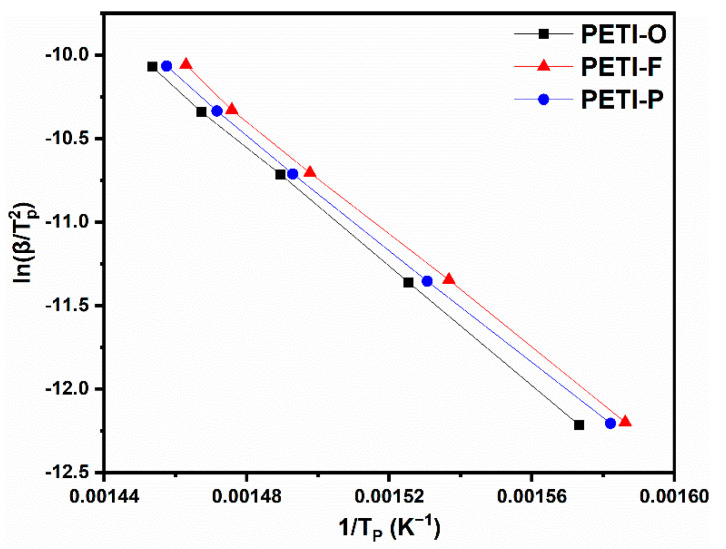
Phenylethynyl-terminated aromatic polyimides meet requirements of resin transfer molding (RTM) and exhibits high glass transition temperature (T) were prepared. Moreover, the relationship between the polyimide backbones structure and their melting stability was investigated. The phenylethynyl-terminated polyimides were based on 4,4'-(hexafluorosiopropylidene)-diphthalic anhydride (6FDA) and different diamines of 3,4'-oxydianiline (3,4'-ODA), m-phenylenediamine (m-PDA) and 2,2'-bis(trifluoromethyl)benzidine (TFDB) were prepared. These oligoimides exhibit excellent melting flowability with wide processing temperature window and low minimum melt viscosities (<1 Pa·s). Two of the oligoimides display good melting stability at 280-290 °C, which meet the requirements of resin transfer molding (RTM) process. After thermally cured, all resins show high glass transition temperatures (Ts, 363-391 °C) and good tensile strength (51-66 MPa). The cure kinetics studied by the differential scanning calorimetry (DSC), C nuclear magnetic resonance (C NMR) characterization and density functional theory (DFT) definitely confirmed that the electron-withdrawing ability of oligoimide backbone can tremendously affect the curing reactivity of terminated phenylethynyl groups. The replacement of 3,4'-ODA units by m-PDA or TFDB units increase the electron-withdrawing ability of the backbone, which increase the curing rate of terminated phenylethynyl groups at processing temperatures, hence results in the worse melting stability.
制备了满足树脂传递模塑(RTM)要求且具有高玻璃化转变温度(T)的苯基乙炔基封端的芳香族聚酰亚胺。此外,还研究了聚酰亚胺主链结构与其熔融稳定性之间的关系。基于4,4'-(六氟异丙基)二邻苯二甲酸酐(6FDA)和3,4'-二氨基二苯醚(3,4'-ODA)、间苯二胺(m-PDA)和2,2'-双(三氟甲基)联苯胺(TFDB)等不同二胺制备了苯基乙炔基封端的聚酰亚胺。这些低聚酰亚胺具有优异的熔体流动性,加工温度窗口宽,最低熔体粘度低(<1 Pa·s)。其中两种低聚酰亚胺在280-290°C下显示出良好的熔融稳定性,满足树脂传递模塑(RTM)工艺的要求。热固化后,所有树脂均显示出高玻璃化转变温度(Ts,363-391°C)和良好的拉伸强度(51-66 MPa)。通过差示扫描量热法(DSC)、碳核磁共振(C NMR)表征和密度泛函理论(DFT)研究的固化动力学明确证实,低聚酰亚胺主链的吸电子能力会极大地影响封端苯基乙炔基的固化反应活性。用m-PDA或TFDB单元取代3,4'-ODA单元会增加主链的吸电子能力,从而提高加工温度下封端苯基乙炔基的固化速率,进而导致熔融稳定性变差。