Xu Chuan, Wang Annie, Hoskin Eileen R, Cugini Carla, Markowitz Kenneth, Chang Theresa L, Fine Daniel H
Public Health Research Institute, Rutgers, New Jersey Medical School, 225 Warren Street, Newark, NJ 07103, USA.
Department of Restorative Dentistry, School of Dental Medicine, Rutgers, The State University of New Jersey, Newark, NJ 07103, USA.
Pathogens. 2021 Mar 1;10(3):272. doi: 10.3390/pathogens10030272.
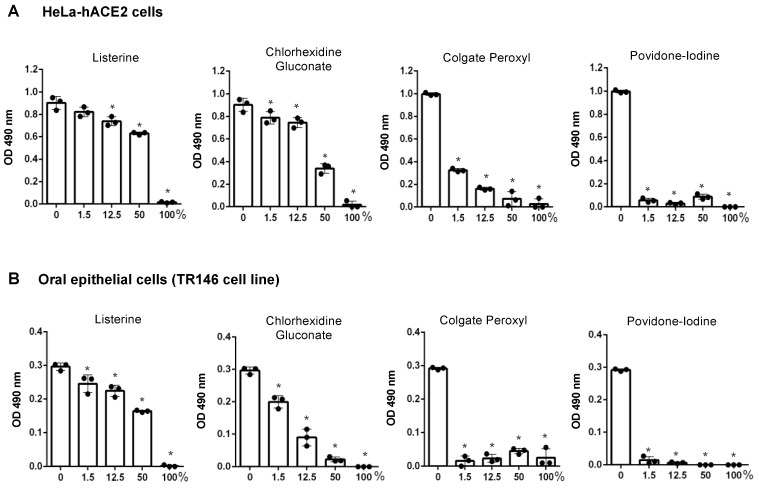
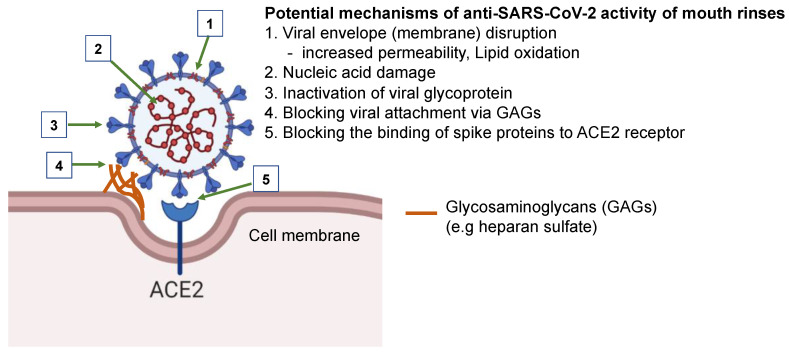
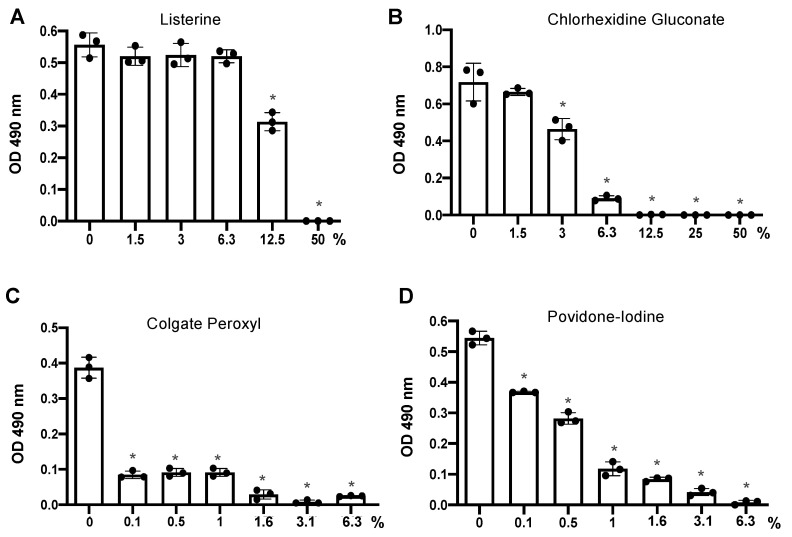
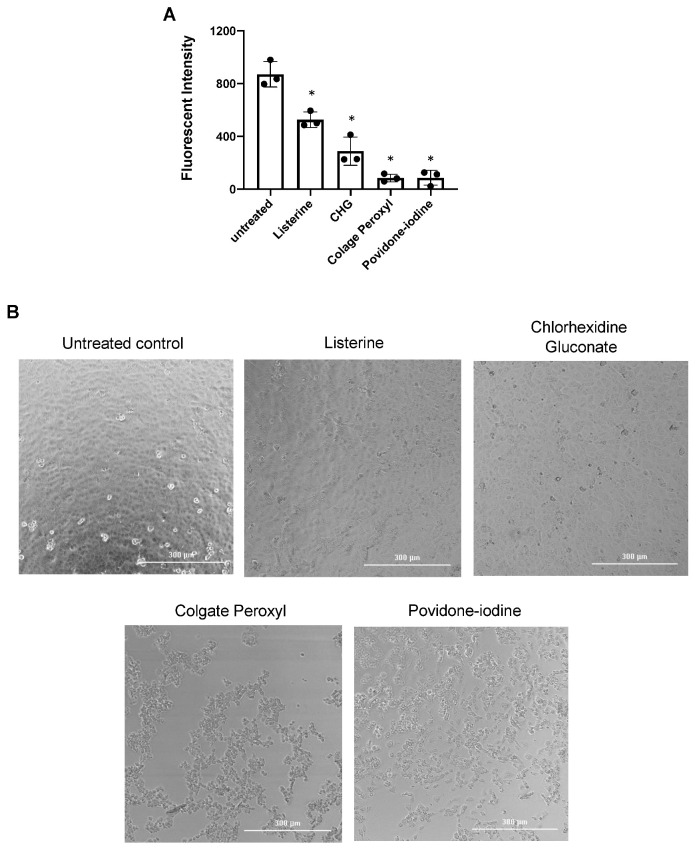
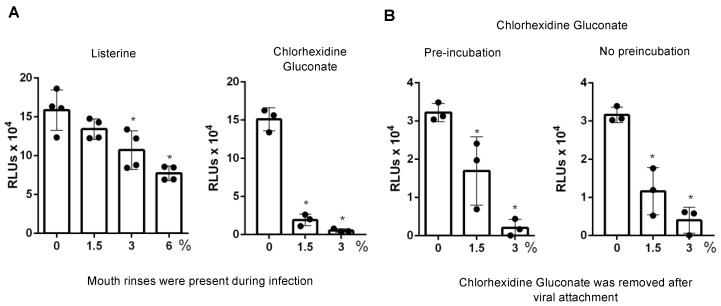
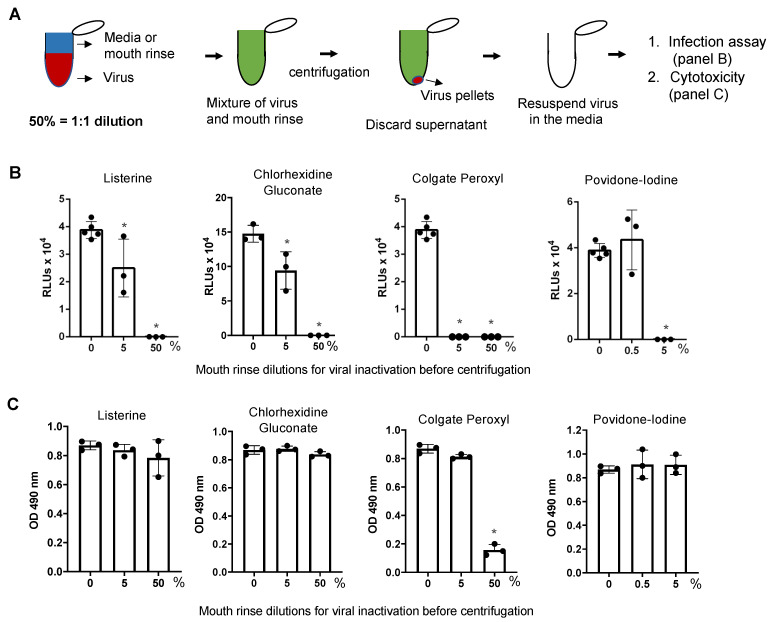
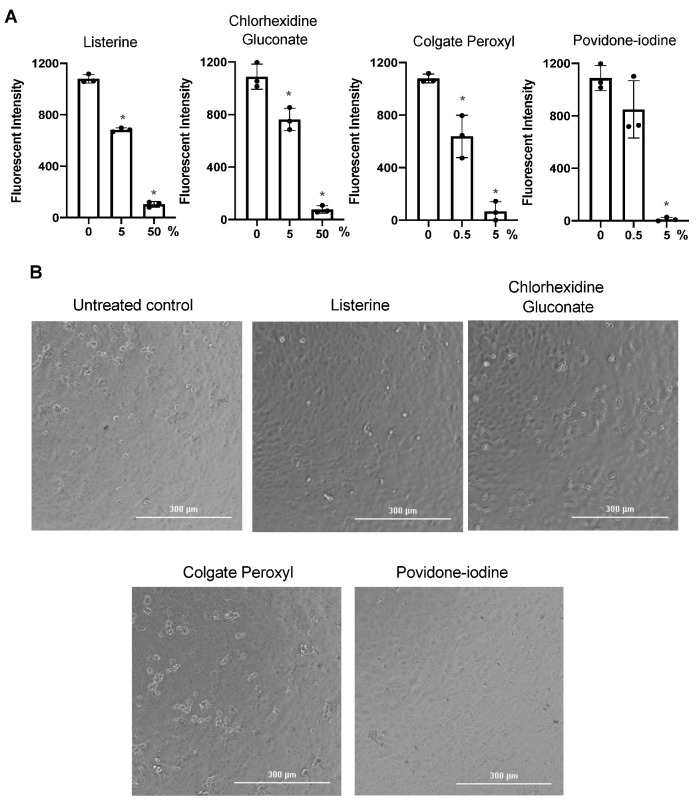
Severe acute respiratory syndrome-related coronavirus (SARS-CoV-2) is detectable in saliva from asymptomatic individuals, suggesting a potential benefit from the use of mouth rinses to suppress viral load and reduce virus spread. Published studies on the reduction of SARS-CoV-2-induced cytotoxic effects by mouth rinses do not exclude antiseptic mouth rinse-associated cytotoxicity. Here, we determined the effect of commercially available mouth rinses and antiseptic povidone-iodine on the infectivity of replication-competent SARS-CoV-2 viruses and of pseudotyped SARS-CoV-2 viruses. We first determined the effect of mouth rinses on cell viability to ensure that antiviral activity was not a consequence of mouth rinse-induced cytotoxicity. Colgate Peroxyl (hydrogen peroxide) exhibited the most cytotoxicity, followed by povidone-iodine, chlorhexidine gluconate (CHG), and Listerine (essential oils and alcohol). The potent antiviral activities of Colgate Peroxyl mouth rinse and povidone-iodine were the consequence of rinse-mediated cellular damage when the products were present during infection. The potency of CHG was greater when the product was not washed off after virus attachment, suggesting that the prolonged effect of mouth rinses on cells impacts the antiviral outcome. To minimalize mouth rinse-associated cytotoxicity, mouth rinse was largely removed from treated viruses by centrifugation prior to infection of cells. A 5% (/) dilution of Colgate Peroxyl or povidone-iodine completely blocked viral infectivity. A similar 5% (/) dilution of Listerine or CHG had a moderate suppressive effect on the virus, but a 50% (/) dilution of Listerine or CHG blocked viral infectivity completely. Mouth rinses inactivated the virus without prolonged incubation. The new infectivity assay, with limited impacts of mouth rinse-associated cytotoxicity, showed the differential effects of mouth rinses on SARS-CoV-2 infection. Our results indicate that mouth rinses can significantly reduce virus infectivity, suggesting a potential benefit for reducing SARS-CoV-2 spread.
在无症状个体的唾液中可检测到严重急性呼吸综合征相关冠状病毒(SARS-CoV-2),这表明使用漱口水抑制病毒载量并减少病毒传播可能有益。关于漱口水降低SARS-CoV-2诱导的细胞毒性作用的已发表研究并未排除含抗菌剂漱口水相关的细胞毒性。在此,我们确定了市售漱口水和抗菌剂聚维酮碘对具有复制能力的SARS-CoV-2病毒和假型SARS-CoV-2病毒感染性的影响。我们首先确定漱口水对细胞活力的影响,以确保抗病毒活性不是漱口水诱导的细胞毒性的结果。高露洁Peroxyl(过氧化氢)表现出最大的细胞毒性,其次是聚维酮碘、葡萄糖酸氯己定(CHG)和李施德林(精油和酒精)。当在感染期间存在这些产品时,高露洁Peroxyl漱口水和聚维酮碘的强效抗病毒活性是冲洗介导的细胞损伤的结果。当病毒附着后未冲洗掉该产品时,CHG的效力更大,这表明漱口水对细胞的延长作用会影响抗病毒结果。为了使漱口水相关的细胞毒性最小化,在感染细胞之前,通过离心将大部分漱口水从处理过的病毒中去除。5%(/)稀释的高露洁Peroxyl或聚维酮碘完全阻断了病毒感染性。类似的5%(/)稀释的李施德林或CHG对病毒有中度抑制作用,但50%(/)稀释的李施德林或CHG完全阻断了病毒感染性。漱口水无需长时间孵育即可使病毒失活。这种新的感染性测定方法,受漱口水相关细胞毒性的影响有限,显示了漱口水对SARS-CoV-2感染的不同影响。我们的结果表明,漱口水可显著降低病毒感染性,这表明在减少SARS-CoV-2传播方面可能有益。