Gu Xiaoting, Wang Dongwu, Wang Xin, Liu Youping, Di Xin
Laboratory of Drug Metabolism and Pharmacokinetics, Shenyang Pharmaceutical University, 103 Wenhua Road, Shenyang 110016, China.
Molecules. 2021 Mar 20;26(6):1742. doi: 10.3390/molecules26061742.
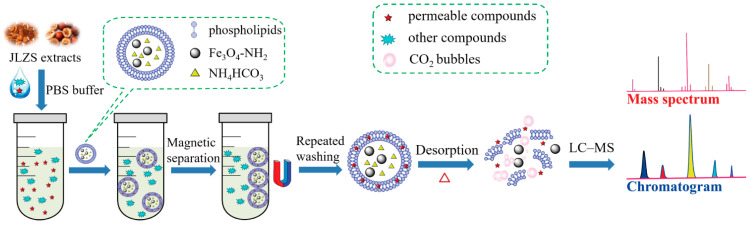
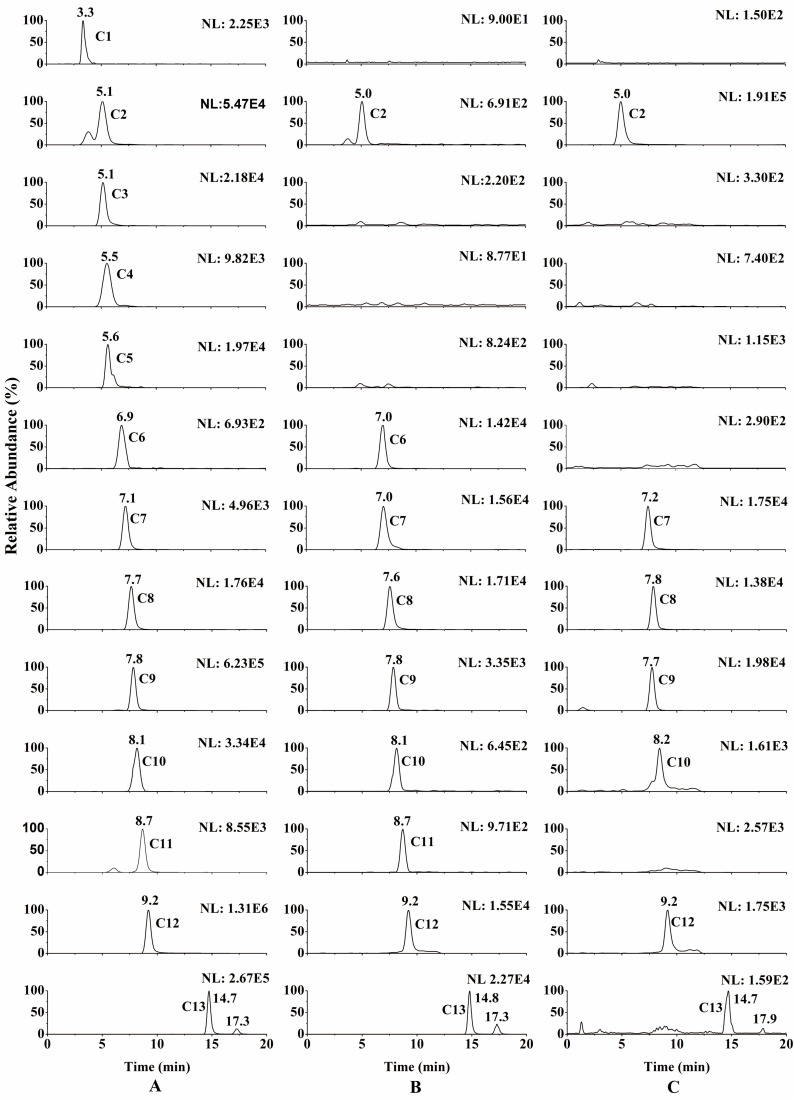
A novel strategy based on the use of bionic membrane camouflaged magnetic particles and LC-MS was developed to quickly screen the biomembrane-permeable compounds in herbal medicines. The bionic membrane was constructed by bubble-generating magnetic liposomes loaded with NHHCO (BMLs). The lipid bilayer structure of the liposomes enabled BMLs to capture biomembrane-permeable compounds from a herbal extract. The BMLs carrying the compounds were then separated from the extract by a magnetic field. Upon heat treatment, NHHCO rapidly decomposed to form CO bubbles within the liposomal bilayer, and the captured compounds were released from BMLs and analyzed by LC-MS. Jinlingzi San (JLZS), which contains various natural ingredients, was chosen to assess the feasibility of the proposed method. As a result, nine potential permeable compounds captured by BMLs were identified for the first time. Moreover, an in vivo animal study found that most of the compounds screened out by the proposed method were absorbed into the blood. The study provides a powerful tool for rapid and simultaneous prediction of multiple biomembrane-permeable components.
基于仿生膜伪装磁性颗粒和液相色谱-质谱联用技术,开发了一种新型策略,用于快速筛选草药中的生物膜可渗透化合物。仿生膜由负载NHHCO的气泡生成磁性脂质体(BMLs)构建而成。脂质体的脂质双分子层结构使BMLs能够从草药提取物中捕获生物膜可渗透化合物。然后通过磁场将携带化合物的BMLs与提取物分离。经过热处理,NHHCO在脂质体双分子层内迅速分解形成CO气泡,捕获的化合物从BMLs中释放出来,并通过液相色谱-质谱联用进行分析。选择含有多种天然成分的金铃子散(JLZS)来评估该方法的可行性。结果,首次鉴定出9种被BMLs捕获的潜在可渗透化合物。此外,一项体内动物研究发现,该方法筛选出的大多数化合物都被吸收到血液中。该研究为快速同时预测多种生物膜可渗透成分提供了有力工具。