Institute of Quality Assessment and Processing of Animal Products, University of Life Sciences in Lublin, Akademicka 13, 20-950 Lublin, Poland.
Institute of Agricultural Sciences, State School of Higher Education in Chełm, Pocztowa 54, 22-100 Chełm, Poland.
Molecules. 2021 Mar 23;26(6):1810. doi: 10.3390/molecules26061810.
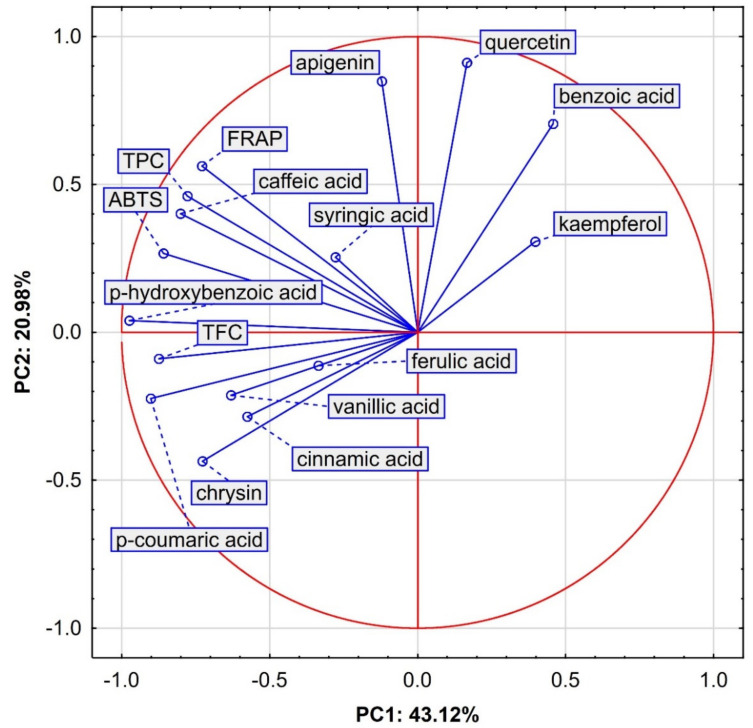
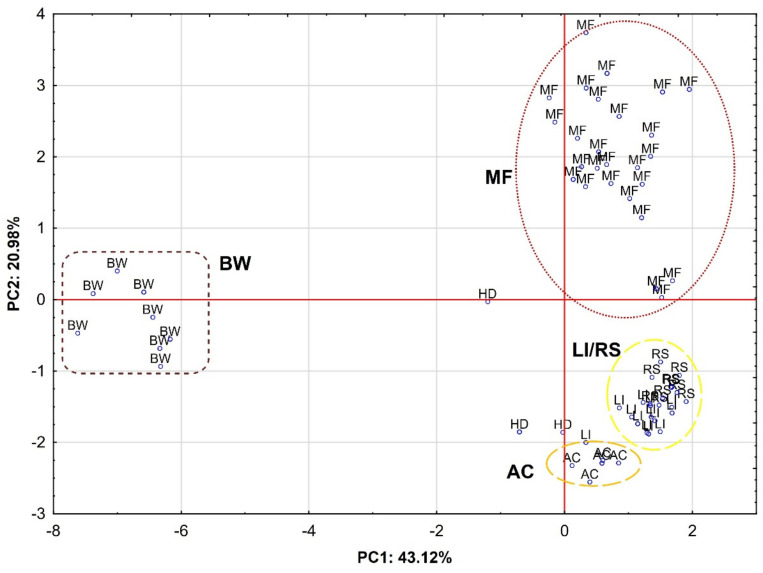
The study compared the content of eight phenolic acids and four flavonoids and the antioxidant activity of six Polish varietal honeys. An attempt was also made to determine the correlations between the antioxidant parameters of the honeys and their polyphenol profile using principal component analysis. Total phenolic content (TPC), total flavonoid content (TFC), antioxidant activity (ABTS) and reduction capacity (FRAP) were determined spectrophotometrically, and the phenolic compounds were determined using high-performance liquid chromatography (HPLC). The buckwheat honeys showed the strongest antioxidant activity, most likely because they had the highest concentrations of total phenols, total flavonoids, p-hydroxybenzoic acid, caffeic acid, p-coumaric acid, vanillic acid and chrysin. The principal component analysis (PCA) of the data showed significant relationships between the botanic origin of the honey, the total content of phenolic compounds and flavonoids and the antioxidant activity of the six Polish varietal honeys. The strongest, significant correlations were shown for parameters of antioxidant activity and TPC, TFC, p-hydroxybenzoic acid, caffeic acid and p-coumaric acid. Analysis of four principal components (explaining 86.9% of the total variance), as a classification tool, confirmed the distinctiveness of the Polish honeys in terms of their antioxidant activity and content of phenolic compounds.
该研究比较了八种酚酸和四种类黄酮的含量以及六种波兰蜂蜜品种的抗氧化活性。还尝试使用主成分分析确定蜂蜜的抗氧化参数与其多酚谱之间的相关性。使用分光光度法测定总酚含量(TPC)、总黄酮含量(TFC)、抗氧化活性(ABTS)和还原能力(FRAP),并使用高效液相色谱法(HPLC)测定酚类化合物。荞麦蜂蜜表现出最强的抗氧化活性,很可能是因为它们具有最高浓度的总酚类、总黄酮类、对羟基苯甲酸、咖啡酸、对香豆酸、香草酸和白杨素。数据的主成分分析(PCA)表明,蜂蜜的植物起源、酚类化合物和类黄酮的总含量以及六种波兰蜂蜜品种的抗氧化活性之间存在显著关系。抗氧化活性和 TPC、TFC、对羟基苯甲酸、咖啡酸和对香豆酸的参数显示出最强、最显著的相关性。四个主成分(解释总方差的 86.9%)的分析作为分类工具,证实了波兰蜂蜜在抗氧化活性和酚类化合物含量方面的独特性。