Evgin Laura, Vile Richard G
Canada's Michael Smith Genome Sciences Centre, BC Cancer, Vancouver, BC V5Z 1L3, Canada.
Department of Medical Genetics, University of British Columbia, Vancouver, BC V6H 3N1, Canada.
Cancers (Basel). 2021 Mar 5;13(5):1106. doi: 10.3390/cancers13051106.
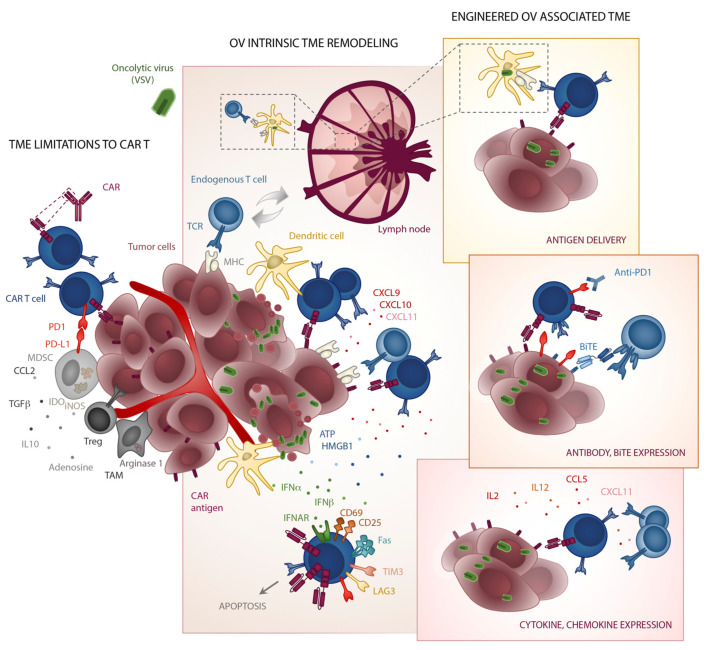
Oncolytic viruses (OVs) and adoptive T cell therapy (ACT) each possess direct tumour cytolytic capabilities, and their combination potentially seems like a match made in heaven to complement the strengths and weakness of each modality. While providing strong innate immune stimulation that can mobilize adaptive responses, the magnitude of anti-tumour T cell priming induced by OVs is often modest. Chimeric antigen receptor (CAR) modified T cells bypass conventional T cell education through introduction of a synthetic receptor; however, realization of their full therapeutic properties can be stunted by the heavily immune-suppressive nature of the tumour microenvironment (TME). Oncolytic viruses have thus been seen as a natural ally to overcome immunosuppressive mechanisms in the TME which limit CAR T cell infiltration and functionality. Engineering has further endowed viruses with the ability to express transgenes in situ to relieve T cell tumour-intrinsic resistance mechanisms and decorate the tumour with antigen to overcome antigen heterogeneity or loss. Despite this helpful remodeling of the tumour microenvironment, it has simultaneously become clear that not all virus induced effects are favourable for CAR T, begging the question whether viruses act as valets ushering CAR T into their active site, or vandals which cause chaos leading to both tumour and T cell death. Herein, we summarize recent studies combining these two therapeutic modalities and seek to place them within the broader context of viral T cell immunology which will help to overcome the current limitations of effective CAR T therapy to make the most of combinatorial strategies.
溶瘤病毒(OVs)和过继性T细胞疗法(ACT)都具有直接的肿瘤细胞溶解能力,它们的联合似乎是天作之合,能够互补各自疗法的优缺点。虽然溶瘤病毒能提供强大的先天免疫刺激,从而调动适应性反应,但由其诱导的抗肿瘤T细胞启动的程度通常较为有限。嵌合抗原受体(CAR)修饰的T细胞通过引入合成受体绕过了传统的T细胞训练;然而,肿瘤微环境(TME)的高度免疫抑制特性可能会阻碍其充分发挥治疗特性。因此,溶瘤病毒被视为克服肿瘤微环境中免疫抑制机制的天然盟友,这些机制会限制CAR T细胞的浸润和功能。通过工程改造,病毒进一步具备了原位表达转基因的能力,以缓解T细胞的肿瘤内在抗性机制,并在肿瘤上修饰抗原,以克服抗原异质性或抗原缺失。尽管对肿瘤微环境进行了这种有益的重塑,但同时也清楚地表明,并非所有病毒诱导的效应都对CAR T细胞有利,这就引发了一个问题:病毒是充当将CAR T细胞引入其活性位点的侍从,还是导致混乱并导致肿瘤和T细胞死亡的破坏者。在此,我们总结了最近将这两种治疗方式相结合的研究,并试图将它们置于更广泛的病毒T细胞免疫学背景中,这将有助于克服当前有效CAR T细胞疗法的局限性,充分利用联合策略。