Department of Internal Medicine, Hallym University College of Medicine, Gangwon-do, Chuncheon 24252, Korea.
Institute for Liver and Digestive Diseases, Hallym University, Gangwon-do, Chuncheon 24253, Korea.
Int J Mol Sci. 2021 Mar 5;22(5):2604. doi: 10.3390/ijms22052604.
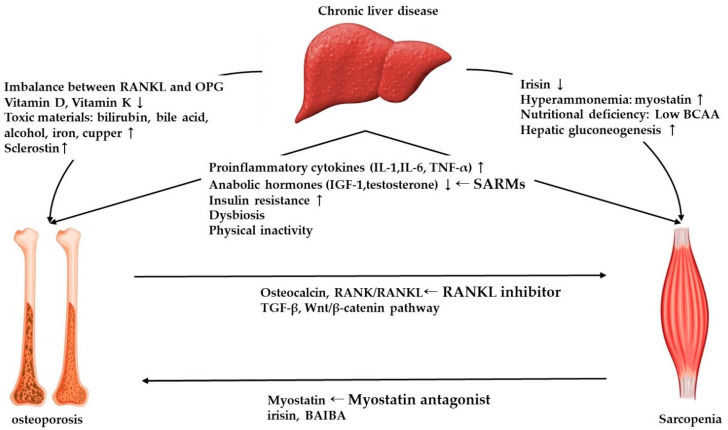
The prevalence of osteoporosis and sarcopenia is significantly higher in patients with liver disease than in those without liver disease and osteoporosis and sarcopenia negatively influence morbidity and mortality in liver disease, yet these musculoskeletal disorders are frequently overlooked in clinical practice for patients with chronic liver disease. The objective of this review is to provide a comprehensive understanding of the molecular mechanisms of musculoskeletal disorders accompanying the pathogenesis of liver disease. The increased bone resorption through the receptor activator of nuclear factor kappa (RANK)-RANK ligand (RANKL)-osteoprotegerin (OPG) system and upregulation of inflammatory cytokines and decreased bone formation through increased bilirubin and sclerostin and lower insulin-like growth factor-1 are important mechanisms for osteoporosis in patients with liver disease. Sarcopenia is associated with insulin resistance and obesity in non-alcoholic fatty liver disease, whereas hyperammonemia, low amount of branched chain amino acids, and hypogonadism contributes to sarcopenia in liver cirrhosis. The bidirectional crosstalk between muscle and bone through myostatin, irisin, β-aminoisobutyric acid (BAIBA), osteocalcin, as well as the activation of the RANK and the Wnt/β-catenin pathways are associated with osteosarcopenia. The increased understandings for these musculoskeletal disorders would be contributes to the development of effective therapies targeting the pathophysiological mechanism involved.
肝病患者的骨质疏松症和肌少症的患病率明显高于无肝病患者,骨质疏松症和肌少症会对肝病的发病率和死亡率产生负面影响,但这些肌肉骨骼疾病在慢性肝病患者的临床实践中经常被忽视。本综述的目的是提供对伴随肝病发病机制的肌肉骨骼疾病的分子机制的全面了解。通过核因子κ(NF-κ)受体激活剂(RANK)-RANK 配体(RANKL)-骨保护素(OPG)系统增加骨吸收,以及通过增加胆红素和硬骨素、降低胰岛素样生长因子-1 增加炎症细胞因子和减少骨形成,是肝病患者骨质疏松症的重要机制。肌少症与非酒精性脂肪性肝病中的胰岛素抵抗和肥胖有关,而高氨血症、支链氨基酸含量低和性腺功能减退症则导致肝硬化中的肌少症。肌肉和骨骼通过肌肉生长抑制素、鸢尾素、β-氨基异丁酸(BAIBA)、骨钙素以及 RANK 和 Wnt/β-连环蛋白途径的激活之间的双向串扰与肌骨减少症有关。对这些肌肉骨骼疾病的深入了解将有助于开发针对涉及的病理生理机制的有效治疗方法。