Heidelberg Institute of Global Health, Heidelberg University, 69117 Heidelberg, Germany.
Nursing and Midwifery, Faculty of Medicine, Nursing and Health Science, Monash University, Clayton, VIC 3800, Australia.
Int J Environ Res Public Health. 2021 Mar 5;18(5):2629. doi: 10.3390/ijerph18052629.
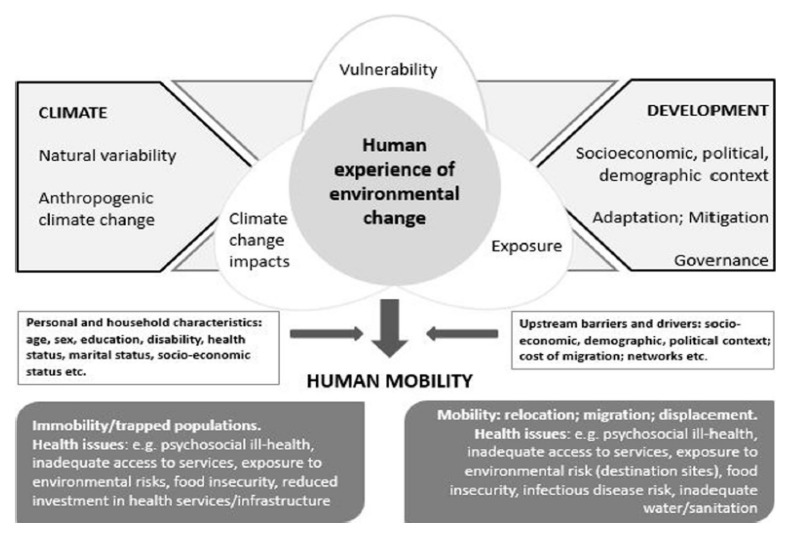
Climate change influences patterns of human mobility and health outcomes. While much of the climate change and migration discourse is invested in quantitative predictions and debates about whether migration is adaptive or maladaptive, less attention has been paid to the voices of the people moving in the context of climate change with a focus on their health and wellbeing. This qualitative research aims to amplify the voices of migrants themselves to add nuance to dominant migration narratives and to shed light on the real-life challenges migrants face in meeting their health needs in the context of climate change.
We conducted 58 semi-structured in-depth interviews with migrants purposefully selected for having moved from rural Bhola, southern Bangladesh to an urban slum in Dhaka, Bangladesh. Transcripts were analysed using thematic analysis under the philosophical underpinnings of phenomenology. Coding was conducted using NVivo Pro 12.
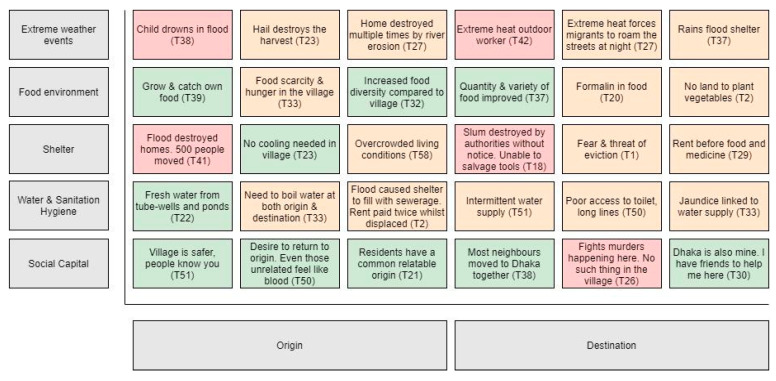
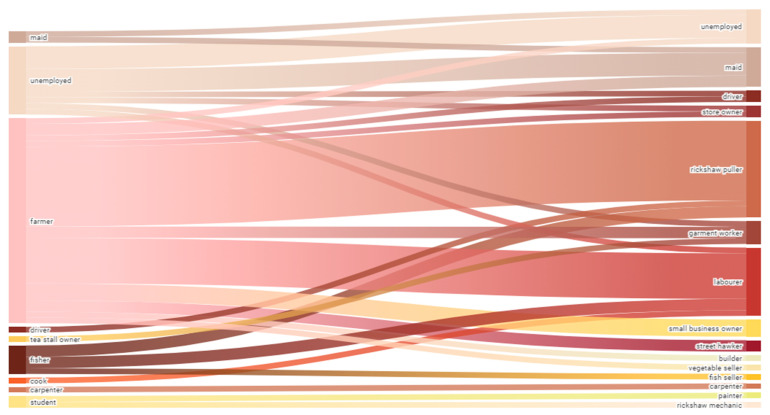
We identified two overarching themes in the thematic analysis: Firstly, we identified the theme "A risk exchange: Exchanging climate change and health risks at origin and destination". Rather than describing a "net positive" or "net negative" outcome in terms of migration in the context of climate change, migrants described an exchange of hazards, exposures, and vulnerabilities at origin with those at destination, which challenged their capacity to adapt. This theme included several sub-themes-income and employment factors, changing food environment, shelter and water sanitation and hygiene (WaSH) conditions, and social capital. The second overarching theme was "A changing health and healthcare environment". This theme also included several sub-themes-changing physical and mental health status and a changing healthcare environment encompassing quality of care and barriers to accessing healthcare. Migrants described physical and mental health concerns and connected these experiences with their new environment. These two overarching themes were prevalent across the dataset, although each participant experienced and expressed them uniquely.
Migrants who move in the context of climate change face a range of diverse health risks at the origin, en route, and at the destination. Migrating individuals, households, and communities undertake a risk exchange when they decide to move, which has diverse positive and negative consequences for their health and wellbeing. Along with changing health determinants is a changing healthcare environment where migrants face different choices, barriers, and quality of care. A more migrant-centric perspective as described in this paper could strengthen migration, climate, and health governance. Policymakers, urban planners, city corporations, and health practitioners should integrate the risk exchange into practice and policies.
气候变化影响人类流动模式和健康结果。虽然气候变化和移民的大部分讨论都集中在定量预测以及关于移民是适应还是不适应的争论上,但人们对在气候变化背景下移民的声音关注较少,这些声音关注的是移民的健康和福祉。这项定性研究旨在放大移民自身的声音,为主导的移民叙事增添细微差别,并揭示移民在气候变化背景下满足其健康需求时面临的现实挑战。
我们对 58 名从孟加拉国南部的博尔拉农村移民到孟加拉国首都达卡的城市贫民窟的移民进行了有针对性的半结构化深入访谈。使用现象学哲学基础下的主题分析对转录本进行分析。使用 NVivo Pro 12 进行编码。
在主题分析中,我们确定了两个总体主题:首先,我们确定了主题“风险交换:在原籍地和目的地交换气候变化和健康风险”。移民们并没有描述在气候变化背景下的移民是“净正”还是“净负”,而是描述了原籍地和目的地之间的危害、暴露和脆弱性的交换,这挑战了他们的适应能力。这一主题包括几个子主题:收入和就业因素、不断变化的食物环境、住所和水卫生与卫生条件以及社会资本。第二个总体主题是“不断变化的健康和医疗环境”。这一主题还包括几个子主题:不断变化的身心健康状况以及包括护理质量和获得医疗保健障碍在内的不断变化的医疗保健环境。移民们描述了身心健康问题,并将这些问题与他们的新环境联系起来。这两个总体主题在整个数据集都很普遍,尽管每个参与者都有独特的经历和表达。
在气候变化背景下移民的人在原籍地、途中和目的地都面临着一系列不同的健康风险。当他们决定移民时,移民个人、家庭和社区会进行风险交换,这对他们的健康和福祉有不同的积极和消极影响。随着健康决定因素的变化,医疗保健环境也在变化,移民面临着不同的选择、障碍和护理质量。本文所述的更以移民为中心的视角可以加强移民、气候和卫生治理。政策制定者、城市规划者、城市公司和卫生从业人员应将风险交换纳入实践和政策中。