Rudi Wolf-Stephan, Molitor Michael, Garlapati Venkata, Finger Stefanie, Wild Johannes, Münzel Thomas, Karbach Susanne H, Wenzel Philip
Center for Thrombosis and Haemostasis, University Medical Center Mainz, Langenbeckstraße 1, 55131 Mainz, Germany.
Center for Cardiology-Cardiology I, University Medical Center Mainz, Langenbeckstraße 1, 55131 Mainz, Germany.
Antioxidants (Basel). 2021 Mar 5;10(3):396. doi: 10.3390/antiox10030396.
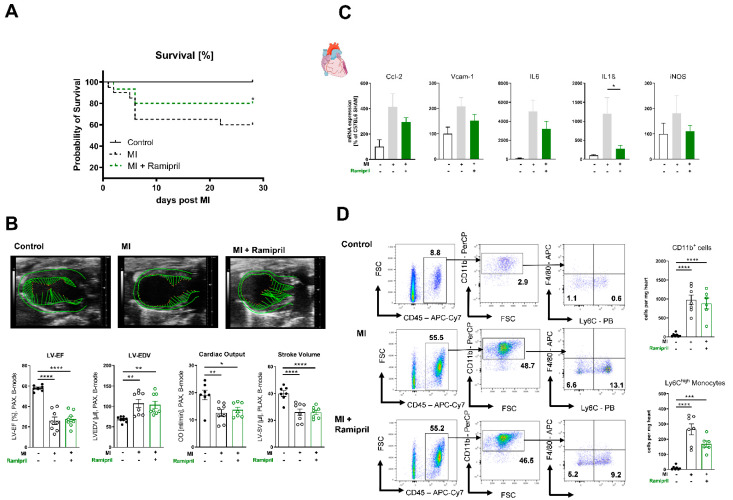
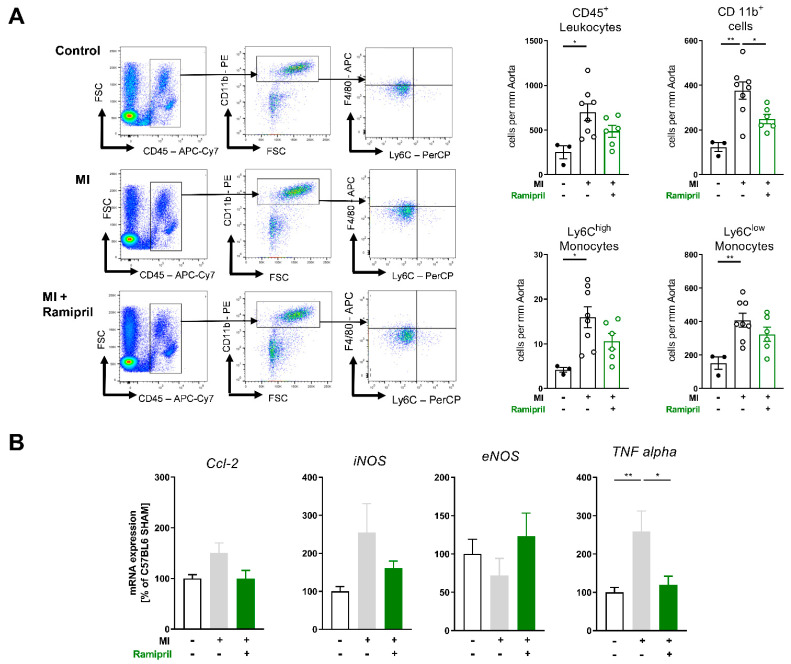
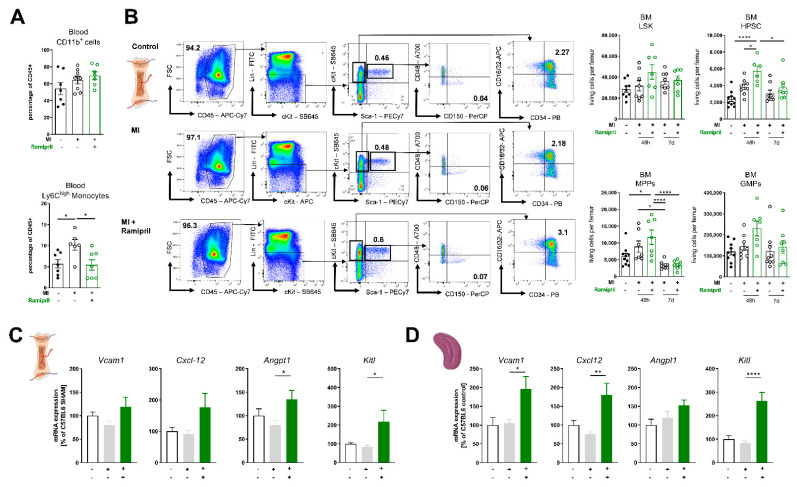
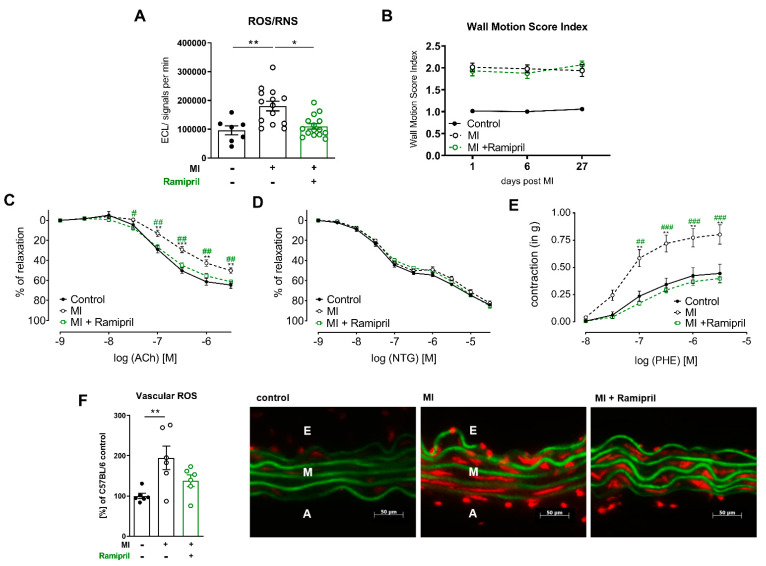
Angiotensin-converting-enzyme inhibitors (ACE inhibitors) are a cornerstone of drug therapy after myocardial infarction (MI) and improve left ventricular function and survival. We aimed to elucidate the impact of early treatment with the ACE inhibitor ramipril on the hematopoietic response after MI, as well as on the chronic systemic and vascular inflammation. In a mouse model of MI, induced by permanent ligation of the left anterior descending artery, immediate initiation of treatment with ramipril (10 mg/k/d via drinking water) reduced cardiac inflammation and the number of circulating inflammatory monocytes, whereas left ventricular function was not altered significantly, respectively. This effect was accompanied by enhanced retention of hematopoietic stem cells, LinSca1c-KitCD34CD16/32 granulocyte-macrophage progenitors (GMP) and LinSca1c-KitCD150CD48 multipotent progenitors (MPP) in the bone marrow, with an upregulation of the niche factors Angiopoetin 1 and Kitl at 7 d post MI. Long-term ACE inhibition for 28 d limited vascular inflammation, particularly the infiltration of Ly6C monocytes/macrophages, and reduced superoxide formation, resulting in improved endothelial function in mice with ischemic heart failure. ACE inhibition modulates the myeloid inflammatory response after MI due to the retention of myeloid precursor cells in their bone marrow reservoir. This results in a reduction in cardiac and vascular inflammation with improvement in survival after MI.
血管紧张素转换酶抑制剂(ACE抑制剂)是心肌梗死(MI)后药物治疗的基石,可改善左心室功能并提高生存率。我们旨在阐明早期使用ACE抑制剂雷米普利治疗对MI后造血反应以及慢性全身和血管炎症的影响。在通过永久性结扎左冠状动脉前降支诱导的MI小鼠模型中,立即开始用雷米普利(通过饮用水,10mg/k/d)治疗可减轻心脏炎症和循环炎症单核细胞的数量,而左心室功能未分别发生明显改变。这种作用伴随着骨髓中造血干细胞、LinSca1c-KitCD34CD16/32粒细胞-巨噬细胞祖细胞(GMP)和LinSca1c-KitCD150CD48多能祖细胞(MPP)的保留增强,在MI后7天时骨髓龛因子血管生成素1和Kitl上调。长期(28天)ACE抑制可限制血管炎症,特别是Ly6C单核细胞/巨噬细胞的浸润,并减少超氧化物的形成,从而改善缺血性心力衰竭小鼠的内皮功能。ACE抑制通过将髓系前体细胞保留在其骨髓库中,调节MI后的髓系炎症反应。这导致心脏和血管炎症减轻,MI后生存率提高。