Kang Haisu, Lee Ji Hee, Choe Youngson, Lee Seung Geol
School of Chemical Engineering, Pusan National University, Busan 46241, Korea.
Department of Chemical and Biomolecular Engineering, Pusan National University, Busan 46241, Korea.
Nanomaterials (Basel). 2021 Mar 30;11(4):872. doi: 10.3390/nano11040872.
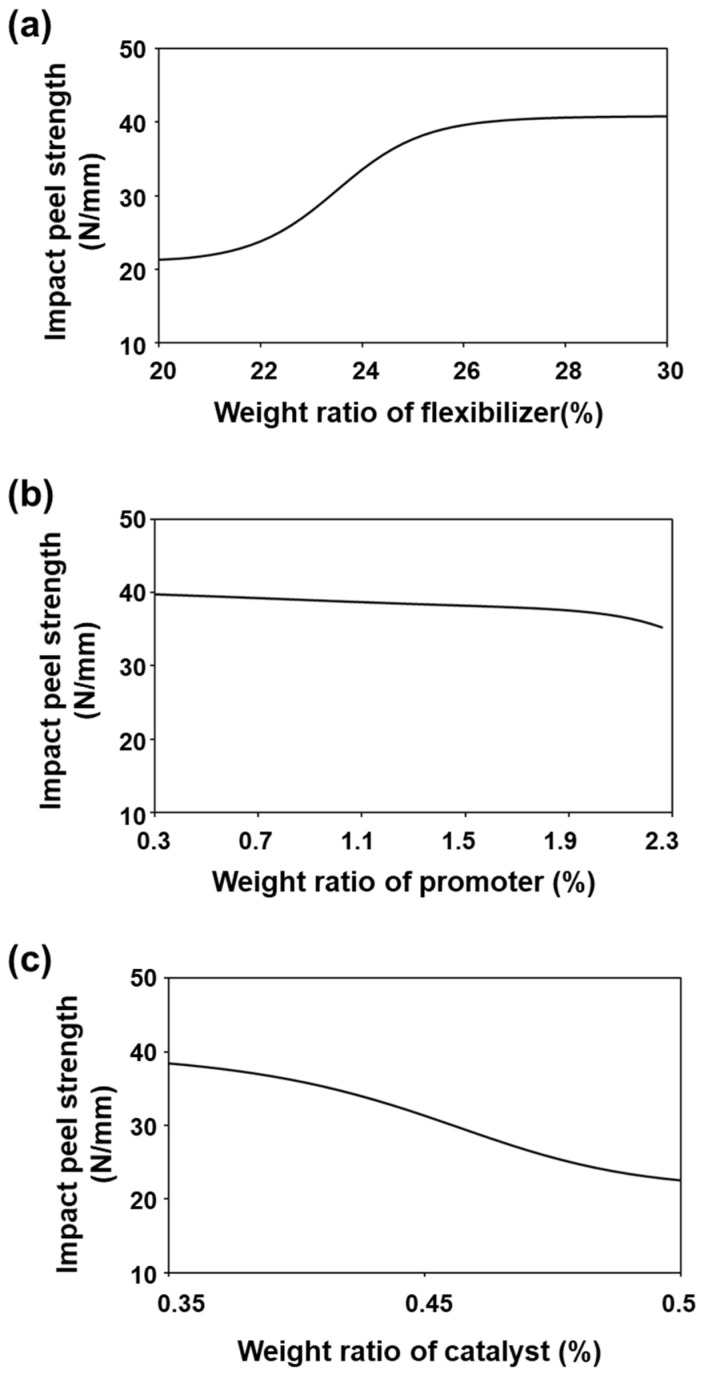
In this study, an artificial neural network (ANN), which is a machine learning (ML) method, is used to predict the adhesion strength of structural epoxy adhesives. The data sets were obtained by testing the lap shear strength at room temperature and the impact peel strength at -40 °C for specimens of various epoxy adhesive formulations. The linear correlation analysis showed that the content of the catalyst, flexibilizer, and the curing agent in the epoxy formulation exhibited the highest correlation with the lap shear strength. Using the analyzed data sets, we constructed an ANN model and optimized it with the selection set and training set divided from the data sets. The obtained root mean square error (RMSE) and values confirmed that each model was a suitable predictive model. The change of the lap shear strength and impact peel strength was predicted according to the change in the content of components shown to have a high linear correlation with the lap shear strength and the impact peel strength. Consequently, the contents of the formulation components that resulted in the optimum adhesive strength of epoxy were obtained by our prediction model.
在本研究中,人工神经网络(ANN)作为一种机器学习(ML)方法,被用于预测结构环氧胶粘剂的粘结强度。通过测试不同环氧胶粘剂配方试样在室温下的搭接剪切强度和在-40°C下的冲击剥离强度来获取数据集。线性相关性分析表明,环氧配方中催化剂、增韧剂和固化剂的含量与搭接剪切强度的相关性最高。利用分析后的数据集,我们构建了一个人工神经网络模型,并通过从数据集中划分出的选择集和训练集对其进行优化。所得到的均方根误差(RMSE)和值证实每个模型都是合适的预测模型。根据与搭接剪切强度和冲击剥离强度具有高线性相关性的组分含量变化,预测了搭接剪切强度和冲击剥离强度的变化。因此,通过我们的预测模型获得了导致环氧胶粘剂达到最佳粘结强度的配方组分含量。