Division of Infectious Diseases and Tropical Medicine, University Hospital, LMU Munich, 80802 Munich, Germany.
German Center for Infection Research (DZIF), Partner Site Munich, 80802 Munich, Germany.
Int J Environ Res Public Health. 2021 Mar 30;18(7):3572. doi: 10.3390/ijerph18073572.
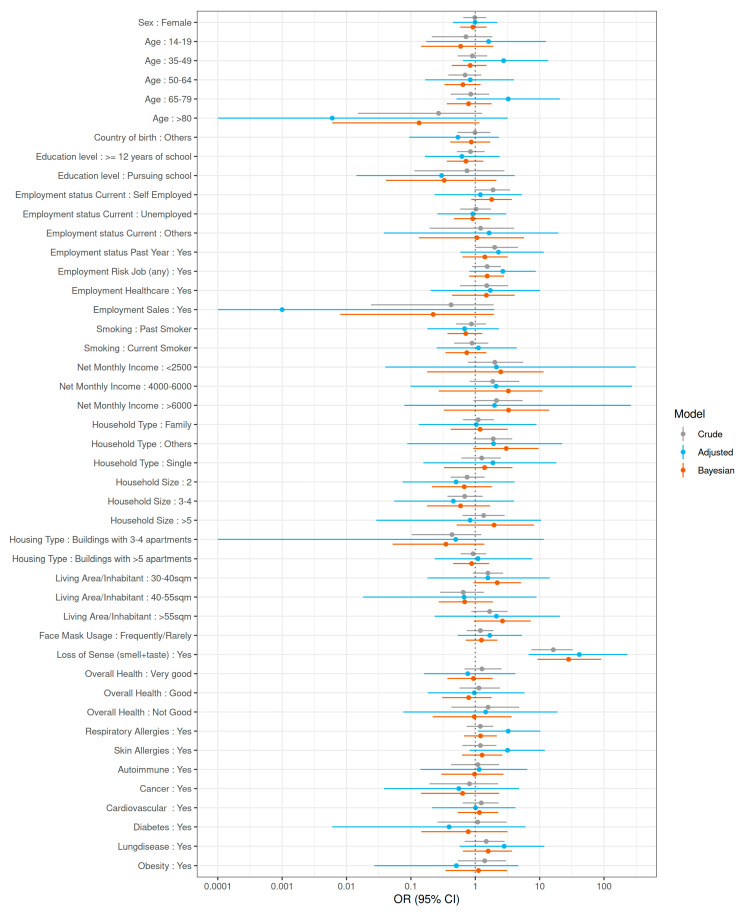
Given the large number of mild or asymptomatic SARS-CoV-2 cases, only population-based studies can provide reliable estimates of the magnitude of the pandemic. We therefore aimed to assess the sero-prevalence of SARS-CoV-2 in the Munich general population after the first wave of the pandemic. For this purpose, we drew a representative sample of 2994 private households and invited household members 14 years and older to complete questionnaires and to provide blood samples. SARS-CoV-2 seropositivity was defined as Roche N pan-Ig ≥ 0.4218. We adjusted the prevalence for the sampling design, sensitivity, and specificity. We investigated risk factors for SARS-CoV-2 seropositivity and geospatial transmission patterns by generalized linear mixed models and permutation tests. Seropositivity for SARS-CoV-2-specific antibodies was 1.82% (95% confidence interval (CI) 1.28-2.37%) as compared to 0.46% PCR-positive cases officially registered in Munich. Loss of the sense of smell or taste was associated with seropositivity (odds ratio (OR) 47.4; 95% CI 7.2-307.0) and infections clustered within households. By this first population-based study on SARS-CoV-2 prevalence in a large German municipality not affected by a superspreading event, we could show that at least one in four cases in private households was reported and known to the health authorities. These results will help authorities to estimate the true burden of disease in the population and to take evidence-based decisions on public health measures.
鉴于大量 SARS-CoV-2 轻症或无症状病例的存在,只有基于人群的研究才能提供有关大流行严重程度的可靠估计。因此,我们旨在评估疫情第一波过后慕尼黑普通人群中 SARS-CoV-2 的血清流行率。为此,我们从 2994 户私人家庭中抽取了一个有代表性的样本,并邀请 14 岁及以上的家庭成员填写问卷并提供血液样本。SARS-CoV-2 血清阳性定义为罗氏 N 泛 IgG≥0.4218。我们根据抽样设计、敏感性和特异性对流行率进行了调整。我们通过广义线性混合模型和置换检验调查了 SARS-CoV-2 血清阳性的危险因素和地理空间传播模式。与慕尼黑官方登记的 0.46%PCR 阳性病例相比,SARS-CoV-2 特异性抗体血清阳性率为 1.82%(95%置信区间 1.28-2.37%)。嗅觉或味觉丧失与血清阳性相关(优势比(OR)47.4;95%置信区间 7.2-307.0),感染在家庭内聚集。通过这项在未受超级传播事件影响的德国大型直辖市进行的 SARS-CoV-2 患病率的首次基于人群的研究,我们可以证明,在私人家庭中,至少每四个病例就有一个向卫生当局报告并被其知晓。这些结果将有助于当局估计人群中的真实疾病负担,并就公共卫生措施做出基于证据的决策。