Moniruzzaman M, Zhong Yun, Huang Zhifeng, Yan Huaxue, Yuanda Lv, Jiang Bo, Zhong Guangyan
Institute of Fruit Tree Research, Guangdong Academy of Agricultural Sciences, Guangzhou 510640, China.
Key Laboratory of South Subtropical Fruit Biology and Genetic Resource Utilization, Ministry of Agriculture, Guangzhou 510640, China.
Plants (Basel). 2021 Mar 30;10(4):664. doi: 10.3390/plants10040664.
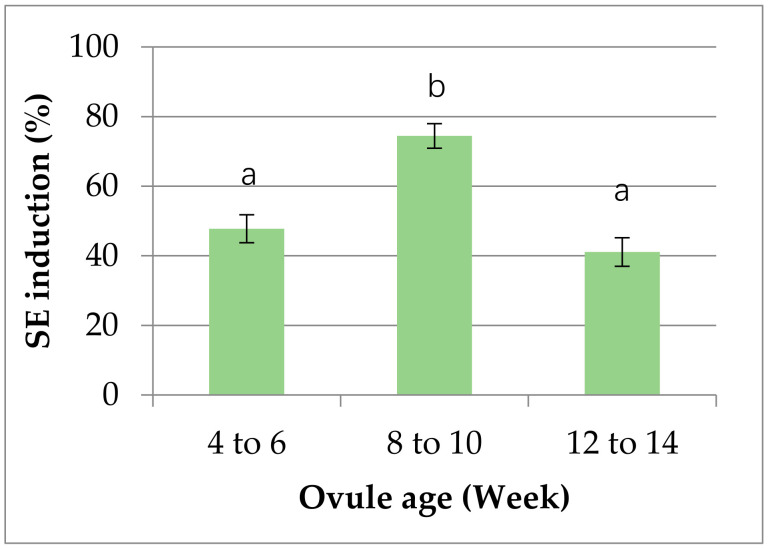
-mediated transformation of epicotyl segment has been used in transgenic studies. The approach suffers, however, from limitations such as occasionally seed unavailability, the low transformation efficiency of juvenile tissues and the high frequency of chimeric plants. Therefore, a suspension cell culture system was established and used to generate transgenic plants in this study to overcome the shortcomings. The embryonic calli were successfully developed from undeveloped ovules of the three cultivars used in this study, "Sweet orange"-Egyptian cultivar (), "Shatangju" () and "W. Murcott" (, on three different solid media. Effects of media, genotypes and ages of ovules on the induction of embryonic calli were also investigated. The result showed that the ovules' age interferes with the callus production more significantly than media and genotypes. The 8 to 10 week-old ovules were found to be the best materials. A cell suspension culture system was established in an H+H liquid medium. Transgenic plants were obtained from -mediated transformation of cell suspension as long as eight weeks subculture intervals. A high transformation rate (~35%) was achieved by using our systems, confirming BASTA selection and later on by PCR confirmation. The results demonstrated that transformation of cell suspension should be more useful for the generation of non-chimeric transgenic plants. It was also shown that our cell suspension culture procedure was efficient in maintaining the vigor and regeneration potential of the cells.
介导的上胚轴切段转化已用于转基因研究。然而,该方法存在一些局限性,如偶尔种子不可用、幼嫩组织转化效率低以及嵌合体植物频率高。因此,本研究建立了悬浮细胞培养系统并用于产生转基因植物以克服这些缺点。本研究使用的三个品种“甜橙”埃及品种()、“砂糖橘”()和“默科特”()未发育的胚珠成功发育出胚性愈伤组织,在三种不同的固体培养基上。还研究了培养基、胚珠基因型和胚珠年龄对胚性愈伤组织诱导的影响。结果表明,胚珠年龄对愈伤组织产生的干扰比培养基和基因型更显著。发现8至10周龄的胚珠是最佳材料。在H+H液体培养基中建立了细胞悬浮培养系统。只要亚培养间隔为8周,通过细胞悬浮的介导转化就可获得转基因植物。使用我们的系统实现了高转化率(约35%),通过BASTA筛选并随后通过PCR确认。结果表明,细胞悬浮转化对于产生非嵌合转基因植物应该更有用。还表明我们的细胞悬浮培养程序在维持细胞活力和再生潜力方面是有效的。