Nguyen Chi D, Chen Jianjun, Clark David, Perez Hector, Huo Heqiang Alfred
Mid-Florida Research Center, IFAS-University of Florida, Apopka, FL 32703, USA.
Department of Environmental Horticulture, IFAS-University of Florida, Gainesville, FL 32603, USA.
Plants (Basel). 2021 Mar 19;10(3):581. doi: 10.3390/plants10030581.
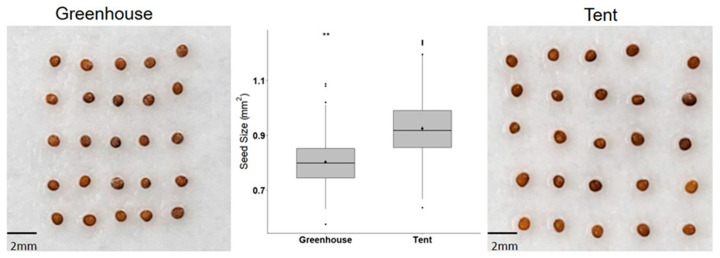
Seed germination and seedling vigor can be affected by environmental cues experienced by the mother plant. However, information about how the maternal environment affects seed quality is scarce in ornamental plants. This study aimed to investigate the effects of two different maternal environments on the seed germination and seedling vigor of a × under a variety of abiotic stresses. Petunia mother plants were grown in either a greenhouse during the summer months or an indoor controlled-temperature-and-light environment. Collected seeds were subjected to external stressors, including polyethylene glycol (PEG), sodium chloride (NaCl), high temperature, and abscisic acid (ABA), to determine seed germination percentage and seedling vigor. Results indicated that seeds harvested from the mother plants grown in a controlled environment germinated better than seeds harvested from the mother plants grown in the greenhouse when suboptimal germination conditions were applied. Additionally, the seedlings from the controlled maternal environment performed better in both ABA and salinity stress tests than the greenhouse seedlings. Interestingly, the greenhouse seedlings displayed less reactive oxygen species (ROS) damage and lower electrolyte leakage than the controlled environment seedlings under dehydration stress. The difference in germination and seedling vigor of seeds from the two different maternal environments might be due to the epigenetic memory inherited from the mother plants. This study highlighted the strong impact of the maternal environment on seed germination and seedling vigor in Petunia and may assist in high-quality seed production in ornamental plants.
种子萌发和幼苗活力会受到母株所经历的环境线索的影响。然而,在观赏植物中,关于母本环境如何影响种子质量的信息却很少。本研究旨在调查两种不同母本环境对某矮牵牛品种在多种非生物胁迫下种子萌发和幼苗活力的影响。矮牵牛母株在夏季种植于温室中,或种植于室内控温控光环境中。收集的种子经受包括聚乙二醇(PEG)、氯化钠(NaCl)、高温和脱落酸(ABA)在内的外部胁迫因素,以确定种子发芽率和幼苗活力。结果表明,在应用次优萌发条件时,从生长在可控环境中的母株收获的种子比从温室中生长的母株收获的种子发芽更好。此外,来自可控母本环境的幼苗在ABA和盐度胁迫试验中的表现均优于温室幼苗。有趣的是,在脱水胁迫下,温室幼苗比可控环境幼苗表现出更少的活性氧(ROS)损伤和更低的电解质渗漏。来自两种不同母本环境的种子在萌发和幼苗活力上的差异可能归因于从母株继承的表观遗传记忆。本研究突出了母本环境对矮牵牛种子萌发和幼苗活力的强烈影响,并可能有助于观赏植物的高质量种子生产。