Department of Plant and Soil Sciences, Mississippi State University, Mississippi State, MS, United States of America.
Mississippi Water Resources Research Institute, Mississippi State University, Mississippi State, MS, United States of America.
PLoS One. 2019 Sep 9;14(9):e0214977. doi: 10.1371/journal.pone.0214977. eCollection 2019.
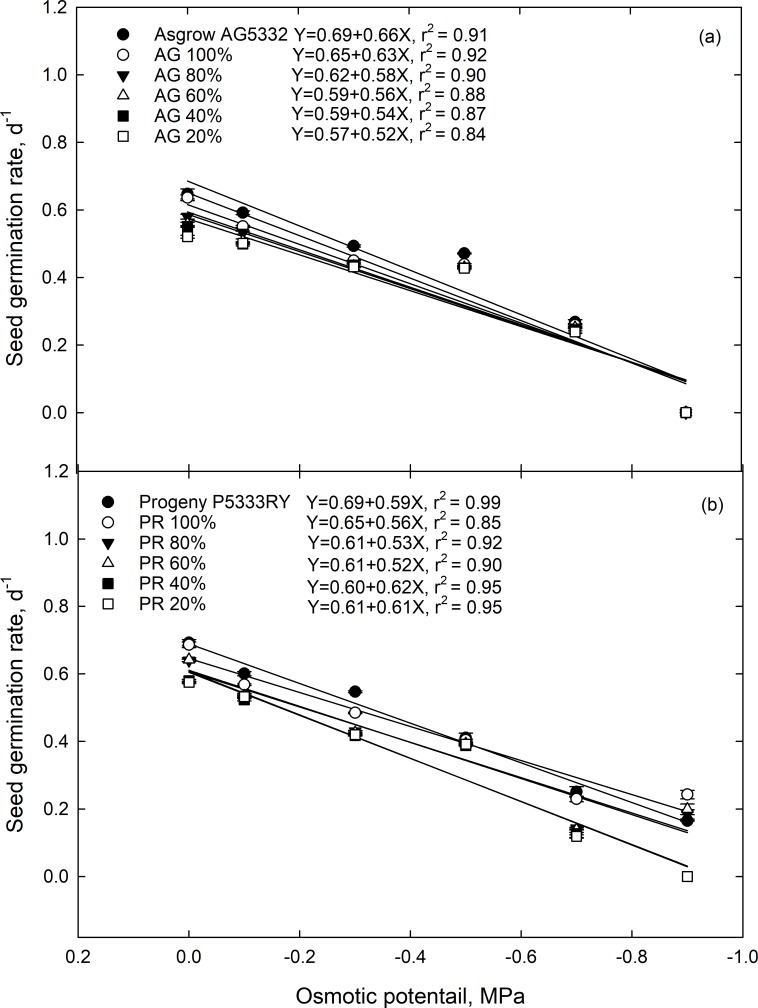
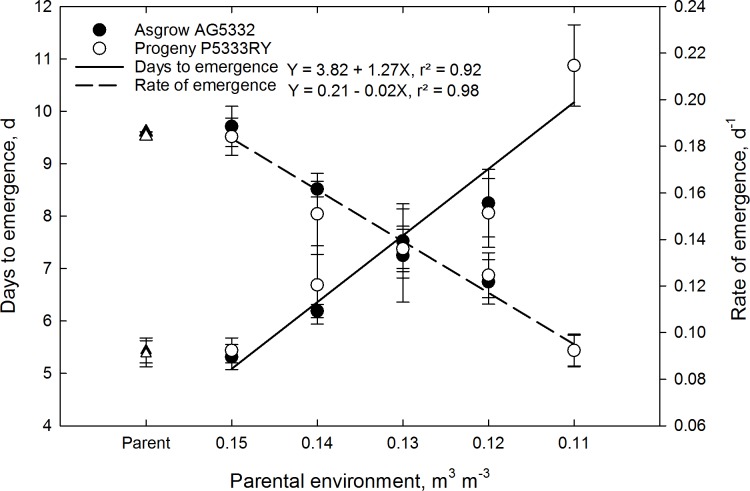
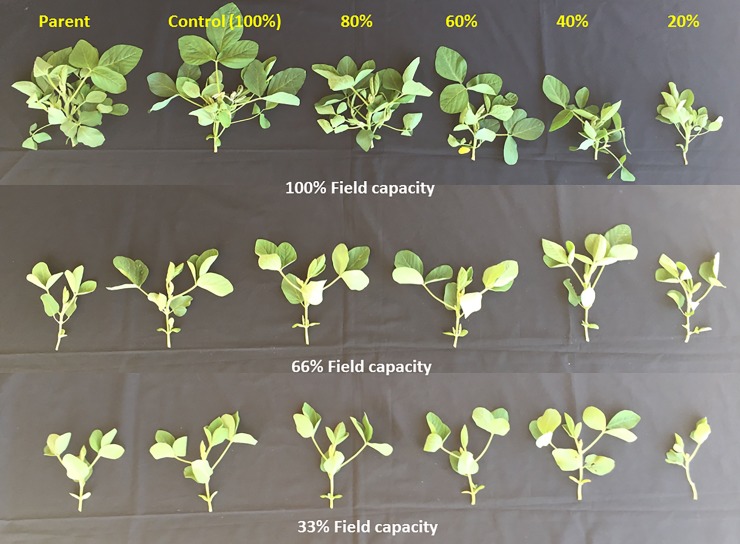
Effects of environmental stressors on the parent may be transmitted to the F1 generation of plants that support global food, oil, and energy production for humans and animals. This study was conducted to determine if the effects of drought stress on parental soybean plants are transmitted to the F1 generation. The germination and seedling vigor of F1 soybean whose maternal parents, Asgrow AG5332 and Progeny P5333RY, were exposed to soil moisture stress, that is, 100, 80, 60, 40, and 20% replacement of evapotranspiration (ET) during reproductive growth, were evaluated under controlled conditions. Pooled over cultivars, effects of soil moisture stress on the parents caused a reduction in the seed germination rate, maximum seed germination, and overall seedling performance in the F1 generation. The effect of soil moisture stress on the parent environment induced seed quality that carried on the F1 generation seed gemination and seedling traits under optimum conditions and further exasperated when exposed to increasing levels of drought stress. Results indicate that seed weight and storage reserve are key factors positively associated with germination traits and seedling growth. Our data confirm that the effects of soil moisture stress on soybean are transferable, causing reduced germination, seedling vigor, and seed quality in the F1 generation. Therefore, optimal water supply during soybean seed formation period may be beneficial for seed producers in terms of optimizing seed quality and vigor characteristics of commodity seed.
环境胁迫对母体的影响可能会传递给支持全球人类和动物粮食、石油和能源生产的 F1 代植物。本研究旨在确定干旱胁迫对母体大豆植株的影响是否会传递给 F1 代。在受控条件下,评估了暴露于土壤水分胁迫(即在生殖生长期间,替代蒸散量(ET)的 100%、80%、60%、40%和 20%)的母体大豆亲本(Asgrow AG5332 和 Progeny P5333RY)的 F1 大豆的发芽和幼苗活力。综合来看,土壤水分胁迫对亲本的影响导致 F1 代种子发芽率、最大种子发芽率和整体幼苗性能降低。土壤水分胁迫对母体环境的影响导致种子质量下降,这种下降在最佳条件下会延续到 F1 代种子发芽和幼苗特性中,并在受到更高水平的干旱胁迫时进一步加剧。结果表明,种子重量和储存储备是与发芽特性和幼苗生长呈正相关的关键因素。我们的数据证实,大豆对土壤水分胁迫的反应是可传递的,导致 F1 代种子发芽率、幼苗活力和种子质量降低。因此,在大豆种子形成期间提供最佳的水分供应可能有助于种子生产者优化商品种子的种子质量和活力特性。