Richter Kneginja, Zimni Melanie, Tomova Iva, Retzer Lukas, Höfig Joachim, Kellner Stefanie, Fries Carla, Bernstein Karina, Hitzl Wolfgang, Hillemacher Thomas, Miloseva Lence, Acker Jens
Outpatient Clinic for Sleep Disorders and Tinnitus, University Clinic for Psychiatry and Psychotherapy, Paracelsus Medical University, 90419 Nuremberg, Germany.
Faculty for Social Work, Technical University of Applied Sciences Nuremberg Georg Simon Ohm, 90489 Nuremberg, Germany.
Int J Environ Res Public Health. 2021 Mar 19;18(6):3209. doi: 10.3390/ijerph18063209.
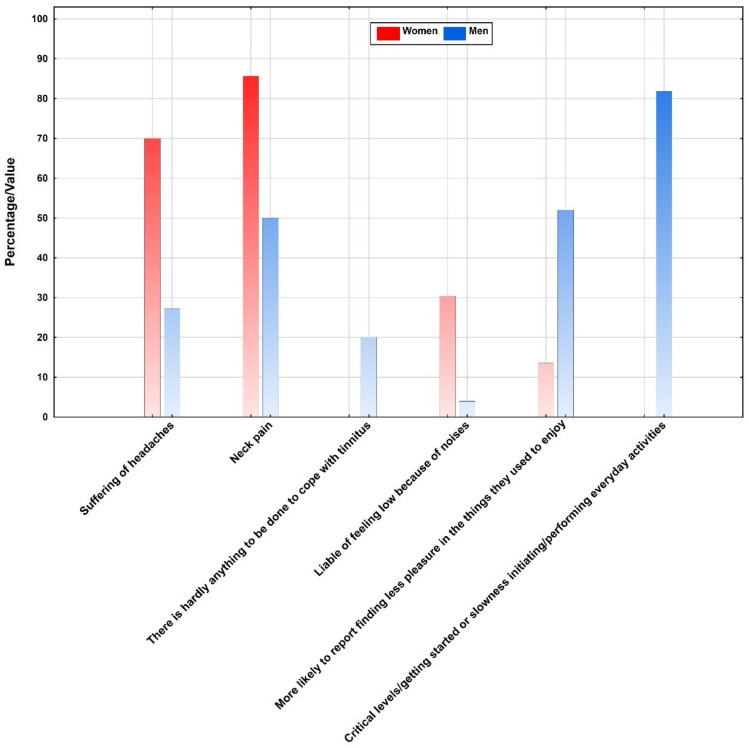
Chronic tinnitus causes a decrease in well-being and can negatively affect sleep quality. It has further been indicated that there are clinically relevant gender differences, which may also have an impact on sleep quality. By conducting a retrospective and explorative data analysis for differences in patients with tinnitus and patients diagnosed with tinnitus and insomnia, hypothesized differences were explored in the summed test scores and on item-level of the validated psychometric instruments. A cross-sectional study was conducted collecting data from a sample of tinnitus patients ( = 76). Insomnia was diagnosed in 49 patients. Gender differences were found on aggregated test scores of the MADRS and BDI with men scoring higher than women, indicating higher depressive symptoms in men. Women stated to suffer more from headaches ( < 0.003), neck pain ( < 0.006) and nervousness as well as restlessness ( < 0.02). Women also reported an increase in tinnitus loudness in response to stress compared to men ( < 0.03). Male individuals with tinnitus and insomnia have higher depression scores and more clinically relevant depressive symptoms than women, who suffer more from psychosomatic symptoms. The results indicate a need for a targeted therapy of depressive symptoms in male patients and targeted treatment of psychosomatic symptoms, stress-related worsening of insomnia and tinnitus in women.
慢性耳鸣会导致幸福感下降,并可能对睡眠质量产生负面影响。进一步研究表明,存在临床相关的性别差异,这也可能对睡眠质量产生影响。通过对耳鸣患者与被诊断为耳鸣和失眠的患者进行回顾性探索性数据分析,在经过验证的心理测量工具的总测试分数和项目层面上探索了假设的差异。进行了一项横断面研究,从一组耳鸣患者样本( = 76)中收集数据。49名患者被诊断为失眠。在抑郁自评量表(MADRS)和贝克抑郁量表(BDI)的综合测试分数上发现了性别差异,男性得分高于女性,表明男性的抑郁症状更严重。女性表示头痛( < 0.003)、颈部疼痛( < 0.006)以及紧张和不安的情况更多( < 0.02)。与男性相比,女性还报告说压力会导致耳鸣响度增加( < 0.03)。患有耳鸣和失眠的男性个体比女性有更高的抑郁得分和更具临床相关性的抑郁症状,而女性则更多地患有心身症状。结果表明,需要针对男性患者的抑郁症状进行有针对性的治疗,并针对女性的心身症状、与压力相关的失眠和耳鸣恶化进行针对性治疗。