Wu Choufei, Ding Chaohui, Chen Shi, Wu Xiaoying, Zhang Liqin, Song Yuanyuan, Li Wu, Zeng Rensen
Key Laboratory of Vector Biology and Pathogen Control of Zhejiang Province, School of Life Sciences, Huzhou University, Huzhou 313000, China.
Guangdong Provincial Key Laboratory of Crop Genetic Improvement, Crops Research Institute, Guangdong Academy of Agricultural Sciences, Guangzhou 510640, China.
Insects. 2021 Mar 12;12(3):238. doi: 10.3390/insects12030238.
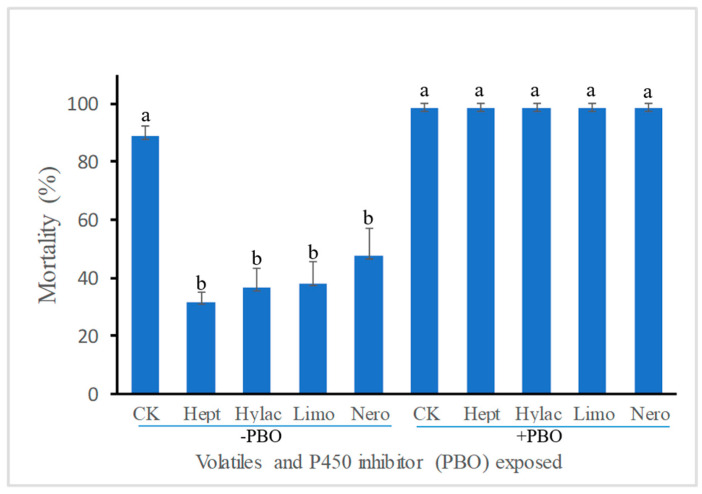
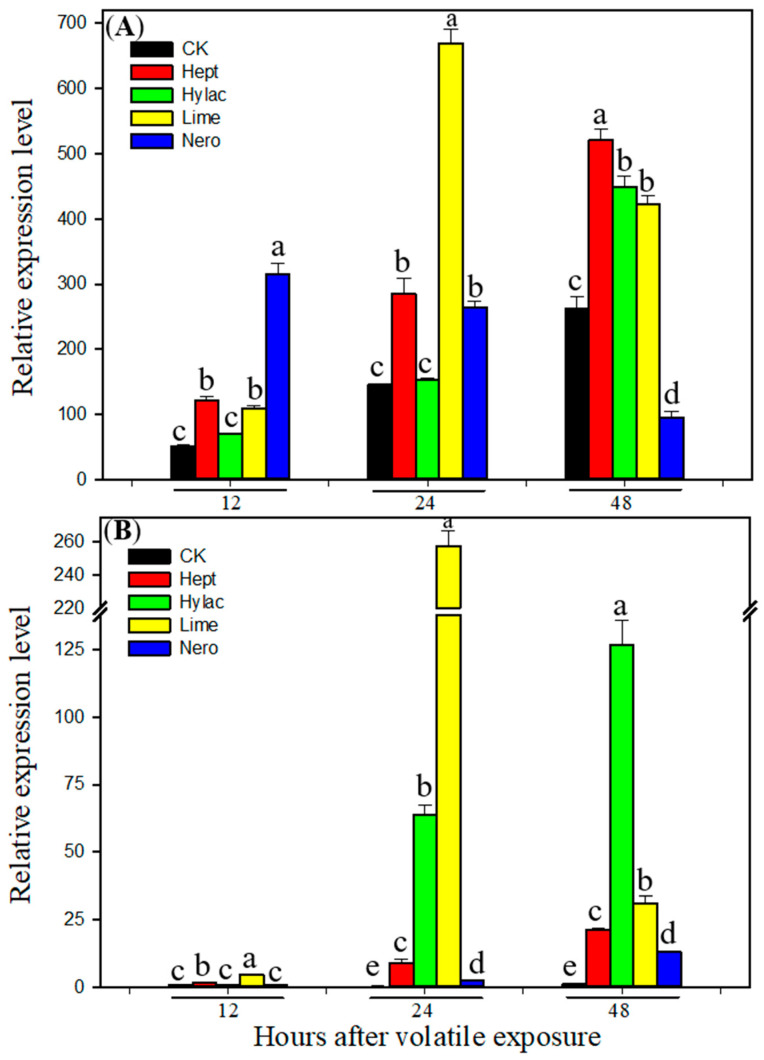
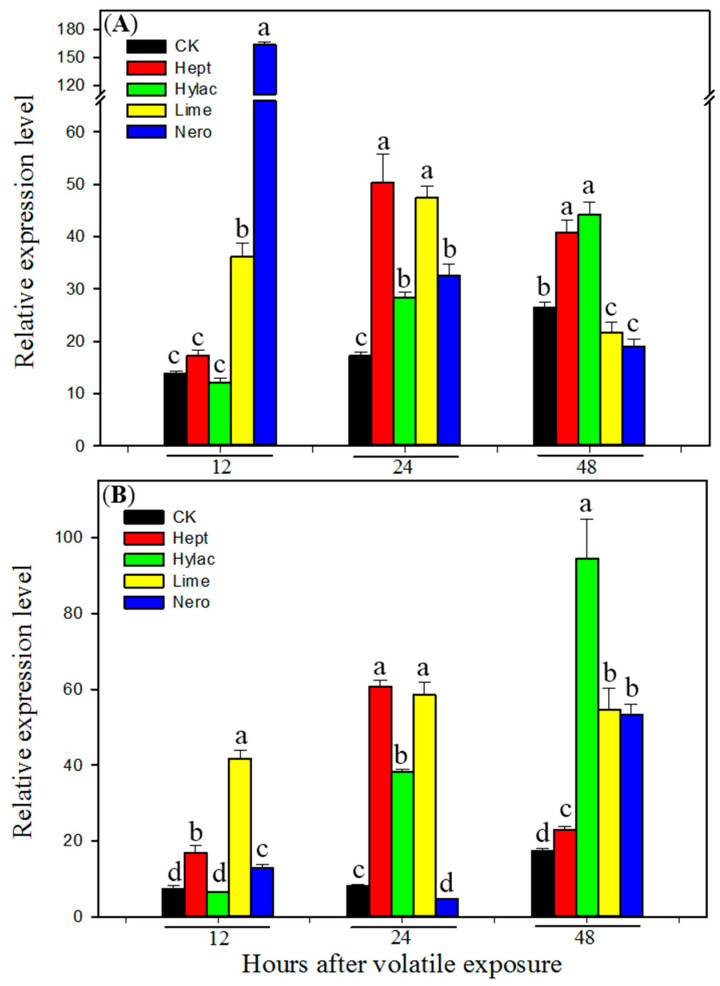
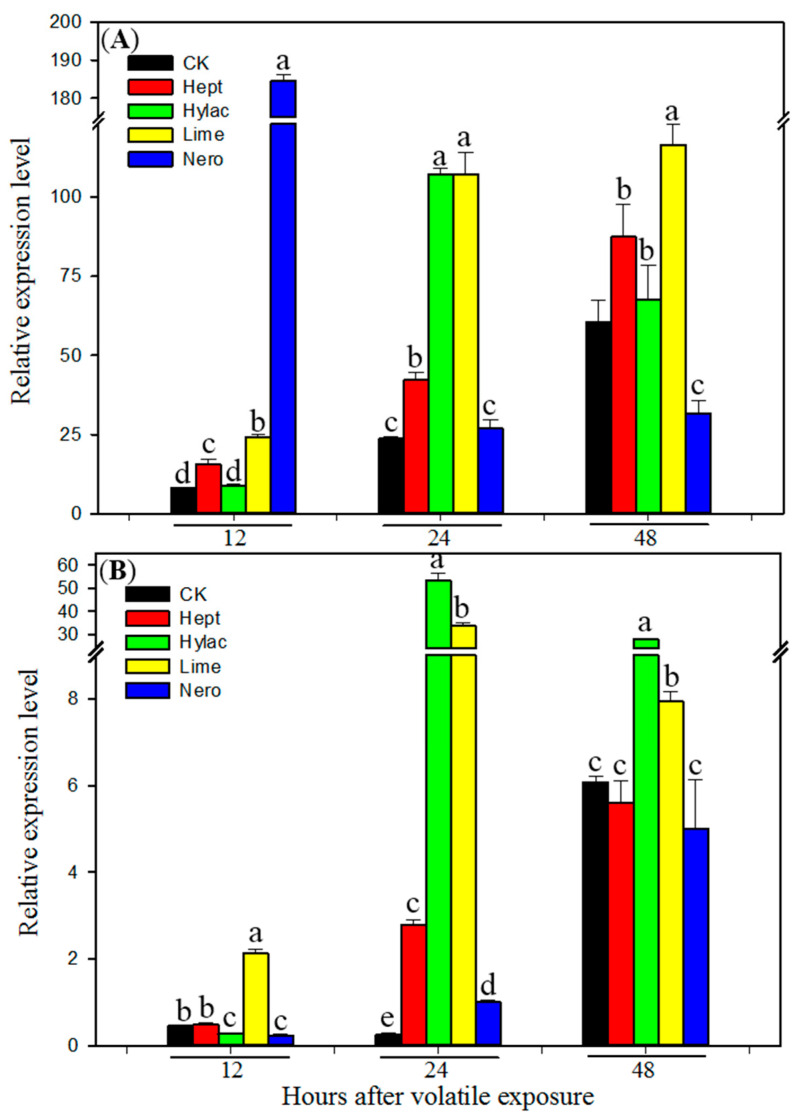
Plants release an array of volatile chemicals into the air to communicate with other organisms in the environment. Insect attack triggers emission of herbivore-induced plant volatiles (HIPVs). How insect herbivores use these odors to plan their detoxification systems is vital for insect adaptation to environmental xenobiotics. Here we show that the larvae of (Hübner), a broadly polyphagous lepidopteran herbivore, have the capacity to use plant volatiles as cues to upregulate multiple detoxification systems, including cytochrome P450 monooxygenases (P450s), for detoxification of insecticides. Olfactory exposure of the fifth instars to two terpene volatiles limonene and nerolidol, and two green-leaf volatiles 2-heptanone and -3-hexenyl acetate significantly reduced larval susceptibility to the insecticide methomyl. However, larval pretreatment with piperonyl butoxide (PBO), a known P450 inhibitor, neutralized the effects of volatile exposure. Furthermore, larval exposure to the four plant volatiles enhanced activities of P450 enzymes in midguts and fatbodies, and upregulated expression of CYP6B2, CYP6B6 and CYP6B7, P450s involved in detoxification of the insecticide. Larval exposure to 2-heptanone and limonene volatiles also enhanced activities of glutathione-s-transferase and carboxylesterase. Our findings suggest that olfactory exposure to HIPVs enhances larval insecticide tolerance via induction of detoxification P450s.
植物向空气中释放一系列挥发性化学物质,以便与环境中的其他生物进行交流。昆虫攻击会引发植物释放食草动物诱导的挥发性物质(HIPVs)。昆虫食草动物如何利用这些气味来规划其解毒系统,对于昆虫适应环境中的异生物质至关重要。在此,我们表明,一种广泛多食性鳞翅目食草动物(Hübner)的幼虫有能力利用植物挥发性物质作为线索,上调包括细胞色素P450单加氧酶(P450s)在内的多种解毒系统,以对杀虫剂进行解毒。将五龄幼虫嗅觉暴露于两种萜类挥发性物质柠檬烯和橙花叔醇,以及两种绿叶挥发性物质2-庚酮和乙酸-3-己烯酯中,显著降低了幼虫对杀虫剂灭多威的敏感性。然而,用已知的P450抑制剂胡椒基丁醚(PBO)对幼虫进行预处理,可抵消挥发性物质暴露的影响。此外,幼虫暴露于这四种植物挥发性物质中,增强了中肠和脂肪体中P450酶的活性,并上调了参与杀虫剂解毒的P450s CYP6B2、CYP6B6和CYP6B7的表达。幼虫暴露于2-庚酮和柠檬烯挥发性物质中,还增强了谷胱甘肽-S-转移酶和羧酸酯酶的活性。我们的研究结果表明,嗅觉暴露于HIPVs可通过诱导解毒P450s增强幼虫对杀虫剂的耐受性。