School of Geodesy and Geomatics, Wuhan University, Wuhan 430079, China.
Xi'an Division of Surveying and Mapping, Xi'an 710054, China.
Sensors (Basel). 2021 Mar 12;21(6):1995. doi: 10.3390/s21061995.
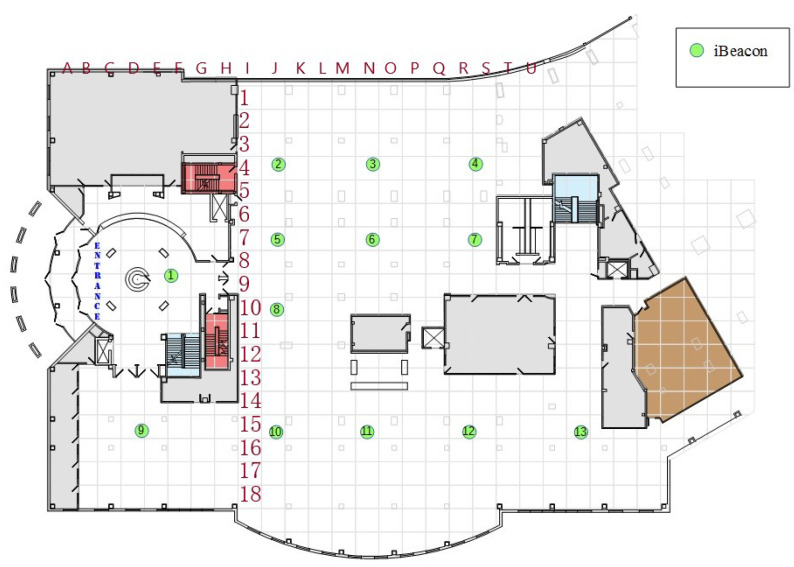
Indoor navigation has attracted commercial developers and researchers in the last few decades. The development of localization tools, methods and frameworks enables current communication services and applications to be optimized by incorporating location data. For clinical applications such as workflow analysis, Bluetooth Low Energy (BLE) beacons have been employed to map the positions of individuals in indoor environments. To map locations, certain existing methods use the received signal strength indicator (RSSI). Devices need to be configured to allow for dynamic interference patterns when using the RSSI sensors to monitor indoor positions. In this paper, our objective is to explore an alternative method for monitoring a moving user's indoor position using BLE sensors in complex indoor building environments. We developed a Convolutional Neural Network (CNN) based positioning model based on the 2D image composed of the received number of signals indicator from both x and y-axes. In this way, like a pixel, we interact with each 10 × 10 matrix holding the spatial information of coordinates and suggest the possible shift of a sensor, adding a sensor and removing a sensor. To develop CNN we adopted a neuro-evolution approach to optimize and create several layers in the network dynamically, through enhanced Particle Swarm Optimization (PSO). For the optimization of CNN, the global best solution obtained by PSO is directly given to the weights of each layer of CNN. In addition, we employed dynamic inertia weights in the PSO, instead of a constant inertia weight, to maintain the CNN layers' length corresponding to the RSSI signals from BLE sensors. Experiments were conducted in a building environment where thirteen beacon devices had been installed in different locations to record coordinates. For evaluation comparison, we further adopted machine learning and deep learning algorithms for predicting a user's location in an indoor environment. The experimental results indicate that the proposed optimized CNN-based method shows high accuracy (97.92% with 2.8% error) for tracking a moving user's locations in a complex building without complex calibration as compared to other recent methods.
室内导航在过去几十年中引起了商业开发者和研究人员的关注。定位工具、方法和框架的发展使当前的通信服务和应用能够通过纳入位置数据进行优化。对于临床应用,如工作流程分析,已经使用蓝牙低能 (BLE) 信标来绘制室内环境中个体的位置。为了绘制位置,某些现有方法使用接收信号强度指示符 (RSSI)。当使用 RSSI 传感器来监测室内位置时,设备需要配置为允许动态干扰模式。在本文中,我们的目标是探索一种在复杂室内建筑环境中使用 BLE 传感器监测移动用户室内位置的替代方法。我们开发了一种基于卷积神经网络 (CNN) 的定位模型,该模型基于由 x 和 y 轴接收信号数量指示符组成的 2D 图像。通过这种方式,就像像素一样,我们与每个 10x10 矩阵交互,该矩阵包含坐标的空间信息,并建议传感器可能的移动、添加传感器和移除传感器。为了开发 CNN,我们采用神经进化方法通过增强粒子群优化 (PSO) 来动态优化和创建网络中的多个层。对于 CNN 的优化,PSO 获得的全局最佳解直接提供给 CNN 每个层的权重。此外,我们在 PSO 中使用了动态惯性权重,而不是常数惯性权重,以保持与 BLE 传感器的 RSSI 信号相对应的 CNN 层的长度。实验在一个建筑物环境中进行,其中在不同位置安装了十三个信标设备以记录坐标。为了进行评估比较,我们进一步采用机器学习和深度学习算法来预测室内环境中用户的位置。实验结果表明,与其他最近的方法相比,所提出的基于优化 CNN 的方法在无需复杂校准的情况下,在复杂建筑物中跟踪移动用户位置时具有较高的准确性(97.92%,误差为 2.8%)。