Nagah Amr Mohammed, El Attar Hussein M, Abd El Azeem Mohamed H, El Badawy Hesham
Department of Electronics and Communications Engineering, Canadian International College (CIC), Cairo 12588, Egypt.
Department of Electronics and Communications Engineering, Arab Academy for Science, Technology and Maritime Transport (AASTMT), Cairo 11799, Egypt.
Sensors (Basel). 2021 Jan 21;21(3):719. doi: 10.3390/s21030719.
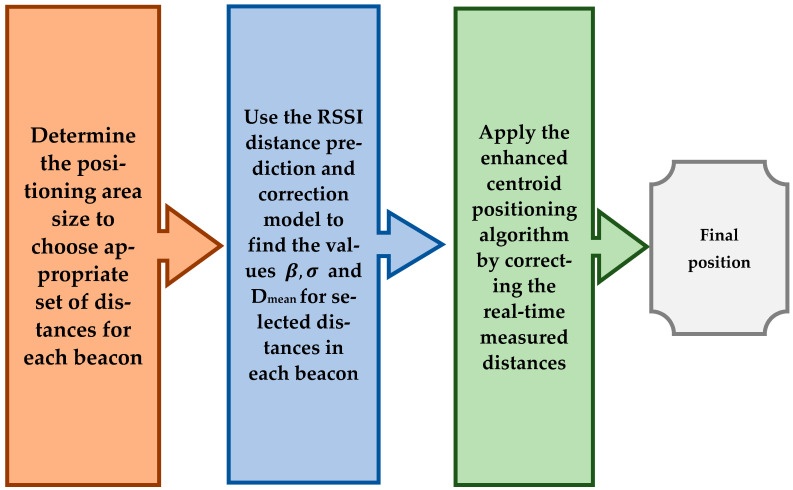
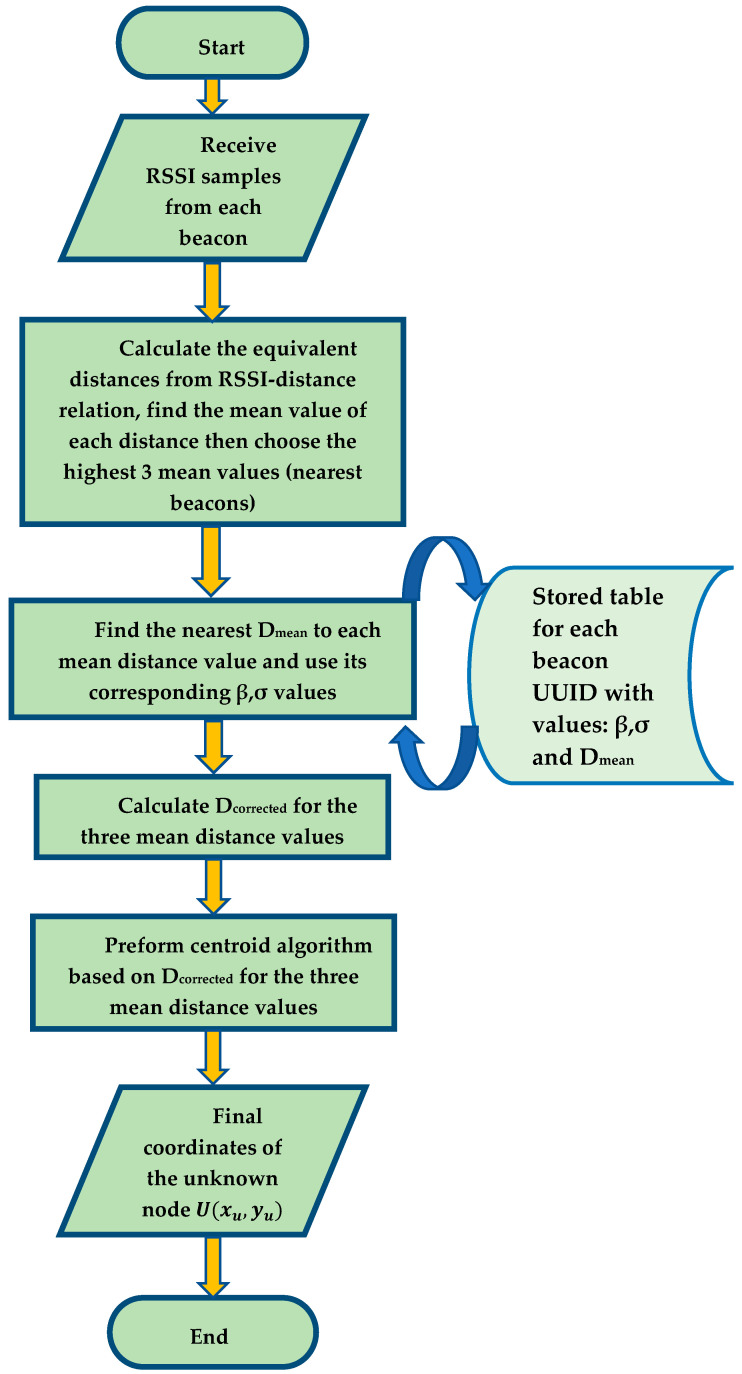
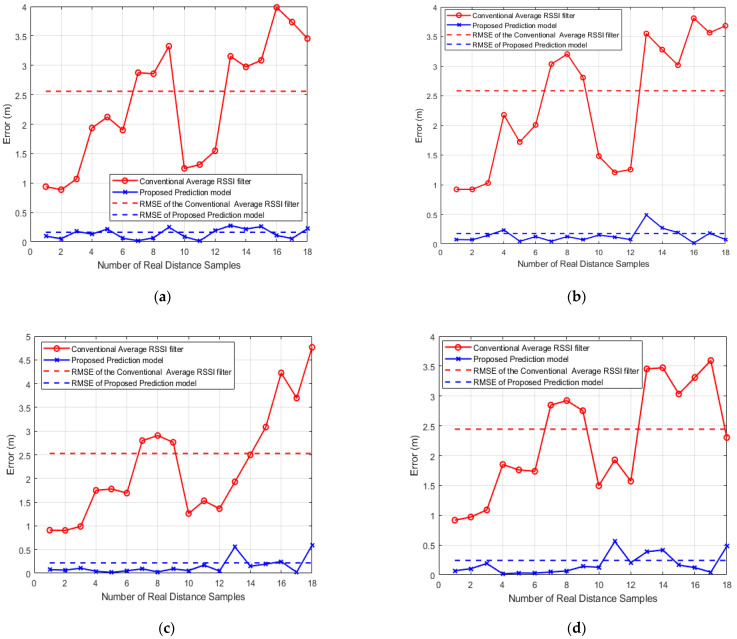
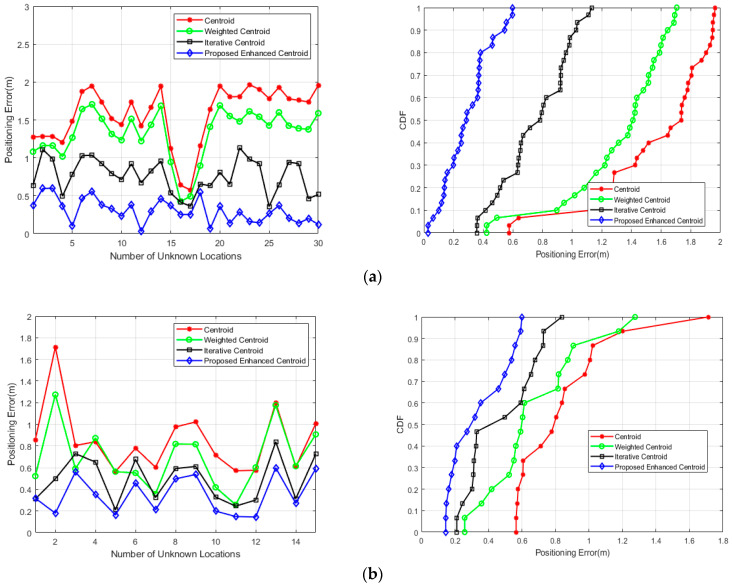
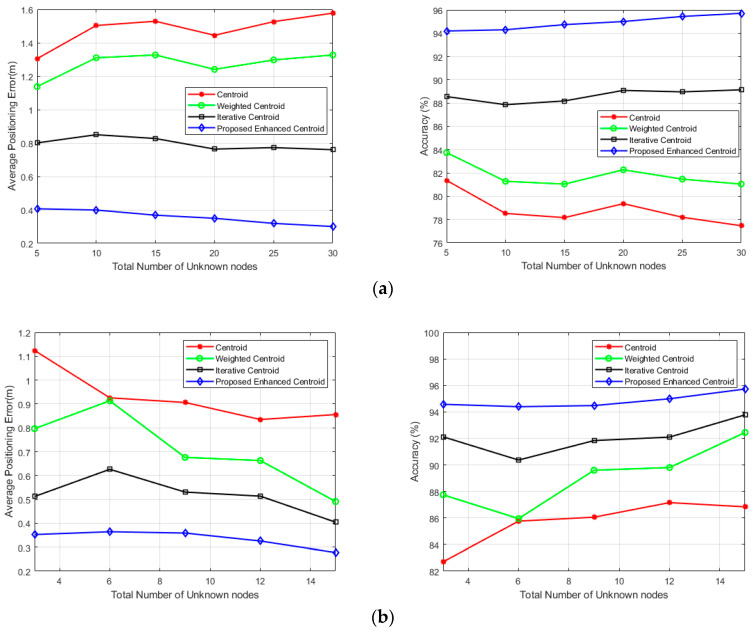
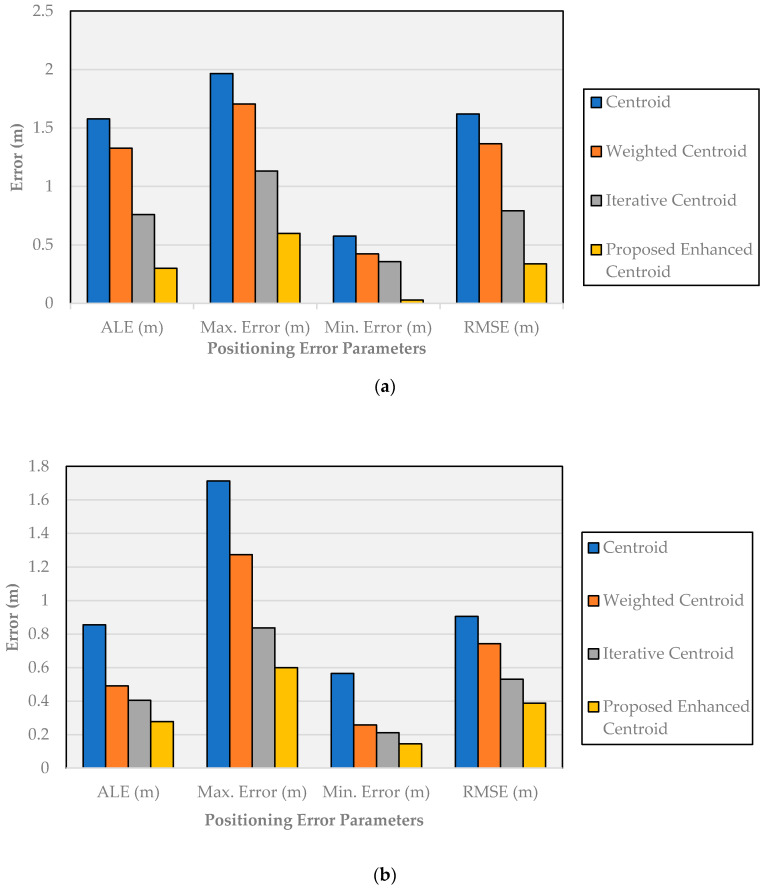
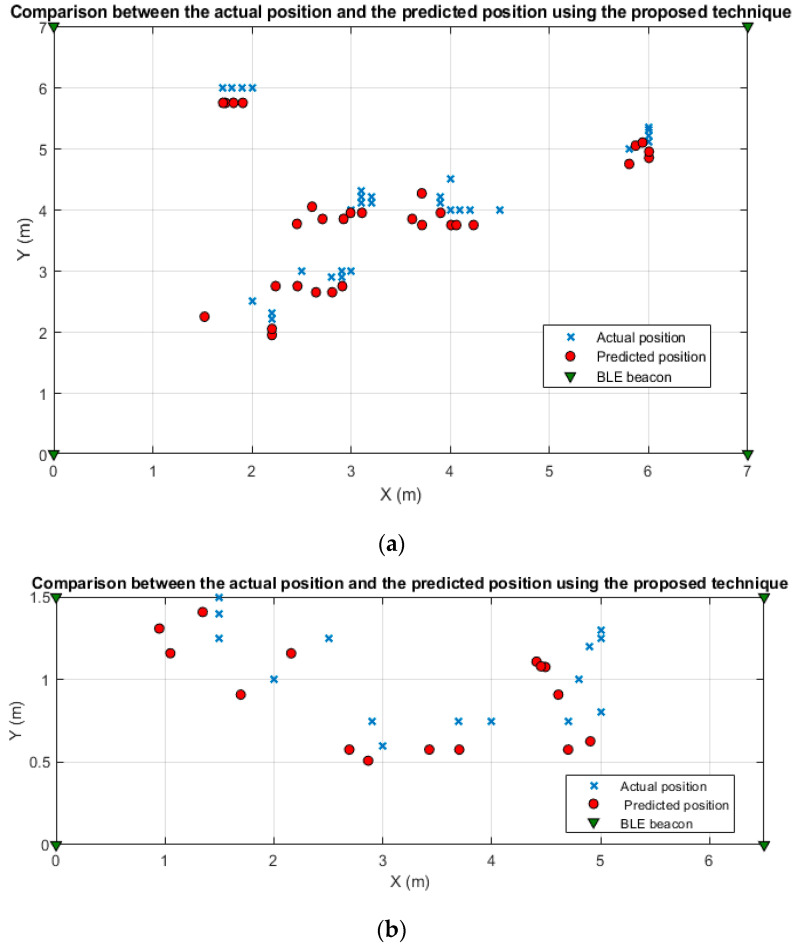
Indoor positioning has become a very promising research topic due to the growing demand for accurate node location information for indoor environments. Nonetheless, current positioning algorithms typically present the issue of inaccurate positioning due to communication noise and interferences. In addition, most of the indoor positioning techniques require additional hardware equipment and complex algorithms to achieve high positioning accuracy. This leads to higher energy consumption and communication cost. Therefore, this paper proposes an enhanced indoor positioning technique based on a novel received signal strength indication (RSSI) distance prediction and correction model to improve the positioning accuracy of target nodes in indoor environments, with contributions including a new distance correction formula based on RSSI log-distance model, a correction factor (Beta) with a correction exponent (Sigma) for each distance between unknown node and beacon (anchor nodes) which are driven from the correction formula, and by utilizing the previous factors in the unknown node, enhanced centroid positioning algorithm is applied to calculate the final node positioning coordinates. Moreover, in this study, we used Bluetooth Low Energy (BLE) beacons to meet the principle of low energy consumption. The experimental results of the proposed enhanced centroid positioning algorithm have a significantly lower average localization error (ALE) than the currently existing algorithms. Also, the proposed technique achieves higher positioning stability than conventional methods. The proposed technique was experimentally tested for different received RSSI samples' number to verify its feasibility in real-time. The proposed technique's positioning accuracy is promoted by 80.97% and 67.51% at the office room and the corridor, respectively, compared with the conventional RSSI trilateration positioning technique. The proposed technique also improves localization stability by 1.64 and 2.3-fold at the office room and the corridor, respectively, compared to the traditional RSSI localization method. Finally, the proposed correction model is totally possible in real-time when the RSSI sample number is 50 or more.
由于室内环境对精确节点位置信息的需求不断增长,室内定位已成为一个非常有前景的研究课题。尽管如此,当前的定位算法通常存在因通信噪声和干扰导致定位不准确的问题。此外,大多数室内定位技术需要额外的硬件设备和复杂的算法来实现高精度定位。这导致了更高的能耗和通信成本。因此,本文提出了一种基于新颖的接收信号强度指示(RSSI)距离预测和校正模型的增强型室内定位技术,以提高室内环境中目标节点的定位精度,其贡献包括基于RSSI对数距离模型的新距离校正公式、从未知节点到信标(锚节点)的每个距离的具有校正指数(Sigma)的校正因子(Beta),该校正因子由校正公式推导得出,并且通过利用未知节点中的先前因子,应用增强型质心定位算法来计算最终节点的定位坐标。此外,在本研究中,我们使用低功耗蓝牙(BLE)信标以满足低能耗原则。所提出的增强型质心定位算法的实验结果表明,其平均定位误差(ALE)明显低于现有算法。而且,所提出的技术比传统方法具有更高的定位稳定性。所提出的技术针对不同数量的接收RSSI样本进行了实验测试,以验证其在实时情况下的可行性。与传统的RSSI三边定位技术相比,所提出的技术在办公室和走廊的定位精度分别提高了80.97%和67.51%。与传统的RSSI定位方法相比,所提出的技术在办公室和走廊的定位稳定性也分别提高了1.64倍和2.3倍。最后,当RSSI样本数量为50或更多时,所提出的校正模型完全可以实时实现。