Servicio de Farmacología Clínica, Hospital General Universitario de Alicante, Departamento de Farmacología, Pediatría y Química Orgánica, Universidad Miguel Hernández, C/Pintor Baeza 12, 03010 Alicante, Spain.
Instituto de Investigación Sanitaria y Biomédica de Alicante (ISABIAL), C/Pintor Baeza 12, 03010 Alicante, Spain.
Int J Environ Res Public Health. 2021 Mar 22;18(6):3277. doi: 10.3390/ijerph18063277.
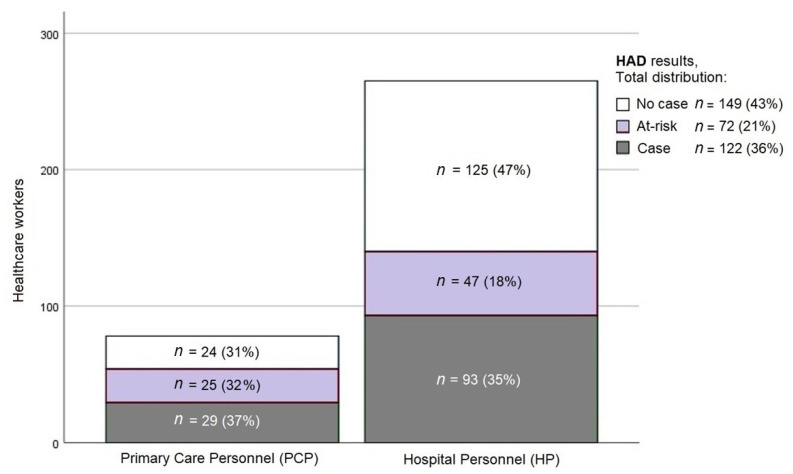
The COVID-19 pandemic has had an emotional impact on healthcare professionals at different levels of care, and it is important to understand the levels of anxiety of hospital personnel (HP) compared to those of primary care personnel (PCP). The objectives herein were to assess the differences in anxiety levels between these populations and to detect factors that may influence them. The anxiety levels (measured using the Hospital Anxiety and Depression (HAD) scale) of the HP and PCP groups were compared using data collected from a cross-sectional study. The secondary variables included demographic and health data, confinement factors, contact with COVID-19 patients, having suffered from COVID-19, perceptions of protection, caregiver overload, threat, and satisfaction with management. We found anxiety "case" (35.6%) and "at-risk" (21%), with statistically significant differences in the group "at risk", and higher scores in the PCP group. The factors associated with the perception of threat and protection were significant determinants of an increase in anxiety, with all of them showing statistically significant differences. There were greater symptoms of anxiety in the PCP group than the HP group (32% vs. 18%). The factors associated with the prevalence of anxiety symptoms were the perceptions of threat, protection, management, caregiver overload, and perceived degree of threat associated with COVID-19.
新冠疫情对各级医护人员都产生了情绪影响,了解医院人员(HP)与初级保健人员(PCP)的焦虑水平差异很重要。本文旨在评估这两个群体的焦虑水平差异,并发现可能影响焦虑水平的因素。采用医院焦虑和抑郁量表(HAD 量表)评估了来自横断面研究的数据中 HP 和 PCP 两组的焦虑水平。次要变量包括人口统计学和健康数据、隔离因素、与 COVID-19 患者的接触、感染过 COVID-19、对保护的看法、照顾者负担、威胁和对管理的满意度。我们发现有 35.6%的“病例”和 21%的“高危”焦虑,在“高危”组中存在统计学显著差异,且 PCP 组的评分更高。与威胁和保护的感知相关的因素是焦虑增加的重要决定因素,所有这些因素都具有统计学显著差异。PCP 组的焦虑症状比 HP 组更明显(32%对 18%)。与焦虑症状发生率相关的因素是对威胁、保护、管理、照顾者负担和与 COVID-19 相关的感知威胁程度的感知。