Department of Anesthesiology, Intensive Care, Emergency and Pain Medicine, University Hospital of Wuerzburg, 97080 Wuerzburg, Germany.
Department of Anesthesiology and Intensive Care, Karlsruhe Municipal Hospital, 76133 Karlsruhe, Germany.
Int J Mol Sci. 2021 Mar 22;22(6):3224. doi: 10.3390/ijms22063224.
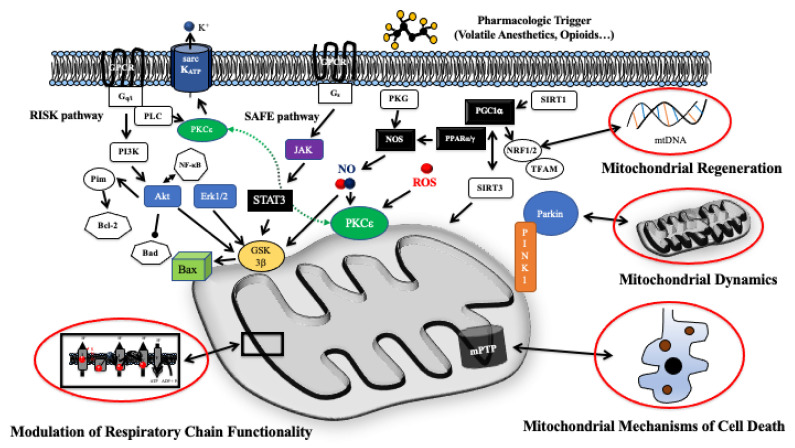
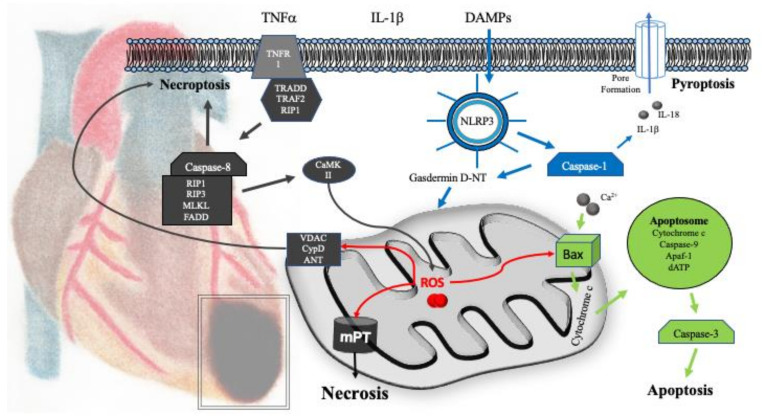
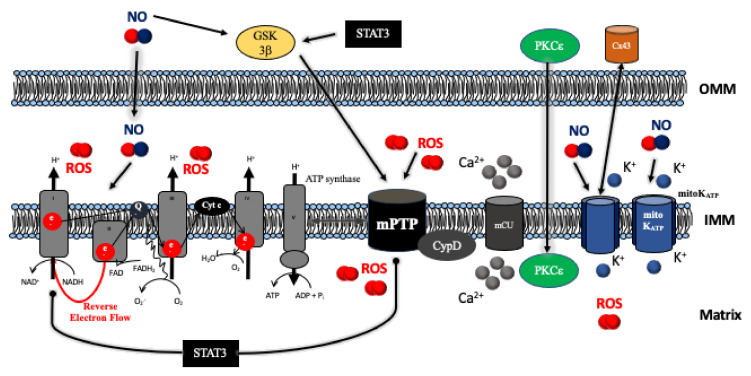
Pharmacologic cardiac conditioning increases the intrinsic resistance against ischemia and reperfusion (I/R) injury. The cardiac conditioning response is mediated via complex signaling networks. These networks have been an intriguing research field for decades, largely advancing our knowledge on cardiac signaling beyond the conditioning response. The centerpieces of this system are the mitochondria, a dynamic organelle, almost acting as a cell within the cell. Mitochondria comprise a plethora of functions at the crossroads of cell death or survival. These include the maintenance of aerobic ATP production and redox signaling, closely entwined with mitochondrial calcium handling and mitochondrial permeability transition. Moreover, mitochondria host pathways of programmed cell death impact the inflammatory response and contain their own mechanisms of fusion and fission (division). These act as quality control mechanisms in cellular ageing, release of pro-apoptotic factors and mitophagy. Furthermore, recently identified mechanisms of mitochondrial regeneration can increase the capacity for oxidative phosphorylation, decrease oxidative stress and might help to beneficially impact myocardial remodeling, as well as invigorate the heart against subsequent ischemic insults. The current review highlights different pathways and unresolved questions surrounding mitochondria in myocardial I/R injury and pharmacological cardiac conditioning.
药物心脏预处理可提高心肌缺血再灌注(I/R)损伤的固有抗性。心脏预处理反应是通过复杂的信号网络介导的。几十年来,这些网络一直是一个令人着迷的研究领域,极大地推动了我们对心脏信号的认识,超出了预处理反应的范围。该系统的核心是线粒体,一种动态细胞器,几乎可以作为细胞内的细胞。线粒体在细胞死亡或存活的十字路口具有多种功能。这些功能包括维持需氧 ATP 的产生和氧化还原信号,与线粒体钙处理和线粒体通透性转换密切相关。此外,线粒体还拥有程序性细胞死亡的途径,影响炎症反应,并包含其自身的融合和裂变(分裂)机制。这些机制在细胞衰老、促凋亡因子的释放和线粒体自噬中作为质量控制机制发挥作用。此外,最近发现的线粒体再生机制可以增加氧化磷酸化的能力,减少氧化应激,并可能有助于有益地影响心肌重构,以及激活心脏以抵抗随后的缺血性损伤。本综述强调了心肌 I/R 损伤和药物心脏预处理中围绕线粒体的不同途径和未解决的问题。