Li J, Bergin E A, Blake G A, Ciesla F J, Hirschmann M M
Department of Earth and Environmental Sciences, University of Michigan, Ann Arbor, MI 48109, USA.
Department of Astronomy, University of Michigan, Ann Arbor, MI 48109, USA.
Sci Adv. 2021 Apr 2;7(14). doi: 10.1126/sciadv.abd3632. Print 2021 Apr.
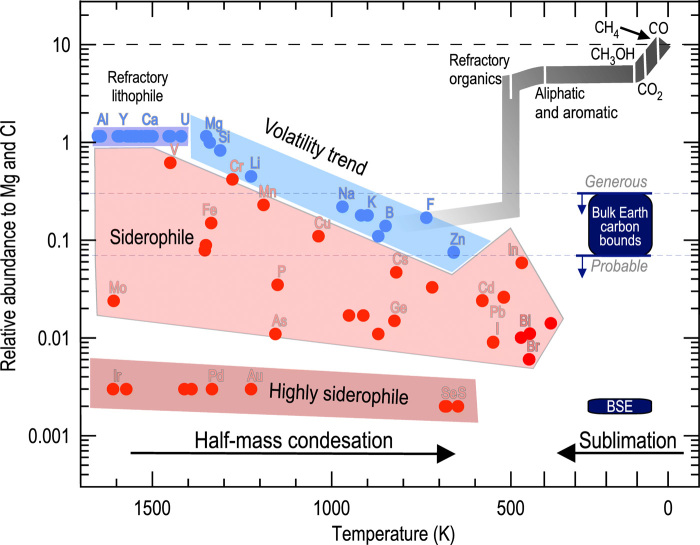
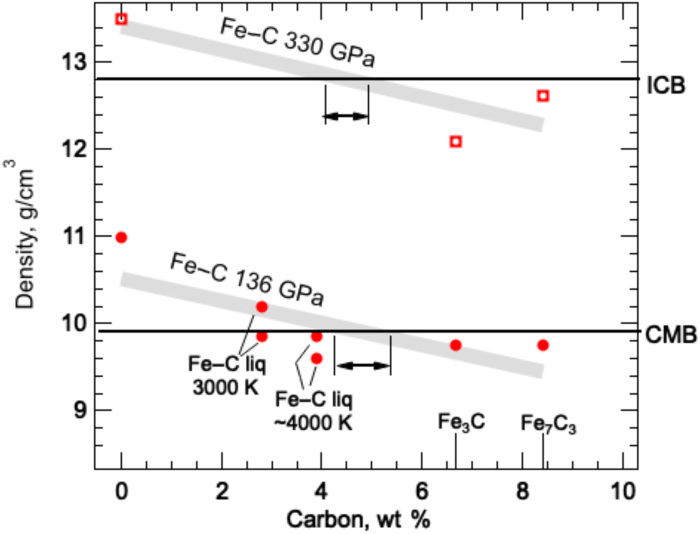
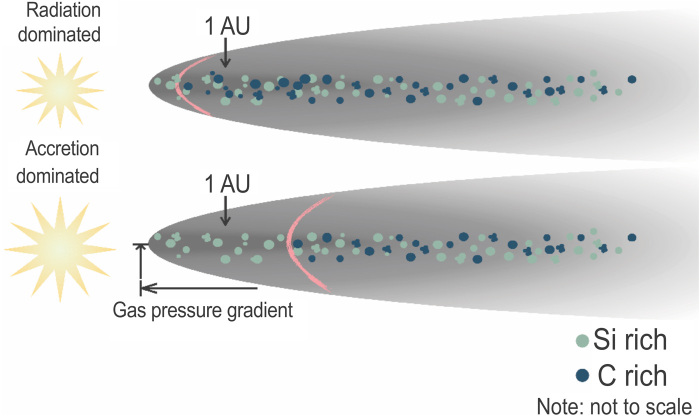
Carbon is an essential element for life, but its behavior during Earth's accretion is not well understood. Carbonaceous grains in meteoritic and cometary materials suggest that irreversible sublimation, and not condensation, governs carbon acquisition by terrestrial worlds. Through astronomical observations and modeling, we show that the sublimation front of carbon carriers in the solar nebula, or the soot line, moved inward quickly so that carbon-rich ingredients would be available for accretion at 1 astronomical unit after the first million years. On the other hand, geological constraints firmly establish a severe carbon deficit in Earth, requiring the destruction of inherited carbonaceous organics in the majority of its building blocks. The carbon-poor nature of Earth thus implies carbon loss in its precursor material through sublimation within the first million years.
碳是生命的基本元素,但其在地球吸积过程中的行为尚未得到很好的理解。陨石和彗星物质中的碳质颗粒表明,不可逆的升华而非凝聚控制着类地行星对碳的获取。通过天文观测和建模,我们表明太阳星云中碳载体的升华前沿,即碳烟线,迅速向内移动,这样在最初的一百万年之后,富含碳的成分就可以在1天文单位处用于吸积。另一方面,地质约束明确表明地球存在严重的碳亏缺,这要求其大部分构成物质中继承的碳质有机物遭到破坏。因此,地球贫碳的性质意味着其前体物质在最初的一百万年里通过升华而损失了碳。