Cam Hasan Huseyin, Ustuner Top Fadime, Kuzlu Ayyildiz Tülay
Department of Public Health Nursing, Yusuf Serefoglu Faculty of Health Sciences, Kilis 7 Aralık University, Kilis, Turkey.
Department of Pediatric Nursing, Faculty of Health Sciences, Giresun University, Giresun, Turkey.
Curr Psychol. 2022;41(2):1033-1042. doi: 10.1007/s12144-021-01674-y. Epub 2021 Mar 31.
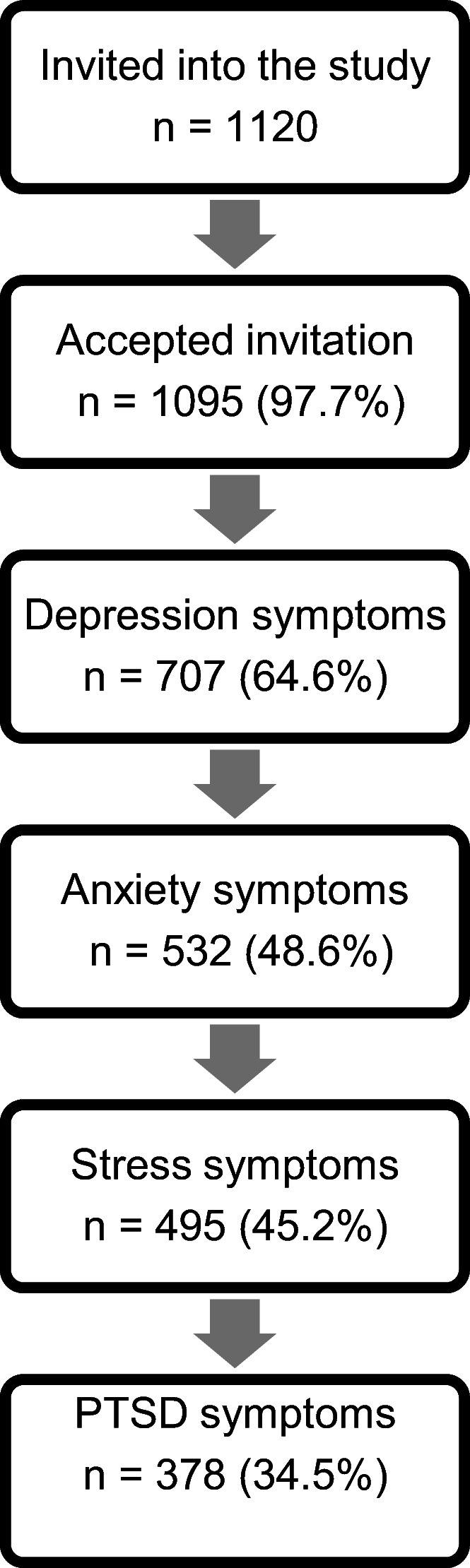
The COVID-19 health crisis has reached pandemic scale spreading globally. The present study examines the COVID-19 pandemic's impact on psychological and physical health-related quality of life (HRQOL) among university students in Turkey. A cross-sectional survey design was used for data collection. From May 11th to May 15th 2020, the study utilized snowball sampling techniques to gather data through an online survey. The pandemic's psychological effects on participants were measured by the Impact of Event Scale-Revised. Depression, Anxiety and Stress Scale-21 and the 12-Item Short Form Health Survey assess related HRQOL were used to make mental health assessments. 1120 university students were contacted to complete the survey. Of these, a total of 1095 completed the survey, translating to a participation rate of 97.7%. Overall, 64.6%, 48.6% and 45.2%, and 34.5% of all participants self-reported symptomatic signs of depression, anxiety, stress and post-traumatic stress disorder (PTSD), respectively. Female gender and poor family relationships were identified as risk factors for probably PTSD, and symptoms of depression, anxiety, and stress as well. The mean scores of Physical Component Summary (PCS-12) and Mental Component Summary (MCS-12) were 66.99 ± 2.14 and 40.76 ± 2.31, respectively. Students suspected of a history with PTSD had considerably lower total scores for PCS-12 and MCS-12, when cross checked for similarity to those without such a history. The findings of this research suggest that evidence of PTSD, depression, anxiety, and stress is commonly apparent among university students during the period of the COVID-19 crisis. Prevention and intervention approaches to attenuate the psychosocial impact should be an integral component of crisis response during pandemic conditions.
新冠疫情引发的健康危机已达到全球大流行规模。本研究调查了新冠疫情对土耳其大学生心理和身体健康相关生活质量(HRQOL)的影响。采用横断面调查设计收集数据。2020年5月11日至5月15日,该研究利用滚雪球抽样技术通过在线调查收集数据。采用事件影响量表修订版来衡量疫情对参与者的心理影响。使用抑郁、焦虑和压力量表-21以及12项简短健康调查问卷评估相关的HRQOL,以进行心理健康评估。研究联系了1120名大学生来完成调查。其中,共有1095人完成了调查,参与率为97.7%。总体而言,分别有64.6%、48.6%、45.2%和34.5%的参与者自我报告有抑郁、焦虑、压力和创伤后应激障碍(PTSD)的症状迹象。女性性别和不良家庭关系被确定为可能患PTSD以及抑郁、焦虑和压力症状的风险因素。身体成分总结(PCS-12)和心理成分总结(MCS-12)的平均得分分别为66.99±2.14和40.76±2.31。与无PTSD病史的学生相比,疑似有PTSD病史的学生的PCS-12和MCS-12总分显著更低。本研究结果表明,在新冠疫情期间,大学生中PTSD、抑郁、焦虑和压力的迹象普遍明显。减轻心理社会影响的预防和干预方法应成为疫情期间危机应对的一个组成部分。